Facts
Respondent No. 1 (SSL), a generating company, sold surplus power through inter-State open access after its PPA with the appellants ended in 2009
Source reference: para. 6-7To facilitate this, SSL required a Standing Clearance/No-Objection Certificate (SC/NOC) from the State Load Despatch Centre (SLDC)
Source reference: para. 7From April 2010, the SLDC inserted "Clause (m)" into the SC/NOC, stipulating that excess generation would be paid at low rates fixed by the State Commission (KERC) for old plants rather than the Unscheduled Interchange (UI) rates prescribed by the Central Commission (CERC)
Source reference: para. 10SSL challenged this before the CERC, which set aside the clause as arbitrary and in violation of the CERC Open Access Regulations
Source reference: para. 4, 20-22The appellants challenged the CERC's order via a Writ Petition, which was dismissed by a Single Judge
Source reference: para. 27-35The appellants then filed this intra-court appeal
Source reference: para. 39Issues
1. Whether Regulation 8 of the CERC (Open Access in Inter-State Transmission) Regulations, 2008, is ultra vires the Electricity Act, 2003
Source reference: para. 40, 782. Whether the CERC had the jurisdiction to adjudicate this dispute under Section 79(1)(f) of the Act
Source reference: para. 40, 903. Whether the SLDC has the statutory authority to override CERC Regulations by imposing conditions related to tariffs and UI charges
Source reference: para. 40, 86Law Applied
Section 32 (functions of SLDC), Section 33 (compliance with directions), Section 79 (functions of CERC), and Section 178 (CERC's power to make regulations) of the Electricity Act, 2003.
Source reference: para. 45, 46, 52, 53The Supreme Court's decision in PTC India Ltd. v. CERC, which established that CERC's regulations are delegated legislation and functions under Section 79 must conform to them.
Source reference: para. 42, 53-55Central Power Distribution Co. v. CERC, affirming that the CERC has plenary power to regulate the Grid and specify the Grid Code, making State Commissions/SLDCs subservient to CERC in inter-State transmission matters.
Source reference: para. 60, 68-69, 76Reasoning
The Court reasoned that while Sections 32 and 33 grant the SLDC power to ensure integrated grid operations within a State, these powers are restricted to intra-State matters and must align with the Regional Load Despatch Centre (RLDC) and CERC guidelines.
Source reference: para. 77, 83The dispute involved inter-State transmission, where the CERC holds exclusive jurisdiction to regulate and determine tariffs/charges.
Source reference: para. 75, 90The Court found that Regulation 8 of the Open Access Regulations was a valid exercise of CERC’s power under Section 178 to carry out the provisions of the Act regarding inter-State movement.
Source reference: para. 79-80The Court found that the SLDC’s "Clause (m)" was illegal because it sought to substitute UI rates—a commercial mechanism for grid discipline established by CERC—with rates for "old plants," an action for which the SLDC has no statutory authority under the Act.
Source reference: para. 86, 89As delegated legislation, CERC Regulations prevail over the SLDC's administrative or statutory directions.
Source reference: para. 88Holding
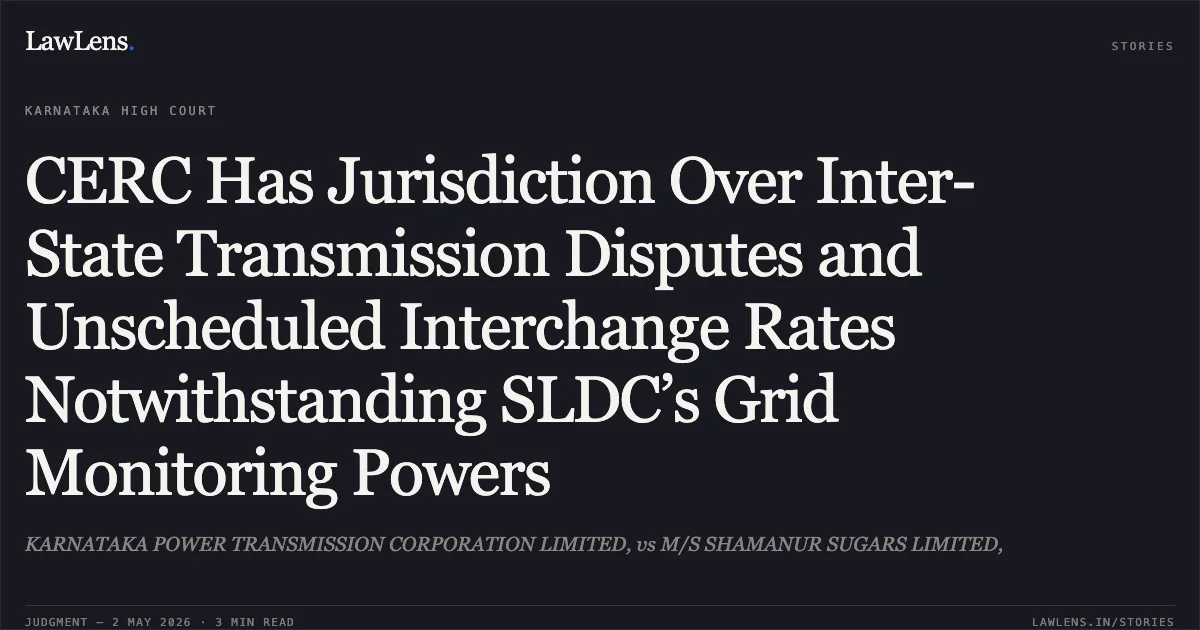
The Court answered all issues in the negative and dismissed the appeal, holding that: (i) Regulation 8 of the Open Access Regulations is intra vires the Act; (ii) the CERC had the requisite jurisdiction under Section 79(1)(f) to adjudicate the dispute as it related to inter-State transmission; and (iii) the impugned Clause (m) was invalid as the SLDC cannot fix tariffs or override CERC’s UI accounting scheme.
The Court upheld the Single Judge's order and the CERC's direction to settle SSL's dues as per Regulation 20(5) of the Open Access Regulations.
Source reference: para. 22, 89Acts & Sections Cited
43 provisions across 2 statutes referred to in this judgment. Each provision opens on LawLens.
Electricity Act, 2003
KARNATAKA HIGH COURT ACT, 19611
Original Court PDF
KARNATAKA POWER TRANSMISSION CORPORATION LIMITED,vsM/S SHAMANUR SUGARS LIMITED,
Click to open original judgment
Original judgment, available to read, download and summarize on LawLens.in