Facts
The petitioner challenged the certificate proceedings in Certificate Case No. 15/2014–15 initiated at the instance of Syndicate Bank for recovery of ₹6,29,423, together with court fees and other charges, under the Bihar and Orissa Public Demand Recovery Act, 1914 (“PDR Act”).
Source reference: p. 3After service of notice, the petitioner appeared and filed objections under Section 9 of the PDR Act.
Source reference: p. 3Although he appeared on several dates, the parties subsequently failed to pursue the matter on certain dates.
Source reference: pp. 3–5On 19 July 2017, the Certificate Officer rejected the petitioner’s objection on the ground of non-appearance and proceeded with execution.
Source reference: pp. 3–5A warrant was thereafter issued, and the petitioner was eventually sent to civil prison by order dated 25 January 2019.
Source reference: pp. 3–5In an earlier order dated 26 June 2019, the High Court prima facie found that the mandatory requirements of Sections 10 and 14 had not been followed and directed the petitioner’s release from civil prison subject to the final outcome of the writ petition.
Source reference: pp. 2–6In the final judgment, the petitioner sought quashing of the certificate proceedings and consequential relief.
Source reference: p. 1Issues
1. Whether the Certificate Officer could proceed with execution and arrest of the petitioner without hearing and determining the petitioner’s objections filed under Section 9 of the PDR Act.
Source reference: pp. 3–72. Whether the mandatory requirements of Sections 10 and 14 of the PDR Act were complied with before taking coercive steps against the petitioner.
Source reference: pp. 4–73. Whether the matter should be remitted to the Certificate Officer for consideration of the petitioner’s objections on merits.
Source reference: p. 7Law Applied
The Court applied Sections 9, 10, 14 and 15 of the Bihar and Orissa Public Demand Recovery Act, 1914.
Source reference: no citationSection 9 permits the certificate debtor to file objections to the certificate.
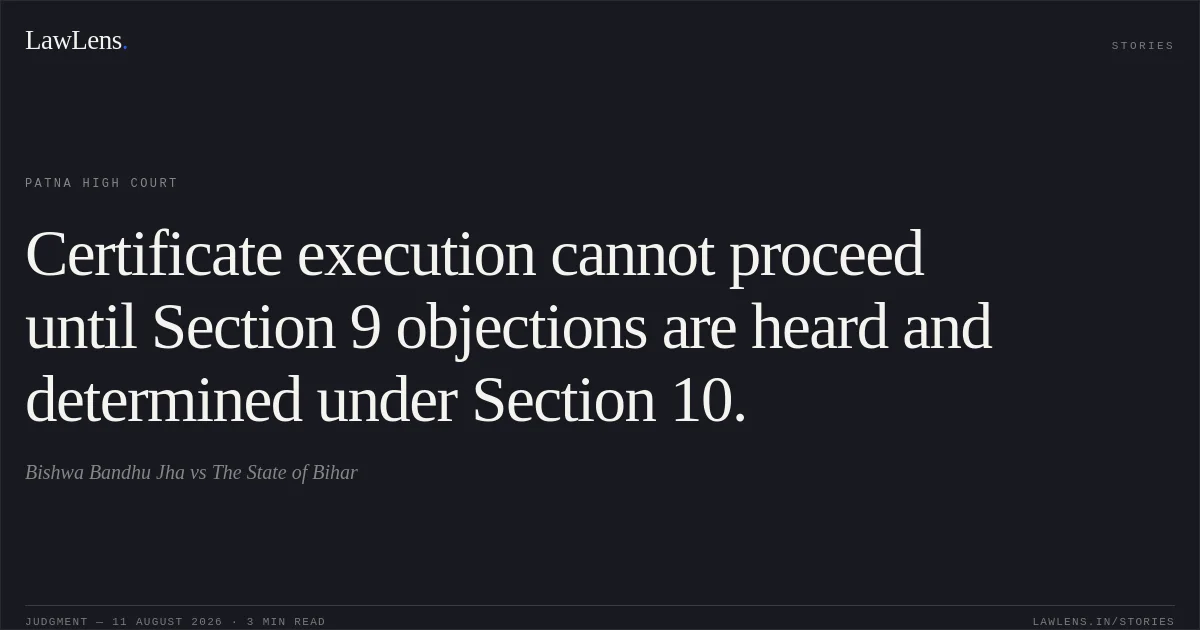
Source reference: no citationUnder Section 10, once such objections are filed, the Certificate Officer is required to hear the petition, take necessary evidence, and determine whether the certificate debtor is liable for the whole or any part of the certified amount.
Source reference: pp. 3–4Section 14 imposes a mandatory restriction that no step in execution may be taken until the statutory period has expired and, where an objection petition has been duly filed under Section 9, until that petition has been heard and determined.
Source reference: p. 4Section 15 prescribes the modes available for execution only after the statutory preconditions for execution have been satisfied.
Source reference: p. 4The Court also relied on the principle that statutory safeguards affecting a person’s liberty must be strictly observed before coercive recovery measures, including detention in civil prison, are adopted.
Source reference: pp. 4–6Reasoning
The petitioner had admittedly filed objections under Section 9, thereby attracting the Certificate Officer’s duty under Section 10 to hear and determine those objections.
Source reference: pp. 3–4The rejection of the objection merely because of the petitioner’s absence on a particular date, without adjudicating the objection on merits or determining the petitioner’s liability, did not satisfy Section 10.
Source reference: pp. 3–4, 7Since Section 14 expressly prohibits execution until a duly filed objection has been heard and determined, the subsequent issuance of the warrant and detention of the petitioner in civil prison were procedurally premature.
Source reference: pp. 4–6The Court therefore found that the Certificate Officer had proceeded with coercive execution without complying with the mandatory statutory safeguards.
Source reference: no citationHowever, rather than deciding the merits of the petitioner’s liability or quashing the entire certificate proceeding, the Court directed the Certificate Officer to reconsider and decide the objections in accordance with Section 10.
Source reference: p. 7Holding
The Court held that the Certificate Officer had failed to comply with the mandatory requirements of Sections 10 and 14 of the PDR Act before proceeding against the petitioner.
Without expressing any opinion on the merits of the underlying recovery claim, the Court directed the Certificate Officer to hear the petitioner, consider his objections on merits, and pass an appropriate order under Section 10 of the Act.
Source reference: p. 7No coercive steps were to be taken against the petitioner until such an order was passed.
Source reference: no citationThe writ petition was accordingly disposed of.
Source reference: p. 7Acts & Sections Cited
6 provisions across 1 statute referred to in this judgment. Linked provisions open on LawLens.
Bihar and Orissa Public Demands Recovery Act, 19146
Original Court PDF
Bishwa Bandhu JhavsThe State of Bihar
Click to open original judgment
Original judgment, available to read, download and summarize on LawLens.in