Facts
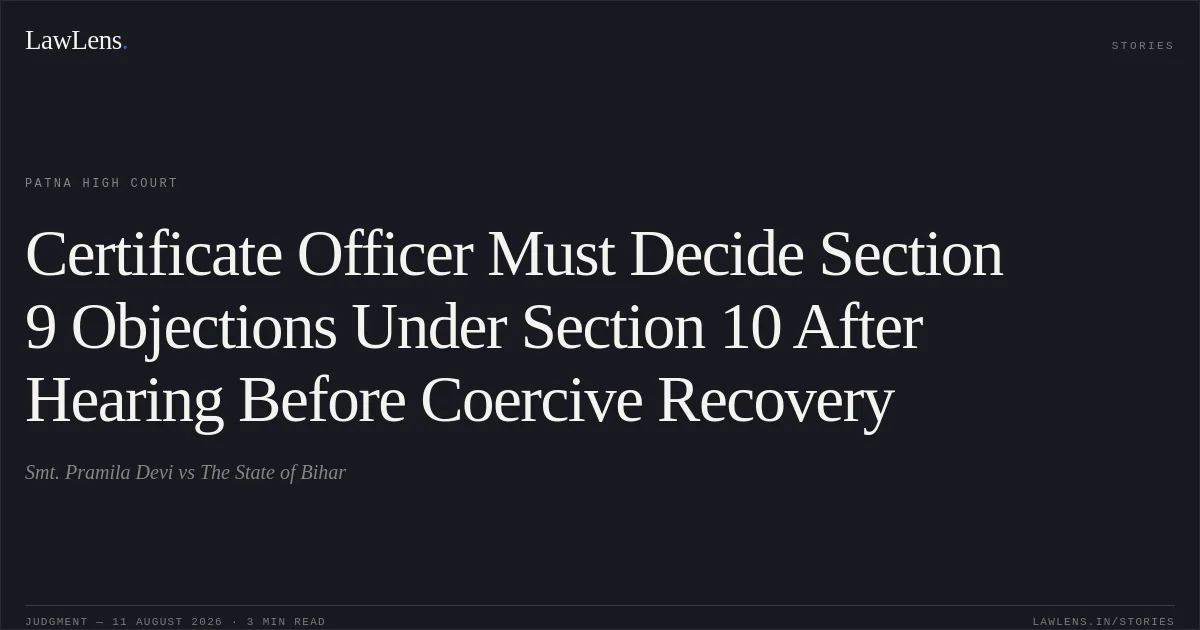
The petitioner, the Mukhiya of Gram Panchayat Raj Borha @ Rasulpur Gaus, challenged Certificate Case Nos. 303–305 of 2014–15 initiated under the Public Demands Recovery Act, along with consequential coercive measures, including an attachment notice and warrant of arrest.
Source reference: pp. 1–3The alleged liability arose from the purchase of solar lamps under the Twelfth Finance Scheme during the years 2006–07, 2008–09 and 2009–10, for which the petitioner and the then Panchayat Secretary were held jointly liable for alleged excess payment, together with interest.
Source reference: pp. 1–3The petitioner submitted that the purchases were made after inviting quotations and obtaining approval of the Gram Sabha, and that payments were made through cheques.
Source reference: pp. 1–3During the proceedings, the petitioner conceded that she had filed objections to the first certificate notice under Section 9 of the Public Demands Recovery Act (“the Act”).
Source reference: para. 2The Certificate Officer allegedly proceeded to issue a second notice and a warrant of arrest without deciding the objections under Section 10 of the Act.
Source reference: para. 3The High Court stayed Certificate Case No. 305 of 2014–15 on 15 October 2019, due to which no order under Section 10 was passed.
Source reference: para. 4Issues
1. Whether the Certificate Officer could proceed with coercive recovery measures without first considering and deciding the petitioner’s objections filed under Section 9 of the Act in accordance with Section 10.
Source reference: paras. 2–62. Whether the matter should be remitted to the Certificate Officer for adjudication of the petitioner’s objections after affording her a reasonable opportunity of hearing.
Source reference: paras. 5–7Law Applied
The Court applied Sections 9 and 10 of the Public Demands Recovery Act. Section 9 permits the certificate-debtor to deny liability and file objections to the certificate, while Section 10 requires the Certificate Officer to consider and determine those objections in accordance with law before proceeding further.
Source reference: paras. 2, 5–6The Court also applied the principle of procedural fairness, holding that the certificate-debtor must receive a reasonable opportunity of hearing before an order under Section 10 is passed.
Source reference: paras. 2, 5–6Reasoning
The petitioner had invoked the statutory procedure by filing objections under Section 9 of the Act. Since those objections had not been adjudicated under Section 10, the subsequent issuance of coercive measures, including the warrant of arrest, was procedurally premature.
Source reference: paras. 2–3The Court noted that the failure to pass an order under Section 10 was attributable to the stay granted in the writ proceedings, rather than resolving the merits of the alleged liability itself.
Source reference: para. 4Accordingly, instead of determining whether the alleged excess payments were legally recoverable, the Court directed the Certificate Officer to consider all claims and contentions after granting the petitioner a reasonable opportunity of hearing.
Source reference: para. 5Holding
The Court disposed of the writ petition by directing the concerned respondents, particularly the Certificate Officer, Vaishali at Hajipur, to pass an appropriate order under Section 10 of the Act in Certificate Case No. 305 of 2014–15 after hearing the petitioner.
The Certificate Officer was directed to dispose of the case within three months from receipt of the order.
Source reference: para. 7No coercive steps were to be taken against the petitioner until such order was passed.
Source reference: para. 6The writ petition and any pending interlocutory applications were accordingly disposed of.
Source reference: paras. 8–9Acts & Sections Cited
2 provisions across 1 statute referred to in this judgment. Linked provisions open on LawLens.
Bihar and Orissa Public Demands Recovery Act, 19142
Original Court PDF
Smt. Pramila DevivsThe State of Bihar
Click to open original judgment
Original judgment, available to read, download and summarize on LawLens.in