Facts
The appellants were Class A registered contractors executing Kerala Water Authority (“KWA”) projects involving the supply, laying, erection, testing and commissioning of pipelines and water-distribution infrastructure.
Source reference: paras. 2–4, 67–70; pp. 38–40, 83–84The contracts were item-rate Bill of Quantities (“BoQ”) contracts containing separately identified and valued components for civil construction, materials, equipment and allied supplies.
Source reference: paras. 2–4, 67–70; pp. 38–40, 83–84KWA deducted cess at 1% from the entire contract value and bill amounts under the Building and Other Construction Workers Welfare Cess Act, 1996 (“Cess Act”), and under the applicable tender conditions.
Source reference: paras. 5–10, 24–35; pp. 39–42, 51–55The learned Single Judge held that the contracts were composite works contracts attracting the Cess Act, while permitting the contractors to approach the competent Assessing Authority to establish that particular activities fell outside the statutory definition.
Source reference: para. 10; p. 42Issues
Whether the KWA was entitled to levy and deduct cess at 1% on the entire contract value merely because the contracts were composite works contracts.
Source reference: para. 36; pp. 56–57Whether cess under the Cess Act is confined to the “cost of construction” attributable to “building or other construction work” under Section 2(1)(d) of the Building and Other Construction Workers (Regulation of Employment and Conditions of Service) Act, 1996 (“Regulation Act”).
Source reference: paras. 36, 50–54; pp. 56–70Whether separately identifiable supply components, including materials, equipment, pipes, valves and other goods, could be excluded from the cessable amount where they did not constitute construction activity.
Source reference: paras. 40–41, 48–51; pp. 60–67Whether deductions made at source from contractors’ bills were final, or merely provisional and subject to assessment and recomputation by the competent authority.
Source reference: paras. 55–57; pp. 70–73Law Applied
Section 2(1)(d) of the Regulation Act defines “building or other construction work” to include construction, alteration, repair, maintenance or demolition relating to, inter alia, water works and pipelines.
Source reference: para. 36; pp. 56–57Section 3 of the Cess Act authorises levy of cess at 1%–2% of the cost of construction incurred by an employer, not the entire contract value; Rule 3 of the Building and Other Construction Workers Welfare Cess Rules, 1998 similarly refers to expenditure incurred in connection with construction work, while Rule 4(3) permits deduction from Government or public-sector bills as a mode of collection.
Source reference: para. 52; pp. 67–69The Court relied on Lanco Anpara Power Ltd. v. State of Uttar Pradesh, (2016) 10 SCC 329, which construed the definition broadly but linked the levy to construction-related activity.
Source reference: paras. 38, 62; pp. 58–59, 76–77Uttar Pradesh Power Transmission Corpn. Ltd. v. CG Power & Industrial Solutions Ltd., (2021) 6 SCC 15, held that a pure supply contract, without construction activity, does not attract the Regulation Act or the Cess Act.
Source reference: paras. 57–61; pp. 71–76The Court further held that contractual clauses and subordinate rules cannot enlarge the charging provision in Section 3.
Source reference: paras. 72–76; pp. 85–87Reasoning
The Court held that the underlying water-supply projects—particularly pipeline laying and related infrastructure—fell within “building or other construction work” because water works and pipelines are expressly included in Section 2(1)(d).
Source reference: paras. 36–37, 77; pp. 56–58, 87–88However, that conclusion did not mean that every component of a composite contract automatically constituted the cost of construction.
Source reference: paras. 46–50, 67–70; pp. 62–66, 83–84The BoQ separately identified and valued civil works, supply items, machinery, laboratory equipment and other materials, thereby providing a factual basis for determining their true character.
Source reference: paras. 46–50, 67–70; pp. 62–66, 83–84Applying the principle that cess is attracted by the nature and nexus of the expenditure to construction—not merely by the composite form of the contract—the Court held that pure supply components could not automatically be subjected to cess.
Source reference: paras. 61, 65–66, 71–74; pp. 75–86At the same time, the Court did not itself classify each BoQ item.
Source reference: paras. 55–56, 78–80; pp. 70–73, 88–91It treated deduction at source under Rule 4(3) as provisional and directed the competent Assessing Authority to determine the actual liability after examining the contract, BoQ, specifications and other relevant materials and after hearing the contractors.
Source reference: paras. 55–56, 78–80; pp. 70–73, 88–91Holding
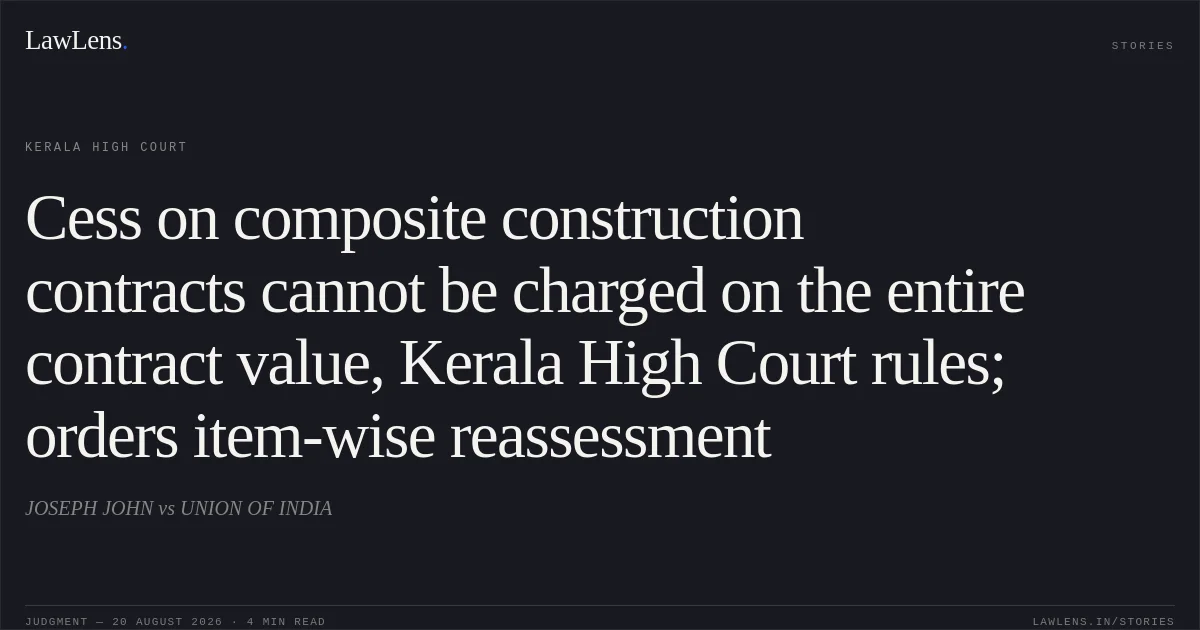
The writ appeals were disposed of with clarification.
The Court affirmed that the projects were covered by the Regulation Act and the Cess Act, and that KWA could deduct cess at source from contractors’ bills as a provisional collection mechanism.
Source reference: paras. 77–80; pp. 87–91However, cess could be finally levied and recovered only on those components constituting the “cost of construction” under Section 3 of the Cess Act, and not automatically on the entire contract value.
Source reference: paras. 73–80; pp. 85–91The competent Assessing Authority was directed to identify the cessable components from the contractual documents and accepted BoQs, afford the appellants an opportunity of hearing, and recompute the liability within two months from receipt of the judgment.
Source reference: para. 80(ii)–(iv); pp. 90–92Any excess recovery was to be refunded or adjusted against future bills within a further one month, at the contractor’s option.
Source reference: para. 80(ii)–(iv); pp. 90–92Original Court PDF
JOSEPH JOHNvsUNION OF INDIA
Click to open original judgment
Original judgment, available to read, download and summarize on LawLens.in