Facts
Suresh Pal challenged a Labour Court award rejecting his industrial-dispute claim.
Source reference: no citationHe alleged that he had worked for the respondent since April 1998, that his wages were reduced, and that his services were illegally terminated on 31 December 2001.
Source reference: pp. 2–3The respondent maintained that he had been engaged as a helper for a fixed term on the “Census of Handicraft Artisans” project, with extensions, and that his engagement ended when the term expired.
Source reference: pp. 2–3The Labour Court held that the respondent was an “industry” but found that Pal’s project-specific, fixed-term engagement had ended on expiry and that the cessation was not retrenchment.
Source reference: p. 3Issues
Whether Pal was engaged on a contractual, project-specific basis or was a permanent employee of the respondent.
Source reference: p. 5, para. 7Whether the end of Pal’s engagement on expiry of its term constituted retrenchment requiring compliance with Section 25-F of the Industrial Disputes Act, 1947.
Source reference: p. 6, paras. 11–12Law Applied
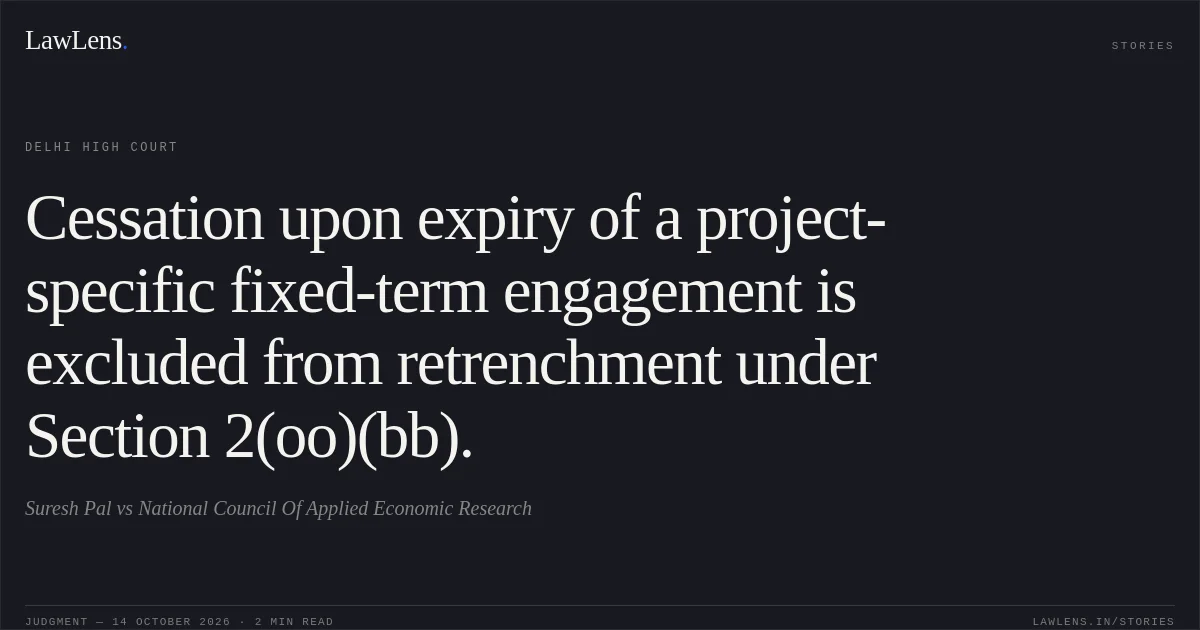
Section 2(oo)(bb) of the Industrial Disputes Act, 1947 excludes from “retrenchment” the termination of a workman’s service resulting from non-renewal of a contract on its expiry, or termination under a contractual stipulation. Where that exception applies, Section 25-F’s retrenchment requirements do not arise.
Source reference: p. 6, para. 11The Court relied on Haryana State F.C.C.W. Store Ltd. v. Ram Niwas, (2002) 5 SCC 654, and Escorts Ltd. v. Presiding Officer, (1997) 11 SCC 521, for the principle that cessation of an engagement made for a specific purpose and period may fall within Section 2(oo)(bb).
Source reference: p. 6, para. 12Under Article 227 of the Constitution, the High Court does not exercise appellate jurisdiction and should not disturb factual findings absent perversity or jurisdictional error, as stated in Estralla Rubber v. Dass Estate (P) Ltd., (2001) 8 SCC 97.
Source reference: pp. 6–7, para. 13Reasoning
Pal’s application for employment showed his awareness that the helper position was connected to the specified project; the record also showed successive extensions, and it was undisputed that his services were for that project and that the project had ended.
Source reference: pp. 5–6, paras. 8, 10His name appearing in an administrative-staff salary chart and evidence of arrears for an earlier period did not, considered alone, establish permanent employment; those records had to be assessed alongside his application, appointment documentation, and extensions.
Source reference: p. 6, para. 9On the cumulative evidence, the Court found no basis to reject the Labour Court’s conclusion that the engagement was fixed-term and project-specific. Its expiry therefore fell within Section 2(oo)(bb), so Section 25-F was not attracted.
Source reference: pp. 6–7, paras. 11–12The factual findings disclosed no perversity or jurisdictional infirmity warranting intervention under Article 227.
Source reference: pp. 6–7, para. 13Holding
The Court held that Pal’s engagement was project-specific and contractual, and that its cessation on expiry of the term did not amount to retrenchment under the Industrial Disputes Act.
Finding no ground for interference under Article 227, it upheld the Labour Court’s award and dismissed the writ petition.
Source reference: p. 7, paras. 13–15The respondent’s application to place documents on record was disposed of because the documents were already on record.
Source reference: p. 1, paras. 1–2Acts & Sections Cited
1 provisions across 1 statute referred to in this judgment. Each provision opens on LawLens.
Code of Civil Procedure, 19081
Original Court PDF
Suresh PalvsNational Council Of Applied Economic Research
Click to open original judgment
Original judgment, available to read, download and summarize on LawLens.in


