Facts
The petitioner’s husband, Ankit Dabas, was investigated by the Directorate General of GST Intelligence for alleged fraudulent availment and passing of Input Tax Credit and IGST refunds through invoices unsupported by actual supply of goods.
Source reference: para. 5During a search on 23 July 2020, ₹15,40,000 was taken by the Department and placed in a fixed deposit; the petitioner disputed the legality of its taking and continued retention.
Source reference: para. 7Dabas died on 6 May 2021, and the Department was informed of his death in October 2021.
Source reference: para. 8On 31 July 2024, the Department issued a Show Cause Notice to the petitioner, as his legal representative, proposing penalties under Section 122(3)(a) of the Central Goods and Services Tax Act, 2017 (“CGST Act”), read with Section 93, for the alleged acts of the deceased.
Source reference: para. 9The Order-in-Original dated 1 February 2025 imposed a penalty of ₹1,50,000 in one clause, while another clause stated that no penalty was imposed and contained inconsistent directions regarding appropriation of the seized amount.
Source reference: paras. 10–12, 38Issues
Whether Section 93 of the CGST Act permits tax, interest, or penalty proceedings to be initiated and determined after the death of the person whose alleged conduct forms the basis of liability, even where no adjudicatory proceedings were commenced during his lifetime?
Source reference: paras. 2–3, 20–24Whether Section 93(1)(b) of the CGST Act is unconstitutional as arbitrary or discriminatory, or as denying the legal representative a meaningful opportunity of defence?
Source reference: paras. 14, 33–37Whether the petitioner’s individual objections concerning service of the Show Cause Notice, proof of contravention, satisfaction of the conditions of Section 93(1)(b), computation of penalty, and the effect of the inconsistent operative clauses could be determined in the writ proceedings?
Source reference: paras. 17–19, 38–44Whether the Department could continue to retain or appropriate ₹15,40,000 without disclosing a subsisting lawful basis and accounting for the amount and interest earned?
Source reference: paras. 40–42Law Applied
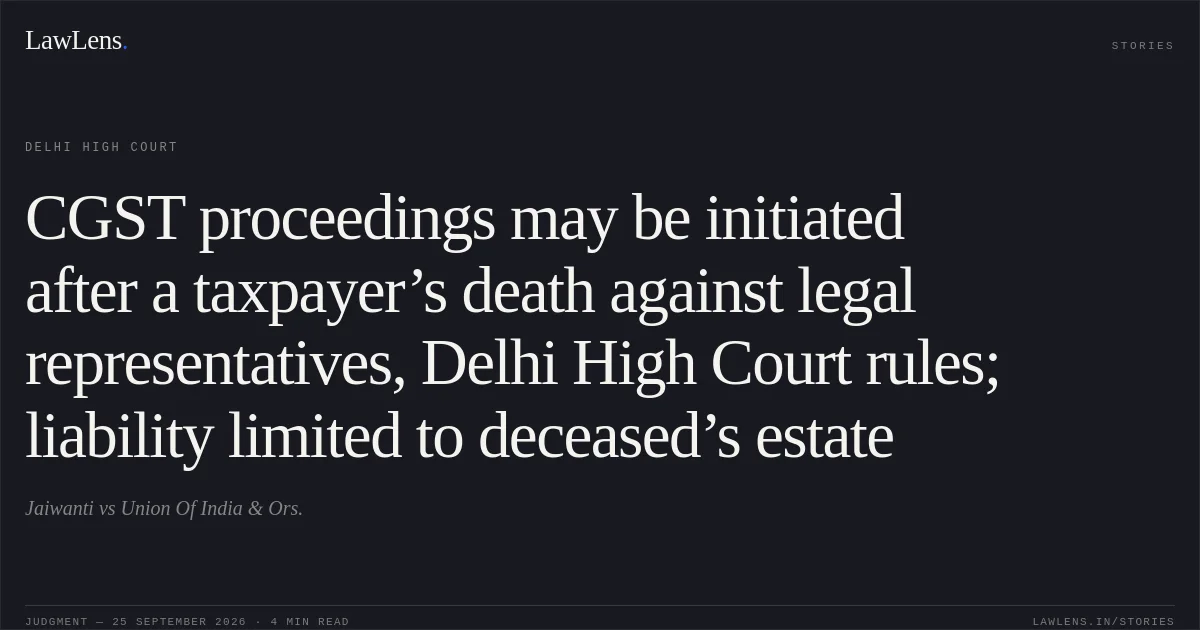
The Court applied Section 93(1) of the CGST Act, which provides that where a person liable to pay tax, interest, or penalty dies, the legal representative may be liable under clause (a) where the business continues, and under clause (b), where the business is discontinued, to pay out of the deceased’s estate to the extent of its capacity, including liabilities “determined after his death”.
Source reference: paras. 20–21Section 122(3)(a) supplies the substantive penalty for aiding or abetting specified contraventions, while Section 93 is not an independent penal provision against the legal representative.
Source reference: para. 25Section 126(3) requires an effective opportunity of hearing before penalty is imposed.
Source reference: paras. 28, 35The Court distinguished Shabina Abraham v. Collector of Central Excise and Customs, (2015) 10 SCC 770, because the relevant legislation there lacked machinery for assessment against legal representatives.
Source reference: paras. 27–28The Court also applied the presumption of constitutionality and the latitude afforded to economic legislation under R.K. Garg v. Union of India, (1981) 4 SCC 675.
Source reference: para. 36The Court relied on Godrej Sara Lee Ltd. v. Excise and Taxation Officer-cum-Assessing Authority, Civil Appeal No. 5393/2010, decided on 1 February 2023, for the principle that a writ court may examine pure questions of law despite an alternative remedy.
Source reference: para. 17Reasoning
The Court held that Section 93 expressly contemplates a liability being determined after the taxpayer’s death and contains no requirement that a Show Cause Notice or penalty proceeding must have been initiated during the deceased’s lifetime.
Source reference: paras. 20–24The underlying liability must nevertheless arise from conduct attributable to the deceased, and the conditions governing representative liability—particularly the distinction between a continuing and discontinued business and the limitation to the deceased’s estate—must independently be established.
Source reference: paras. 23, 26Section 93 therefore enabled the Department to issue the Show Cause Notice to the petitioner in her representative capacity, but did not itself establish the alleged abetment, validate service, determine the penalty, or prove compliance with Section 93(1)(b).
Source reference: paras. 25–26, 43–44The constitutional challenge failed because Section 93(1)(b) rationally preserves liabilities arising from the deceased’s conduct while limiting recovery to the estate and requiring a hearing; the inability of the legal representative to provide the deceased’s personal account may affect the merits of a particular case but does not render the provision unconstitutional on its face.
Source reference: paras. 34–37The Court declined to decide the fact-intensive objections under Article 226 and directed the petitioner to pursue the statutory appeal under Section 107.
Source reference: paras. 18–19, 44–46Regarding ₹15,40,000, the Court held that merely describing the amount as voluntarily deposited during investigation did not justify indefinite retention; the Department was required to disclose the amount’s status, the interest earned, and the precise legal authority for retention or appropriation.
Source reference: paras. 40–42, 47–50Holding
The Court rejected the contention that the Show Cause Notice was without jurisdiction merely because it was issued after the deceased’s death and upheld the constitutional validity of Section 93(1)(b) of the CGST Act.
It expressly left open the issues of service, proof of contravention, satisfaction of Section 93(1)(b), computation of penalty, and interpretation of the inconsistent clauses of the Order-in-Original.
Source reference: paras. 44, 46The petitioner was granted four weeks to file an appeal under Section 107, which was directed to be entertained on merits without rejection on limitation grounds.
Source reference: para. 45Within three weeks, the respondents were directed to furnish a complete account of ₹15,40,000, including its fixed-deposit particulars, interest, and any withdrawal or appropriation; the petitioner could respond, after which the competent authority was to pass a reasoned decision.
Source reference: paras. 47–49Any amount lacking a subsisting lawful basis for retention or appropriation was directed to be released to the petitioner as legal representative, together with the interest actually earned, without prejudice to the rights of other legal heirs.
Source reference: para. 50The writ petition and pending application were disposed of accordingly.
Source reference: para. 52Acts & Sections Cited
7 provisions across 2 statutes referred to in this judgment. Each provision opens on LawLens.
Central Goods and Services Tax Act, 20176
Integrated Goods and Services Tax Act, 20171
Original Court PDF
JaiwantivsUnion Of India & Ors.
Click to open original judgment
Original judgment, available to read, download and summarize on LawLens.in