01Facts
The batch comprised writ petitions challenging proceedings under the Central Goods and Services Tax Act, 2017 (“CGST Act”), principally arising from an investigation into alleged issuance of invoices without actual supply of goods and wrongful availment or passing on of Input Tax Credit (“ITC”).
¶ 1–7In the lead matter, M/s Siwon Enterprises Pvt. Ltd. challenged a Show Cause Notice (“SCN”) dated 30 June 2025 issued under Section 122, and the consequential Order-in-Original dated 26 December 2025 and Form GST DRC-07.
¶ 2, 8–15The petitioners alleged that the SCNs were issued by officers who had not been specifically assigned the relevant functions under Section 122, and further challenged the adjudication on grounds of denial of relied-upon documents, ineffective personal hearing, refusal of cross-examination, reliance on untested statements and electronic material, and mechanical multiplication of penalties.
¶ 14–18, 28The respondents opposed the writ petitions, relying principally on the statutory appellate remedy under Section 107 and contending that the officer’s competence and the evidentiary objections involved mixed questions of fact and law.
¶ 2902Issues
i.Whether the writ petitions should be entertained under Article 226 despite the availability of the statutory appellate remedy under Section 107 of the CGST Act?
¶ 26, 48–55ii.Whether the officers who issued the SCNs under Section 122 possessed the requisite statutory authority or were “proper officers” within the meaning of Section 2(91) of the CGST Act?
¶ 37–48iii.Whether Section 122(1) can be invoked against a person who is not a “taxable person,” and whether the issue should be decided by the High Court or left to the statutory appellate process pending consideration by the Supreme Court?
¶ 34–36, 54iv.Whether the substituted proviso to Section 107(6), requiring an enhanced pre-deposit in cases involving penalty alone, applies to appeals arising from SCNs issued before 1 October 2025?
¶ 18, 31–33, 56v.Whether the alleged violations of natural justice, reliance on disputed evidence, denial of cross-examination, clubbing of transactions and financial years, and multiplication of penalties warranted interference under Article 226?
¶ 49–5303Law Applied
The Court applied Sections 2(91), 3, 5, 107 and 122 of the CGST Act. Section 2(91) defines a “proper officer” functionally as the Commissioner or an officer assigned the relevant function by the Commissioner in the Board; Sections 3 and 5 concern the classes, powers and delegation of central-tax officers.
¶ 38–40The Court considered Notification No. 14/2017-Central Tax, which invested DGGI officers with the powers exercisable by central-tax officers of corresponding rank, and Notification No. 2/2017-Central Tax assigning specified functions to classes of officers.
¶ 41–43Section 122(1) refers to a “taxable person,” whereas Section 122(1A) operates against “any person” in specified circumstances; the legal question concerning the scope of Section 122(1) was left open because it was pending before the Supreme Court in Mukesh Kumar Garg v. Union of India.
¶ 34–36The Court followed Gaurav Jain v. Joint Commissioner (Appeals-II), CGST Delhi Zone, holding that the pre-deposit applicable to an appeal is governed by the law in force when the adjudicatory proceedings commenced, and therefore the substituted proviso to Section 107(6) does not apply to SCNs issued before 1 October 2025.
¶ 31–33Applying Assistant Commissioner of State Tax v. Commercial Steel Ltd., the Court reiterated that alternative remedy is not an absolute bar to writ jurisdiction, but interference is ordinarily justified only in exceptional cases involving, inter alia, violation of fundamental rights, breach of natural justice, patent lack of jurisdiction, or a challenge to statutory vires.
¶ 52Provisions in the judgment · 11 · Linked ones open on LawLens
Central Goods and Services Tax Act, 2017 10 provisions
Section 61Section 70Section 73Section 74Section 75Section 107Section 122Section 130Section 132Section 155Integrated Goods and Services Tax Act, 2017 Section 20
04Reasoning
The Court held that the officer-competence objection was not a patent or self-evident jurisdictional defect.
¶ 40–48The effect of Sections 2(91), 3 and 5, Notifications Nos. 2 and 14 of 2017, and the later Circular dated 27 October 2025 required statutory interpretation and could not be resolved solely by relying on the subsequent Circular.
¶ 40–48The Court also noted the line of authority in Sunil Chauhan, Alokadei Holdings and Patanjali Ayurved suggesting that consequential penalties under Section 122 may form part of adjudication under Sections 73 or 74, rather than requiring an entirely separate adjudication by an independently assigned officer.
¶ 47The remaining objections—whether the petitioners were taxable persons, the genuineness of transactions, the evidentiary value of statements and electronic material, denial of cross-examination, consideration of replies, and quantification or duplication of penalties—were fact-intensive matters better examined by the appellate authority.
¶ 35–36, 49–51Since the Orders-in-Original were appealable under Section 107 and the appellate remedy was not rendered illusory, particularly in light of Gaurav Jain, the Court declined to bypass that remedy.
¶ 51–53However, the Court clarified that all appeals arising from SCNs issued before 1 October 2025 would be governed by the earlier Section 107(6) regime, irrespective of the dates of the Orders-in-Original.
¶ 32–33, 5605Holding
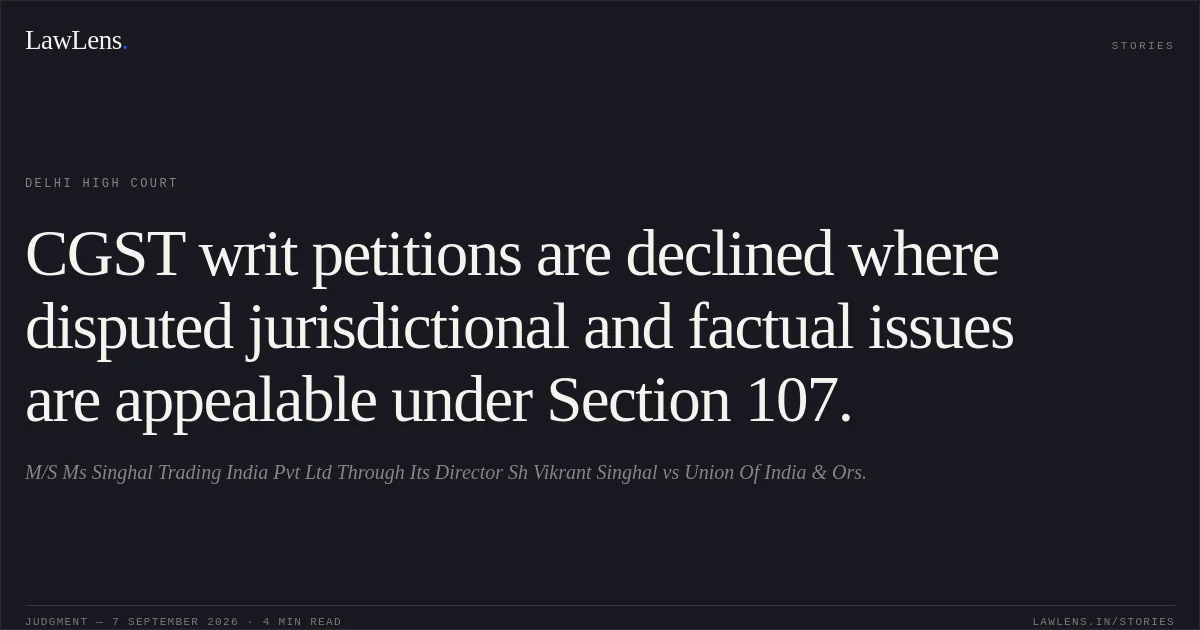
The writ petitions were disposed of on the ground of availability of the statutory appellate remedy under Section 107; the Court declined to exercise extraordinary jurisdiction under Article 226.
¶ 53–55The question whether Section 122(1) applies to persons who are not “taxable persons” was expressly left open for determination in accordance with the eventual decision of the Supreme Court.
¶ 36, 54–55The petitioners were permitted to raise before the Appellate Authority all objections, including officer competence, the effect of the 27 October 2025 Circular, natural-justice violations, evidentiary objections, and penalty quantification.
¶ 55Appeals arising from SCNs issued before 1 October 2025 must be governed by the pre-amendment Section 107(6) pre-deposit requirement and cannot be rejected by applying the substituted proviso merely because the Orders-in-Original were passed later.
¶ 56The petitioners were also permitted to seek exclusion of the period spent prosecuting the writ petitions for limitation purposes, subject to consideration by the Appellate Authority in accordance with law.
¶ 57Original Court PDF
M/S Ms Singhal Trading India Pvt Ltd Through Its Director Sh Vikrant SinghalvsUnion Of India & Ors.
Click to open original judgment
Original judgment, available to read, download and summarize on LawLens.in