Facts
The applicant, a GDS Packer/MC at Swargadwara Sub Post Office, was accused of sexual harassment by a lady colleague in March 2018
Source reference: p.2An Internal Complaints Committee (ICC), chaired by Smt. Smita Mohapatra (Respondent No. 6), conducted a preliminary inquiry and found the allegations prima facie established
Source reference: p.4Based on this, a formal disciplinary proceeding under Rule 10 of the GDS (Conduct and Engagement) Rules, 2011, was initiated
Source reference: p.4Smt. Smita Mohapatra, the same official who chaired the ICC, was appointed as the Inquiry Officer (IO) for the formal departmental inquiry
Source reference: p.6She submitted a report, co-signed by two other ICC members, holding the charges "proved in toto"
Source reference: p.6Consequently, the applicant was compulsorily discharged on 30.07.2022
Source reference: p.7Having exhausted his departmental appeals, the applicant challenged the dismissal
Source reference: p.7Issues
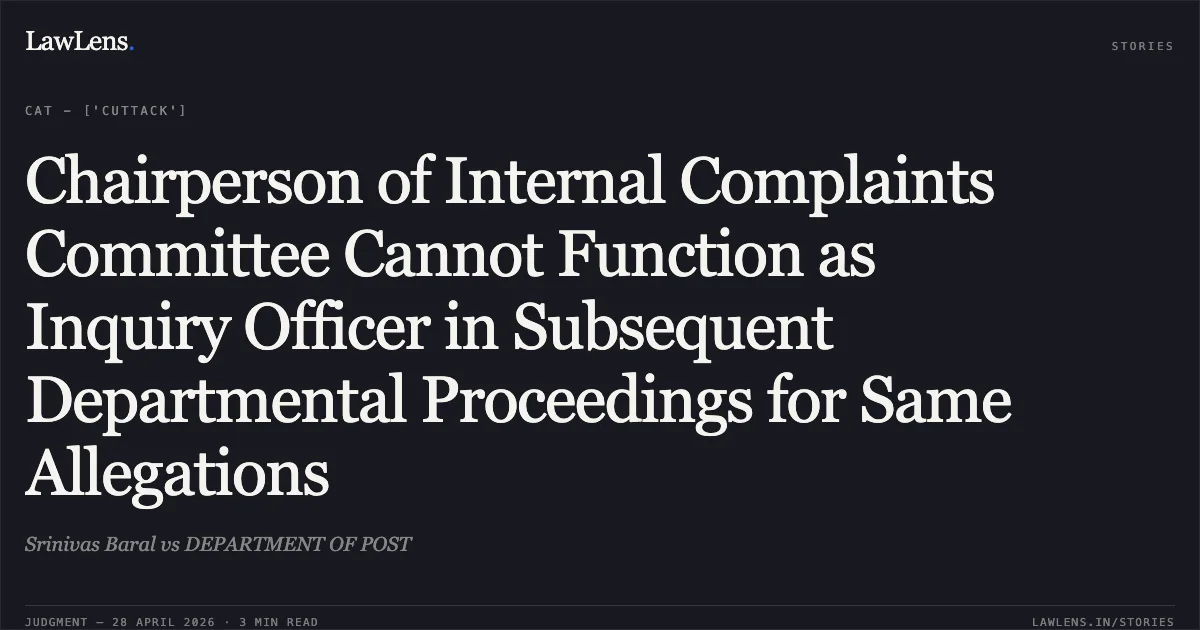
1. Whether the appointment of the ICC Chairperson, who conducted the preliminary inquiry under the POSH Act, as the Inquiry Officer in the subsequent departmental proceedings violates the principle of "nemo judex in causa sua"
Source reference: p.8 / para. 5(i)2. Whether an Inquiry Officer is competent to allow members of the ICC, who were not formally appointed as Co-Inquiry Officers by the competent authority, to participate in the inquiry and sign the final report
Source reference: p.8 / para. 5(ii)Law Applied
The Tribunal applied the fundamental principle of Natural Justice, specifically the rule against bias: nemo judex in causa sua (no man shall be a judge in his own cause)
Source reference: p.9, 10It relied on Lakshmi Ram Bhuyan v. Hari Prasad Bhuyan regarding procedural adherence
Source reference: p.2J. Mohapatra and Co. v. State of Orissa, which establishes that justice must not only be done but must manifestly be seen to be done in administrative and quasi-judicial proceedings.
Source reference: p.9Ministry of Home Affairs OM dated 16.02.1961, which mandates that only disinterested officers should be appointed as Inquiry Officers to avoid any reasonable apprehension of bias
Source reference: p.8Reasoning
The Tribunal found that Smt. Smita Mohapatra had already formed a firm opinion against the applicant during the ICC inquiry, where she recommended disciplinary action
Source reference: p.4Her subsequent appointment as the IO in the formal departmental proceeding created a "reasonable apprehension of bias," as she was effectively acting as both investigator/prosecutor and judge
Source reference: p.10Furthermore, the IO committed a gross procedural illegality by allowing other ICC members to co-sign the inquiry report despite them not being formally appointed as Co-Inquiry Officers by the competent authority
Source reference: p.11The Tribunal noted that the IO has no jurisdiction to involve third parties in the adjudicatory decision-making process
Source reference: p.11The discrepancy between the ICC report (finding allegations "prima facie" true) and the departmental report (finding them "proved in toto") using the same members further undermined the fairness of the process
Source reference: p.12Holding
The Tribunal answered both issues in the negative. It held that the inquiry report and subsequent punishment orders were a nullity due to the violation of the rule against bias and procedural impropriety
The charge memo, inquiry report, and orders of the Disciplinary and Appellate Authorities were quashed. Since the applicant had crossed the retirement age of 65 during the litigation, reinstatement was not ordered. However, the Tribunal directed the respondents to pay the applicant 50% of his TRCA (Time Related Continuity Allowance) from the date of his discharge (01.08.2022) until his attainment of 65 years of age
Source reference: p.12, 13Acts & Sections Cited
2 provisions across 1 statute referred to in this judgment. Linked provisions open on LawLens.
National Monuments Authority (Conditions of Service of Chairman and Members of the Authority and Conduct of Business) Rules, 20112
Original Court PDF
Srinivas BaralvsDEPARTMENT OF POST
Click to open original judgment
Original judgment, available to read, download and summarize on LawLens.in