Facts
Respondents 4–9 claimed that their predecessor, Basheer Khan, was the original owner of land bearing Survey No. 812, measuring 4.78 acres, and that the name of Gopikishan was erroneously entered in the revenue records for 1981–82 pursuant to Revenue Case No. 140/A-6/1981–82. They therefore applied before the SDO under Section 115 of the Madhya Pradesh Land Revenue Code, 1959 for correction of the revenue entries.
Source reference: paras. 3; p. 2–3The petitioners were impleaded before the SDO under Order I Rule 10 CPC. The SDO rejected the respondents’ application under Order VII Rule 11 CPC on 9 May 2023. Respondents 10 and 11 challenged that order before the Additional Collector, who allowed the revision/review on 8 July 2023 and set aside the SDO’s order, without impleading or hearing the petitioners. The petitioners’ subsequent review petition was dismissed as not maintainable, leading to the present writ petition.
Source reference: para. 3; p. 3–4The respondents contended that the challenge to the 1981–82 entry was initiated only in 2022, after more than forty years; that the statutory period under the then-applicable Section 116 was one year; and that development permissions and approximately 91 registered plot sales had created substantial third-party rights.
Source reference: para. 6; p. 5–8The High Court also noted that the relevant revenue entries had not been produced by either side and that the Tehsildar’s report indicated mutation pursuant to the 1981–82 revenue case, although the old record was not traceable.
Source reference: para. 10; p. 9–10Issues
1. Whether the petitioners could seek correction of a revenue entry made in 1981–82 by initiating proceedings under the Madhya Pradesh Land Revenue Code only in 2022, particularly in view of the one-year limitation under the unamended Section 116 and the doctrine against belated exercise of statutory/revisional powers?
Source reference: paras. 10–16; p. 9–162. Whether the Additional Collector’s order was liable to be quashed for having been passed without impleading and hearing the petitioners, despite their having been impleaded before the SDO?
Source reference: paras. 3–5, 17–18; p. 3–5, 163. Whether the non-tracing of the 1981–82 revenue case established that the revenue entry was fraudulent, illegal, without jurisdiction, or merely clerical, warranting interference under Articles 226 or 227 of the Constitution?
Source reference: paras. 4, 10, 16–18; p. 4, 9–16Law Applied
The Court considered Section 115 of the Madhya Pradesh Land Revenue Code, 1959 concerning rectification of revenue records, and the unamended Section 116, which required an aggrieved person to seek correction of an entry within one year of its making.
Source reference: paras. 3, 11; p. 2–3, 10It also referred to Sections 168 and 190 of the Code concerning leases by a bhumiswami and the conferral of bhumiswami rights on certain occupancy tenants.
Source reference: paras. 12–13, 16; p. 10–12, 16Under Article 226/227, interference is warranted only where the impugned order suffers from jurisdictional error, perversity, patent illegality, or violation of natural justice.
Source reference: paras. 17–18; p. 16Relying on State of Gujarat v. Patil Raghav Natha, (1969) 2 SCC 187, and Joint Collector, Ranga Reddy District v. D. Narsingh Rao, (2015) 3 SCC 695, the Court held that revisional or corrective powers must be exercised within a reasonable time, even where no express limitation is prescribed, and that allegations of fraud do not indefinitely extend the period for challenging an old entry.
Source reference: para. 15; p. 12–15The Court additionally referred to Section 92 of the Bharatiya Sakshya Adhiniyam regarding presumptions concerning documents thirty years old.
Source reference: para. 14; p. 12Reasoning
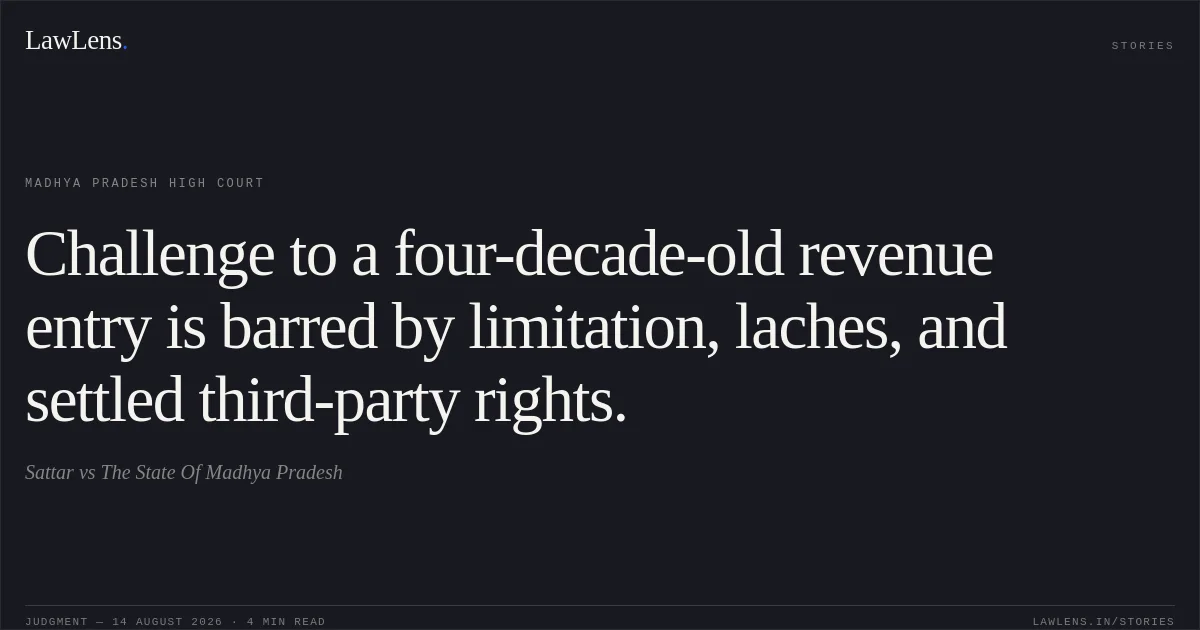
The Court held that the challenge was directed against a revenue entry dating from 1981–82 but was initiated only in 2022, resulting in an unexplained delay of over forty years. This was contrary not only to the one-year period prescribed by the unamended Section 116 but also to the broader rule that statutory corrective or revisional powers must be exercised within a reasonable time.
Source reference: paras. 10–11, 15–16; p. 9–15The long delay was particularly material because the respondents had remained in possession, obtained development permissions, and sold approximately 91 plots through registered instruments, thereby creating third-party rights.
Source reference: para. 10; p. 9–10The Court further found that the mere fact that the old revenue case file was not traceable did not establish that no such case existed or that the resulting entry was fraudulent, illegal, or without jurisdiction. The Tehsildar’s report supported the existence of mutation pursuant to the 1981–82 proceedings.
Source reference: para. 10; p. 9–10The petitioners had also failed to produce the relevant revenue entries or contemporaneous material showing that Basheer Khan continued to assert title or possession after 1981–82.
Source reference: para. 16; p. 16Although the petitioners alleged breach of natural justice because they were not impleaded or heard by the Additional Collector, the High Court found no jurisdictional error or perversity warranting writ interference, particularly as the proceedings were otherwise barred by gross delay and the authorities had concurrently declined relief.
Source reference: paras. 17–18; p. 16Holding
The High Court answered the issues against the petitioners.
It held that the attempt to correct the 1981–82 revenue entry, initiated after more than forty years and after creation of substantial third-party rights, was impermissibly delayed and unsupported by adequate evidence of fraud or illegality.
Source reference: paras. 10–16; p. 9–16The impugned orders were found not to suffer from jurisdictional error, perversity, patent illegality, or a legally actionable violation of natural justice.
Source reference: para. 18; p. 16Accordingly, the writ petition was dismissed for want of merit under Articles 226 and 227 of the Constitution.
Source reference: para. 19; p. 16–17Acts & Sections Cited
15 provisions across 2 statutes referred to in this judgment. Each provision opens on LawLens.
MP Land Revenue Code 1959
Bharatiya Sakshya Adhiniyam, 20231
Original Court PDF
SattarvsThe State Of Madhya Pradesh
Click to open original judgment
Original judgment, available to read, download and summarize on LawLens.in