Facts
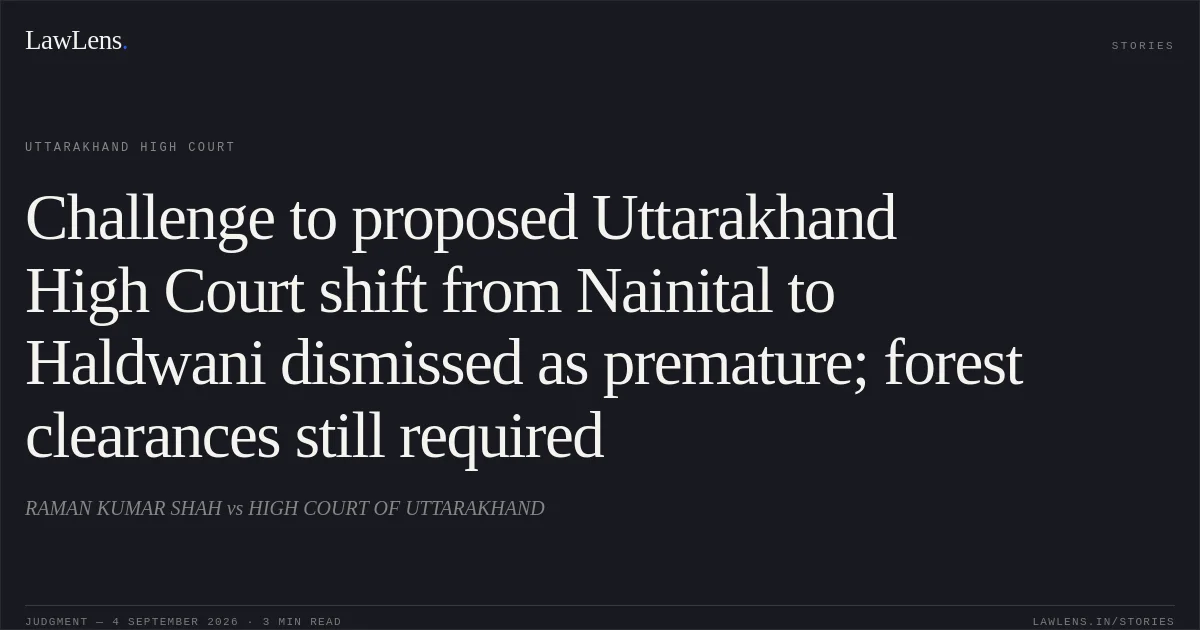
The petitioner challenged the District Magistrate, Nainital’s order dated 14 May 2026 identifying approximately 73 hectares of forest land in the Tarai-Central Forest Division, Rudrapur, near Bel Baba Temple, as a possible site for relocating the High Court Complex from Nainital.
Source reference: p.2He also challenged the Full Court Resolution dated 19 June 2026 supporting the proposed relocation and sought directions for action against the District Magistrate under the Forest (Conservation) Act, 1980.
Source reference: p.1The State and the High Court submitted that the matter was only at the stage of identifying suitable land and that no forest land had yet been de-reserved or diverted.
Source reference: pp.5–7The Union of India stated that no proposal had yet been submitted before the Regional Empowered Committee.
Source reference: p.6Issues
Whether the identification of forest land as a possible site for relocation of the High Court, without actual de-reservation or diversion, required prior approval of the Central Government under Section 2 of the Forest (Conservation) Act, 1980?
Source reference: pp.7–9, paras.14–15Whether the proposed relocation from Nainital to Haldwani was contrary to the Uttar Pradesh Reorganisation Act, 2000 and the Presidential Notification dated 3 November 2000?
Source reference: pp.3, 5, 10–11, paras.4, 10, 17Whether the alleged location of the proposed site near identified elephant corridors and its environmental implications warranted interference at the stage of land identification?
Source reference: pp.4, 7, 10, paras.6, 9, 17Whether the District Magistrate or any other authority had committed an offence under the Forest (Conservation) Act, 1980 by identifying the land without prior Central Government approval?
Source reference: pp.4, 10–11, paras.8, 17Law Applied
The Court applied Section 2 of the Forest (Conservation) Act, 1980, which prohibits de-reservation of reserved forest or use of forest land for a non-forest purpose without the prior approval of the Central Government.
Source reference: p.7It relied on Rules 10(2), 10(4) and 10(5) of the Van (Sanrakshan Evam Samwardhan) Rules, 2023, which prescribe the procedure for processing proposals involving de-reservation, including site inspection, consideration by the Advisory Committee, examination of alternatives, environmental impacts, wildlife concerns and compensatory afforestation.
Source reference: pp.8–9The Court also considered the Uttar Pradesh Reorganisation Act, 2000, the Presidential Notification dated 3 November 2000, Articles 39-A, 46 and 48-A of the Constitution, and the Supreme Court’s order dated 15 July 2026 in High Court Bar Association v. State of Uttarakhand & Others.
Source reference: pp.3–5, 9–10It also referred to the principle stated in Reena Paul v. State of Uttarakhand & Others, W.P. (PIL) No. 5 of 2021, that reserved forest cannot be de-notified or used for non-forest purposes without prior Central Government permission.
Source reference: p.4Reasoning
The Court held that the impugned actions merely identified land as a possible site and did not de-reserve the forest, divert it, clear it, or authorise its use for a non-forest purpose.
Source reference: pp.7–9, paras.14–15Consequently, the statutory requirement of prior Central Government approval under Section 2 had not yet been triggered, although such approval would be mandatory if the proposal subsequently proceeded to de-reservation or diversion.
Source reference: pp.7–9The Court accepted the State’s assurance that the proposal would be placed before the competent authorities and processed in accordance with the 2023 Rules.
Source reference: pp.7–9The environmental objection relating to elephant corridors was rejected at this stage because the respondents stated that the proposed land was approximately ten kilometres from the alleged corridor, a position also supported by material relied upon by the petitioner.
Source reference: p.10, para.17The Court further held that the Presidential Notification located the High Court at “Nainital” but did not permanently prevent a future change through an appropriate notification; in any event, the stage for issuing such a notification had not arisen.
Source reference: pp.5, 10–11Since no statutory violation or offence had yet occurred, the prayer to prosecute the District Magistrate was also found unsustainable.
Source reference: p.11Holding
The writ petition was held to be premature and devoid of merit because the forest land had only been identified and had not yet been de-reserved or diverted.
The Court dismissed the petition, declined to quash the District Magistrate’s order or the Full Court Resolution, and rejected the request for prosecution of the District Magistrate.
Source reference: pp.10–11, paras.16–18It clarified that any future de-reservation or use of the land for a non-forest purpose would require compliance with Section 2 of the Forest (Conservation) Act, 1980, the Van (Sanrakshan Evam Samwardhan) Rules, 2023, and the applicable approval process.
Source reference: pp.7–9Pending applications, if any, were disposed of.
Source reference: p.11, para.19Acts & Sections Cited
2 provisions across 2 statutes referred to in this judgment. Each provision opens on LawLens.
Van (Sanrakshan Evam Samvardhan) Adhiniyam, 19801
Uttar Pradesh Reorganisation Act, 20001
Original Court PDF
RAMAN KUMAR SHAHvsHIGH COURT OF UTTARAKHAND
Click to open original judgment
Original judgment, available to read, download and summarize on LawLens.in