Facts
The petitioner challenged a Bihar State Food and Civil Supplies Corporation letter dated 17 May 2016 concerning adjustment of dues and possible proceedings against millers.
Source reference: p. 1–3, para. 1It sought, among other reliefs, a direction to issue its miller licence and protection from recovery, asserting that it had no outstanding dues and had received a no-objection certificate.
Source reference: p. 1–3, para. 1The respondents submitted that the dispute was governed by the Supreme Court’s decision in Pawapuri Rice Mills v. Bihar State Food and Civil Supplies Corporation Ltd., 2024 SCC OnLine SC 3777, and that the petitioner should pursue the statutory remedy under the Bihar and Orissa Public Demands Recovery Act, 1914 (PDR Act).
Source reference: p. 4, paras. 2–3Issues
Whether the petitioner’s challenge to the recovery-related proceedings should be entertained in writ jurisdiction when a statutory remedy under the PDR Act is available.
Source reference: p. 4, 9, paras. 2–3, 9Whether coercive steps should be restrained while the petitioner pursues that statutory remedy.
Source reference: p. 10, para. 10Law Applied
Under the PDR Act, an aggrieved party may pursue the remedies provided by the Act in relation to certificate proceedings.
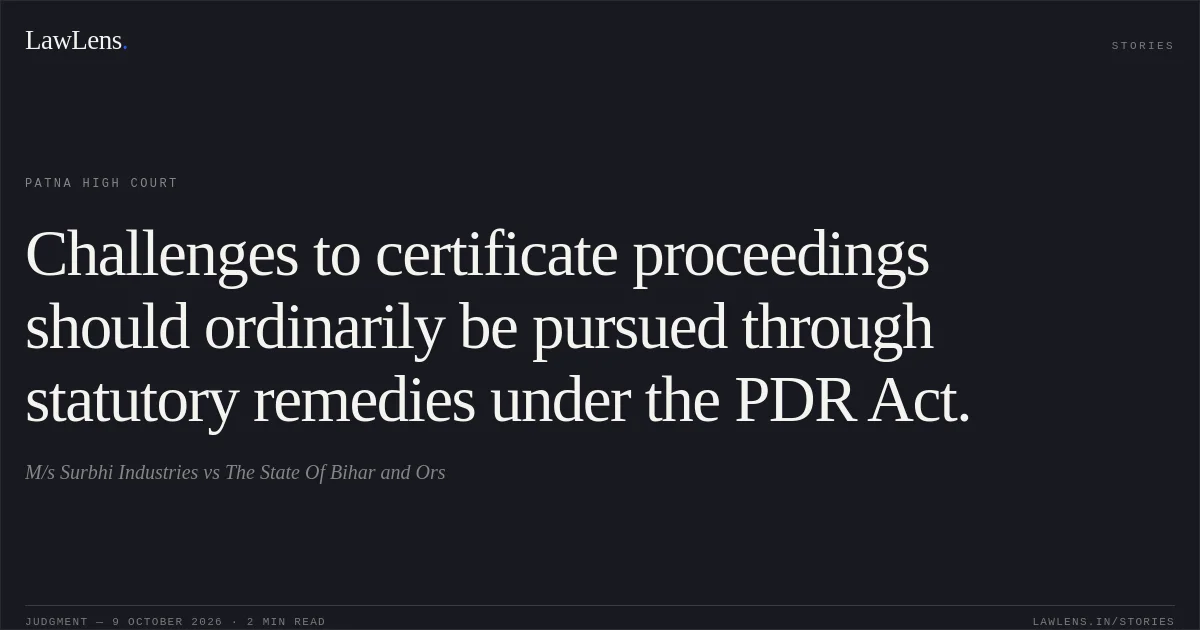
Source reference: p. 5–7, paras. 8–11 of the quoted Ranjeet Kumar Jha decisionFollowing Pawapuri Rice Mills, where an efficacious statutory remedy is available, a party should ordinarily pursue it rather than invoke writ jurisdiction, particularly when the challenge concerns disputed questions or alleged procedural irregularities in certificate proceedings.
Source reference: p. 5–7, paras. 8–11 of the quoted Ranjeet Kumar Jha decision; p. 9, paras. 8–9The competent statutory authority must consider the matter in accordance with law; the writ court’s disposal does not determine the merits of the parties’ claims.
Source reference: p. 10, para. 11Reasoning
The High Court treated the controversy as covered by Pawapuri Rice Mills and concluded that the petitioner had a statutory remedy under the PDR Act.
Source reference: p. 9, para. 9It therefore declined to decide the merits in writ jurisdiction, leaving the parties’ substantive claims open for consideration by the competent authority.
Source reference: p. 10, para. 11To preserve the petitioner’s ability to pursue that remedy, the Court directed that delay in filing the appeal be condoned and barred coercive steps in the certificate proceeding, provided the petitioner availed the remedy within the specified period.
Source reference: p. 9–10, paras. 9–10Holding
The writ petition was disposed of with liberty to the petitioner to avail the statutory remedy within four weeks of receiving the judgment.
The competent authority was directed to condone delay and dispose of the appeal within three months of its filing.
Source reference: p. 9–10, paras. 9–12No coercive steps were to be taken in the certificate proceeding in the meantime, subject to the petitioner pursuing the remedy within the prescribed period.
Source reference: p. 9–10, paras. 9–12The Court expressed no opinion on the merits.
Source reference: p. 9–10, paras. 9–12Acts & Sections Cited
6 provisions across 1 statute referred to in this judgment. Linked provisions open on LawLens.
Bihar and Orissa Public Demands Recovery Act, 19146
Original Court PDF
M/s Surbhi IndustriesvsThe State Of Bihar and Ors
Click to open original judgment
Original judgment, available to read, download and summarize on LawLens.in