Facts
The petitioner filed a writ petition under Article 227 of the Constitution of India challenging an order dated 27/02/2026 passed by the 2nd Additional Senior Civil Judge, Umbergaon, in Execution Petition No. 07/2004
Source reference: p. 1-2The executing court had allowed the respondent to join proceedings as the legal representative (adopted daughter) of the deceased judgment creditor
Source reference: para. 3.1The petitioner contended that the lower court recorded a "statement of fact" claiming the petitioner had no objection to the respondent’s status, whereas the petitioner had actually contested the application in writing
Source reference: para. 3Issues
1. Whether the executing court erred in recording a consent/no-objection on behalf of the petitioner regarding the respondent's status as an adopted daughter despite evidence of a contested reply.
Source reference: para. 3, 42. Whether the executing court was required to conduct a formal inquiry into the status of the legal representative under the Code of Civil Procedure before allowing the joinder.
Source reference: para. 3.1, 6Law Applied
The court applied the principle that records of a judgment or order regarding what transpired in court are sacrosanct; if a party claims a statement was wrongly recorded, the proper remedy is to approach the same court for correction, as established in Central Bank of India v. Vrajlal Kapurchand Gandhi and anr. (2003) 6 SCC 573
Source reference: para. 4Section 47(3) and Order 22, Rule 5 of the Code of Civil Procedure (CPC), which mandate that questions as to whether a person is or is not a legal representative of a deceased party shall be determined by the Court
Source reference: para. 3.1, 6Reasoning
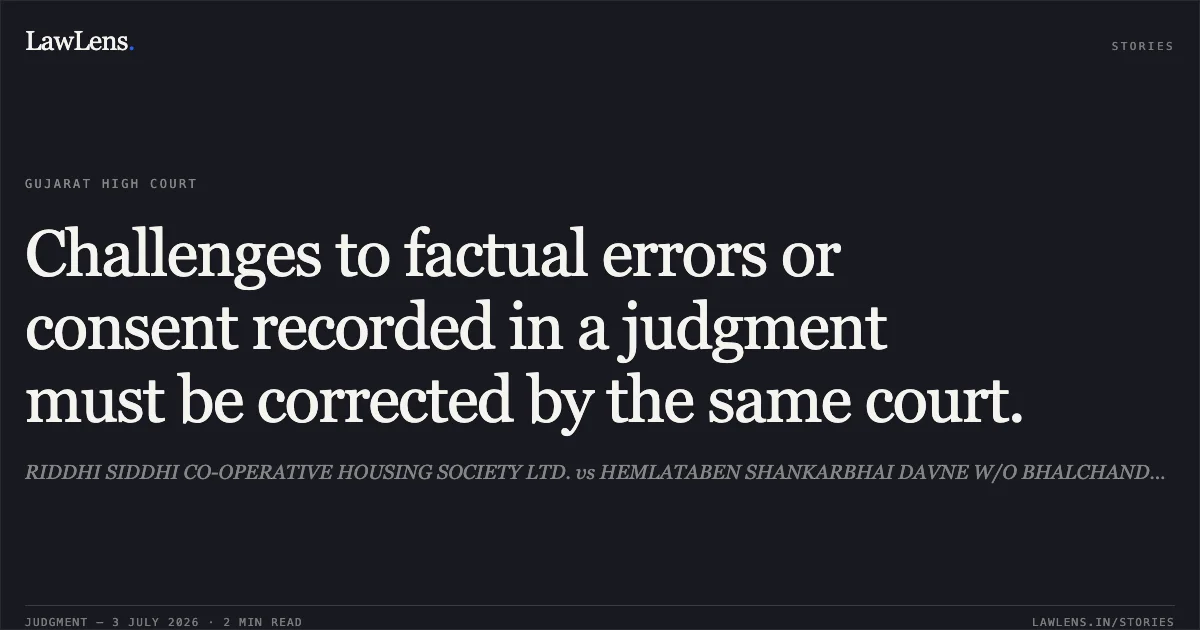
The High Court observed that while the petitioner argued the "no objection" recorded by the lower court was ex-facie erroneous, the law mandates that the High Court cannot easily look behind the record of the lower court's proceedings
Source reference: para. 4Relying on Apex Court precedent, the Court reasoned that the petitioner must first seek a correction of the allegedly "wrong observations/consent" from the executing court itself
Source reference: para. 5Furthermore, the Court noted that the petitioner has a statutory right to demand an inquiry into the respondent's legal status under Order 22, Rule 5 of the CPC, which the executing court is bound to decide in accordance with law after hearing both sides
Source reference: para. 5-6Holding
The High Court disposed of the petition without interference on the merits
It held that the petitioner is permitted to move an application before the executing court to correct the record regarding the alleged "no objection"
Source reference: para. 5The Court further directed that if the petitioner files an application under Section 47(3) read with Order 22, Rule 5 of the CPC to challenge the respondent's status as a legal representative, the executing court must decide the same in accordance with law
Source reference: para. 6Acts & Sections Cited
2 provisions across 1 statute referred to in this judgment. Each provision opens on LawLens.
Code of Civil Procedure, 19082
Original Court PDF
RIDDHI SIDDHI CO-OPERATIVE HOUSING SOCIETY LTD.vsHEMLATABEN SHANKARBHAI DAVNE W/O BHALCHANDRA AKEKAR
Click to open original judgment
Original judgment, available to read, download and summarize on LawLens.in


![Subsequent exoneration does not retrospectively invalidate a finalized promotion select list.. UNNIKRISHNAN M vs M/o Environment And Forests. CAT - ['Ernakulam']. LawLens](/stories/thumbnails/subsequent-exoneration-does-not-retrospectively-invalidate-a-finalized-promotion-select-li-ce80a0e84f2f4887857271e8b4341c42.webp)