Facts
The petitioners filed writ petitions under Article 226 challenging orders of the Intellectual Property Appellate Board concerning revocation of their patents and seeking restoration of the patents to the Register
Source reference: pp. 8–10The Court noted that, in related proceedings, it had set aside revocation orders and directed the Board to decide the validity of a respondent company’s board resolution; appeals against that order remained pending before the Supreme Court in Civil Appeal Nos. 3766 and 3777 of 2016
Source reference: p. 11, para. 2The petitioners’ senior counsel then submitted that the patents at issue in these petitions had expired
Source reference: p. 12, para. 3Issues
Whether the writ petitions required further adjudication after the patents concerned had expired
Source reference: p. 12, paras. 3–4Whether the parties’ rights concerning the IPAB orders should remain open for consideration in the pending Supreme Court appeals
Source reference: p. 12, para. 5Law Applied
The petitions were brought under Article 226 of the Constitution of India
Source reference: pp. 8–10The Court applied the procedural principle that a proceeding may be dismissed as infructuous where the relief sought no longer requires adjudication. It cited no statutory provision or precedent for that principle in this order.
Source reference: no citationThe Court also left the parties’ rights concerning the challenged IPAB orders open for consideration in the pending Supreme Court appeals
Source reference: p. 12, para. 5Reasoning
The petitioners’ submission that the patents had expired meant that no further order restoring or otherwise addressing those patents was necessary in these writ petitions.
Source reference: p. 12, paras. 3–4The Court therefore treated the petitions as having become infructuous, without deciding the merits of the underlying challenges to the IPAB orders.
Source reference: p. 12, paras. 3–4Because the related appeals were pending before the Supreme Court, the Court preserved the parties’ ability to pursue their respective rights there.
Source reference: p. 12, para. 5Holding
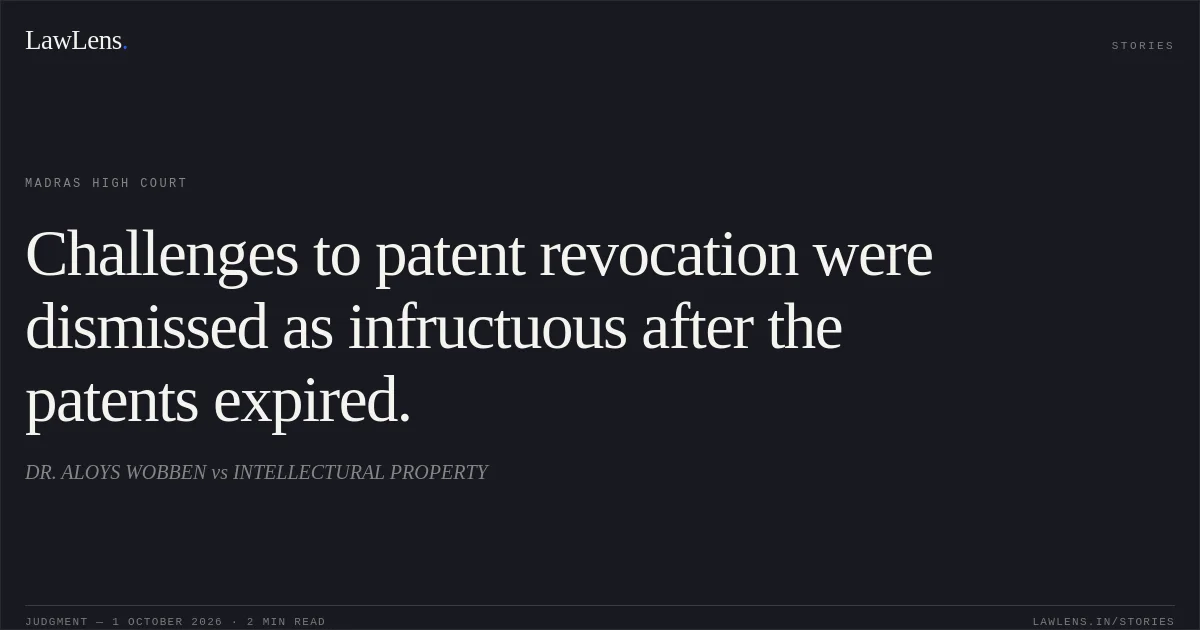
The Court dismissed all the writ petitions as infructuous because the patents had expired and no further orders were necessary.
It left the parties free to agitate their respective rights concerning the IPAB orders in the pending Supreme Court appeals; there was no order as to costs.
Source reference: p. 12, paras. 5–6Original Court PDF
DR. ALOYS WOBBENvsINTELLECTURAL PROPERTY
Click to open original judgment
Original judgment, available to read, download and summarize on LawLens.in