Facts
The petitioner, an Assistant Director of Agriculture and formerly a Seed Certification Officer, accompanied Vigilance and Anti-Corruption officials during a trap against a Tahsildar on 17 November 2014 and was cited as PW-4 in Spl.C.No.10 of 2015 before the Chief Judicial Magistrate, Special Court, Thanjavur at Kumbakonam.
Source reference: para. 2(i), pp. 3–4Although the final report was filed in 2015, the petitioner was examined in chief only on 20 December 2022 and was recalled for cross-examination on 28 July 2023, approximately seven months later.
Source reference: para. 2(ii), p. 4; para. 8, p. 7During cross-examination, he stated that the phenolphthalein test was conducted only after the Vigilance officials questioned the accused about receipt of the money.
Source reference: para. 2(ii), pp. 4–5Relying on the Vigilance communication, the Director of Agriculture issued a charge memo dated 16 September 2024 under Rule 17(b) of the Tamil Nadu Civil Services (Discipline and Appeal) Rules, alleging that the petitioner had turned hostile during the criminal trial.
Source reference: para. 1, p. 2; paras. 3–4, pp. 5–6Issues
Whether the charge memo issued against the petitioner for allegedly giving contradictory evidence and turning hostile during the criminal trial was vitiated by non-application of mind.
Source reference: paras. 7–13, pp. 6–10Whether the petitioner’s evidence justified departmental action when he had not been declared hostile by the prosecution and the criminal trial had not concluded.
Source reference: paras. 9–12, pp. 7–9Whether the petitioner was entitled to consequential promotion if his promotion had been withheld because of the impugned charge memo.
Source reference: para. 13, p. 10Law Applied
The Court exercised its jurisdiction under Article 226 of the Constitution of India to examine the legality of the departmental charge memo.
Source reference: no citationIt applied the administrative-law principle that a disciplinary charge memo must be issued upon due consideration of relevant material and cannot be founded mechanically on an external recommendation without proper application of mind.
Source reference: paras. 10–13, pp. 8–10The Court also considered Rule 17(b) of the Tamil Nadu Civil Services (Discipline and Appeal) Rules, under which major-penalty disciplinary proceedings may be initiated, while assessing whether the alleged misconduct was sufficiently established at the stage of issuing the charge memo.
Source reference: para. 3, p. 5It further applied the principle that the evidentiary effect of a witness’s chief examination and cross-examination is for the criminal trial court to determine, particularly where cross-examination occurred after a substantial delay; departmental action could not properly be based on an assumed adverse conclusion when the witness had not been declared hostile and the criminal trial remained pending.
Source reference: paras. 9–12, pp. 7–9Reasoning
The Court found that the petitioner had not been treated as a hostile witness during the criminal trial and that his statement regarding the timing of the phenolphthalein test did not prejudice the prosecution case.
Source reference: paras. 9–10, pp. 7–8The delay was attributable in part to the Vigilance Department, which filed the final report in 2015 but proceeded with trial only in 2022; moreover, the petitioner’s cross-examination took place seven months after his chief examination.
Source reference: paras. 9–10, p. 7The Court held that the trial court, rather than the disciplinary authorities, had to evaluate the effect of the allegedly contradictory testimony after considering both chief examination and cross-examination, including the delay between them.
Source reference: para. 12, p. 9The recommendation of the Deputy Legal Advisor and the subsequent communication of the Superintendent of Police were therefore acted upon mechanically, and the Director of Agriculture issued the charge memo without independent or proper application of mind.
Source reference: para. 10, p. 8Holding
The writ petition was allowed.
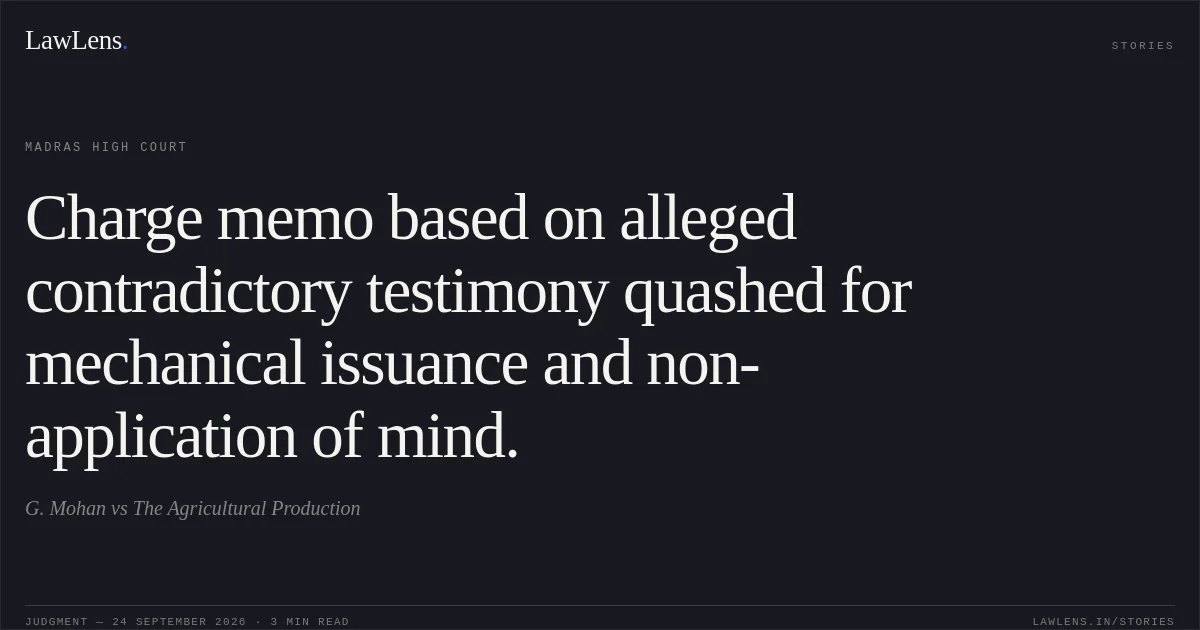
The Court quashed the charge memo dated 16 September 2024, holding that it had been issued mechanically and without proper application of mind.
Source reference: para. 13, p. 10It directed that, if the petitioner’s promotion had been affected by the impugned charge memo, the promotion should be granted to him.
Source reference: para. 13, p. 10No order as to costs was made, and the connected miscellaneous petitions were closed.
Source reference: para. 13, p. 10Original Court PDF
G. MohanvsThe Agricultural Production
Click to open original judgment
Original judgment, available to read, download and summarize on LawLens.in