Facts
The applicant, a retired Principal Commissioner of Income Tax, was served a charge memorandum on 29.06.2018 alleging misconduct during his 2007 tenure as CIT(A) XXIV, Kolkata
Source reference: p.2The charges stated that appellate orders passed by the applicant were strikingly similar to draft orders retrieved from the computers of a private firm, M/s. S.K. Tulsiyan & Co., created prior to the official order dates
Source reference: p.2-3The applicant challenged the memorandum on two primary grounds: a delay of 11 years in initiating proceedings and the lack of approval from the President of India, which he argued was mandatory for a Group-A officer
Source reference: p.3The respondents countered that the matter was under CBI investigation until 2014 and that the charge sheet was approved by the Minister of State (Finance) under validly delegated powers
Source reference: p.3, 6Issues
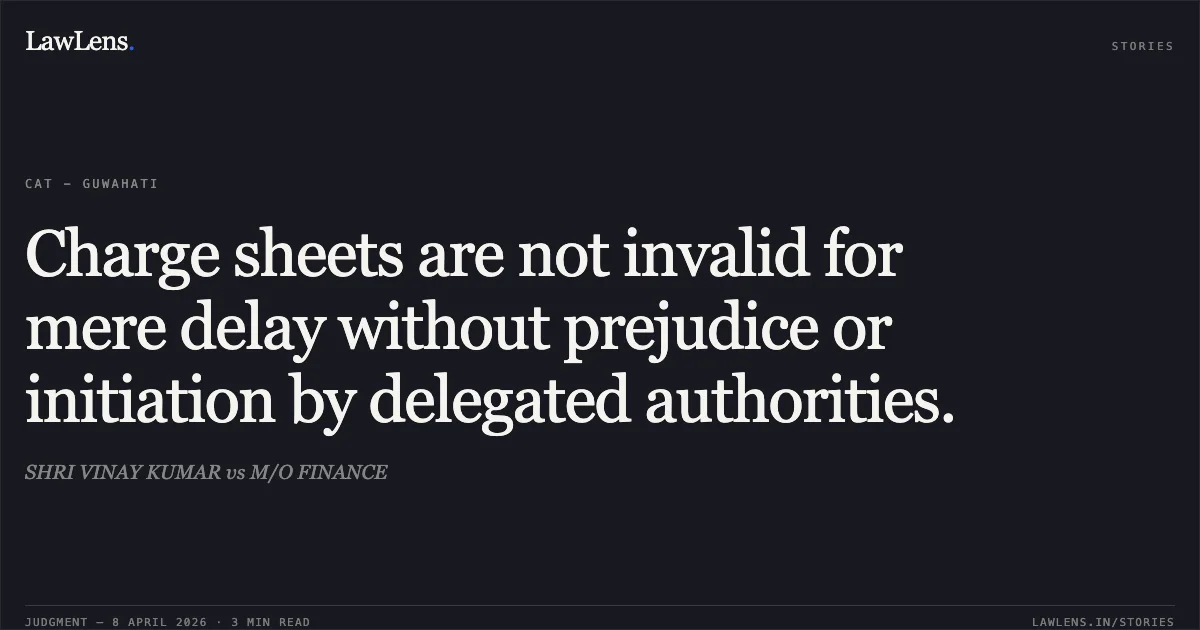
1. Whether a disciplinary proceeding can be quashed solely on the ground of delay in issuing a charge sheet without a showing of prejudice or condonation
Source reference: p.6, para 72. Whether an authority empowered to impose minor penalties (the Minister of State) is competent to initiate disciplinary proceedings for major penalties against a Group-A officer under the CCS (CCA) Rules, 1965
Source reference: p.8, para 9Law Applied
The Tribunal primarily applied Rule 13 of the CCS (CCA) Rules, 1965, which provides that an authority competent to impose minor penalties may institute disciplinary proceedings for major penalties, notwithstanding their inability to impose the latter
Source reference: p.8, para 9.1Regarding delay, the court relied on the principle from Government of A.P. and Ors v. V. Appala Swamy, which holds that delay is a ground for quashing only if it implies condonation of the lapse or causes specific prejudice to the employee
Source reference: p.6-7, para 7It further applied the recent Supreme Court precedents in Union of India & Ors. v. R. Shankarappa (2025) and State of Jharkhand v. Rukma Kesh Mishra (2025), which established that a charge sheet need not be issued by the final appointing authority as long as it is issued by a controlling authority or one empowered under Rule 13
Source reference: p.9-12Reasoning
The Tribunal analyzed the delay and found that while the events occurred in 2007, the CBI investigation continued until 2014, explaining the timeline
Source reference: p.4, 6Applying the Appala Swamy test, the Tribunal noted the applicant failed to demonstrate any specific prejudice or evidence that the employer had condoned the misconduct; thus, the delay was not fatal to the proceedings
Source reference: p.7Regarding the competency of the issuing authority, the Tribunal observed that an office order dated 03.04.2018 delegated the initiation of disciplinary proceedings to the Minister of State (Finance)
Source reference: p.13Since Rule 13(2) of the CCS (CCA) Rules expressly permits an authority competent for minor penalties to initiate major penalty proceedings, and the Minister held such power, the Tribunal concluded that the charge sheet did not require the personal approval of the President of India
Source reference: p.12-13Holding
The Tribunal dismissed the Original Application, holding that the charge sheet was issued by a competent authority and was not vitiated by delay
The court concluded that under Rule 13(2), the Minister of State was legally authorized to initiate the proceedings and that the applicant's reliance on the B.V. Gopinath precedent was misplaced in light of subsequent judicial clarifications regarding statutory rules and delegation
Source reference: p.12-13No order as to costs was issued
Source reference: p.13Original Court PDF
SHRI VINAY KUMARvsM/O FINANCE
Click to open original judgment
Original judgment, available to read, download and summarize on LawLens.in