Facts
Petitioner No. 1, a public charitable trust, operated primary, secondary, junior-college and commerce-college institutions on a common campus in Pimpri.
Source reference: pp. 3–8It claimed exemption from municipal property tax under Section 132(1)(b) of the Maharashtra Municipal Corporations Act, 1949, relying, among other things, on a 1991 “No Tax Due” certificate and asserting that the premises were used solely for education and charitable purposes.
Source reference: pp. 3–8PCMC raised property-tax demands, including arrears, and by an order dated 10 January 2012 rejected the Trust’s objections and its claim to exemption.
Source reference: pp. 5–7The Trust sought to quash that order and subsequent demands; interim protection against coercive action was granted in 2012, and the Petition was amended in 2023 to challenge later demands and an attachment notice.
Source reference: p. 6PCMC opposed the Petition, including on the grounds that exemption was not automatic, had to be established for the relevant period, and an appeal was available under Section 406.
Source reference: pp. 10–11Issues
Whether the Trust’s buildings and lands, used to operate educational institutions, qualified for exemption from general property tax as property “solely occupied and used for a public charitable purpose” under Section 132(1)(b).
Source reference: pp. 12–15Whether the Trust was entitled to a continuing or blanket exemption, or instead had to establish eligibility for each relevant assessment year.
Source reference: pp. 24, 38, 42Law Applied
Section 132(1)(b) of the Maharashtra Municipal Corporations Act, 1949 exempts buildings, lands or portions thereof that are solely occupied and used for public charitable purposes; under Section 132(2), property in which trade or business is carried on, or from which rent is derived, is not treated as so occupied and used.
Source reference: pp. 12–15“Charitable purpose” is informed by Section 9 of the Maharashtra Public Trusts Act, 1950, which includes education.
Source reference: p. 14The exemption is not automatic merely because a trust runs an educational institution: the claimant must establish that the relevant property is solely used for a public charitable purpose, and the claim is assessed on the facts and material for the relevant period.
Source reference: pp. 31–33, 38, 42In Municipal Corporation of Delhi v. Children Book Trust, (1992) 3 SCC 390, the Supreme Court held that education is not charitable per se where carried on with a profit motive; public benefit or philanthropy must be present.
Source reference: pp. 20–32The Bombay High Court treated that decision as distinguishable in its application because of the different statutory and regulatory scheme, while relying on its discussion of the charitable character of education.
Source reference: pp. 20–32The Court also relied on Sindhu Educational Trust v. State of Maharashtra, W.P. No. 2886 of 2013, for the proposition that entitlement under Section 132 depends on the particular facts and use of the property, and that collection of fees alone does not necessarily defeat exemption.
Source reference: pp. 42–45Reasoning
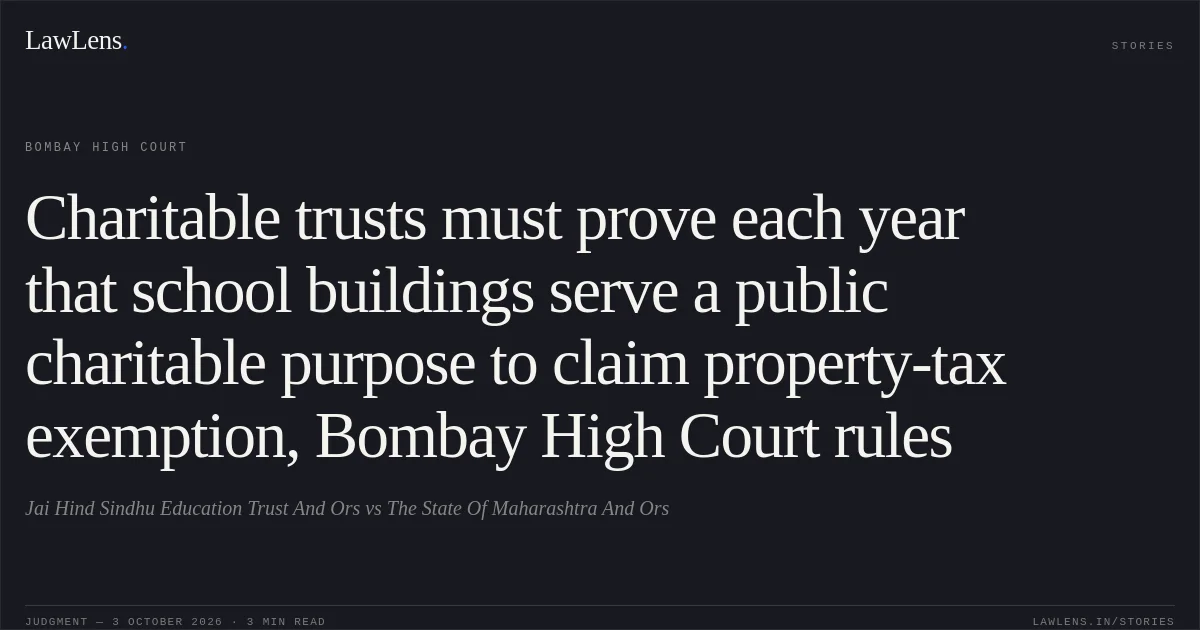
The Court held that operating a school, or being registered as a public trust, did not by itself establish that the campus was used for a public charitable purpose.
Source reference: pp. 38, 42The Trust had to demonstrate, with appropriate material, that the property was solely occupied and used for that purpose; a claim could not be granted permanently or in a blanket manner, but had to be considered for each relevant year.
Source reference: pp. 38, 42Although Children Book Trust arose under a different statutory framework, its reasoning supported the need to distinguish education conducted for public benefit from education conducted with a profit motive.
Source reference: pp. 26–32On the pleadings before it, the Court found that the Trust had not established the required basis for exemption and had not pursued a year-specific claim supported by appropriate material.
Source reference: pp. 45–46It therefore declined to interfere with the impugned demand and order.
Source reference: pp. 45–46Holding
The Court held that the Trust had not established entitlement to exemption under Section 132 for the property-tax demands challenged in the Petition.
It dismissed the Writ Petition, discharged the Rule and vacated the interim order.
Source reference: p. 46The Trust was permitted to apply to PCMC for exemption for future years, supported by appropriate material.
Source reference: p. 46Acts & Sections Cited
9 provisions across 5 statutes referred to in this judgment. Each provision opens on LawLens.
Maharashtra Public Trusts Act.1
Maharashtra Municipal Corporations Act.3
Maharashtra Employees of Private Schools (Conditions of Service) Regulation Act, 1977.1
Delhi Municipal Corporation Act, 19571
Delhi School Education Act, 19733
Original Court PDF
Jai Hind Sindhu Education Trust And OrsvsThe State Of Maharashtra And Ors
Click to open original judgment
Original judgment, available to read, download and summarize on LawLens.in