Facts
The complainant, Surendra Singh, alleged that Petitioner No. 3 offered to arrange a tractor combine through the showroom where he worked.
Source reference: para. 3; pp. 2–3According to the complaint, the petitioners represented that a tractor and combine harvester could be purchased under an available offer, pursuant to which the complainant paid ₹4,04,000 as advance.
Source reference: para. 3; pp. 2–3A tractor was subsequently delivered, but the combine machine was allegedly not supplied.
Source reference: para. 3; pp. 2–3The petitioners asserted that the quotation was for ₹15,00,000 for a Mahindra tractor and combine harvester, but the complainant did not pay the full amount.
Source reference: para. 4; pp. 3–4The ₹4,04,000 received was stated to be a down payment and related charges for financing through Mahindra & Mahindra Financial Services Ltd.
Source reference: para. 4; pp. 3–4After the finance company sanctioned ₹7,20,385, the tractor was delivered under a valid invoice, and ₹3,55,715 was deposited into the complainant’s loan account after adjustment of charges.
Source reference: para. 4; pp. 3–4The complainant had also approached the District Consumer Forum, Siwan, which dismissed his complaint, finding no evidence of an agreement requiring delivery of a combine harvester along with the tractor and noting that the tractor had been delivered under a valid invoice.
Source reference: para. 4; p. 4The ACJM-V, Siwan, took cognizance of offences under Sections 418 and 420 of the Indian Penal Code on 18 August 2017.
Source reference: para. 2; p. 1The petitioners’ criminal revision was dismissed by the Additional District and Sessions Judge-IV, Siwan, on 21 August 2018, leading to the present application under the High Court’s inherent jurisdiction.
Source reference: para. 2; p. 1Issues
Whether the allegations in the complaint and the materials on record disclosed a prima facie offence under Sections 418 and 420 of the IPC against the petitioners
Source reference: paras. 2, 4 and 7; pp. 1–5Whether the dispute was essentially civil or commercial in nature and whether continuation of the criminal proceedings would amount to an abuse of the process of court
Source reference: paras. 4 and 7; pp. 4–5Whether the order taking cognizance dated 18 August 2017 was liable to be quashed for want of initial deception or inducement and for non-application of judicial mind
Source reference: paras. 4 and 7; pp. 2–5Law Applied
The Court considered Sections 418 and 420 of the IPC, which respectively concern cheating involving a person whose interests the offender is legally or contractually bound to protect, and cheating and dishonestly inducing delivery of property.
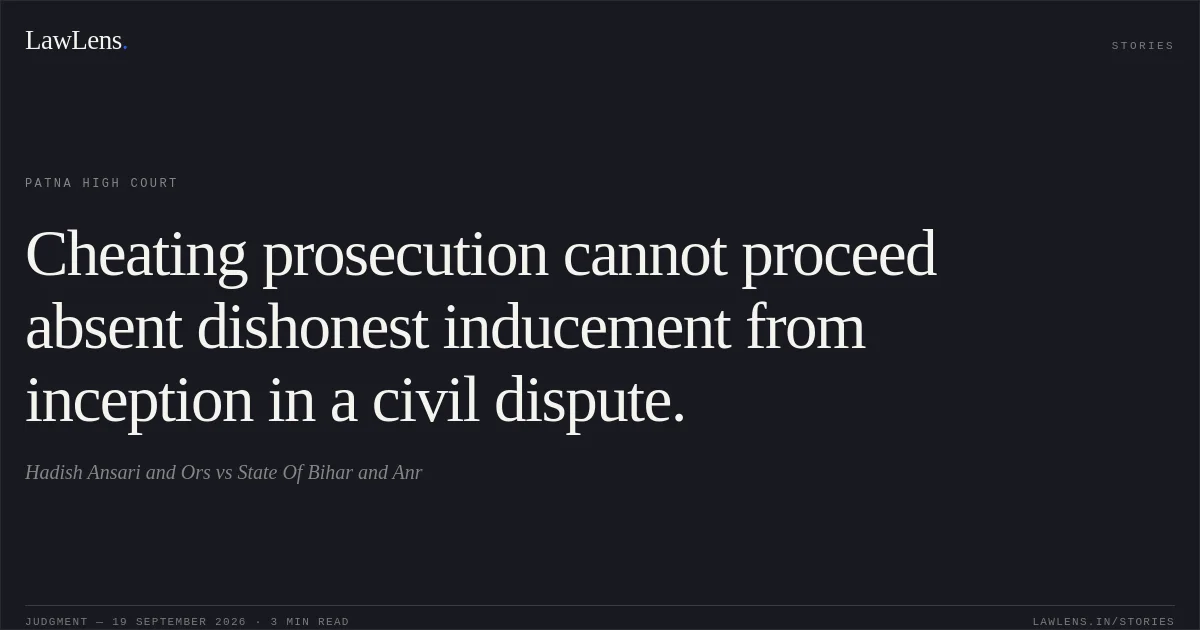
Source reference: paras. 4 and 7; pp. 2–5The Court applied the principle that an offence of cheating requires deception and dishonest or fraudulent inducement from the inception of the transaction; a subsequent failure to perform a contractual or commercial obligation, without initial fraudulent intention, ordinarily does not constitute cheating.
Source reference: paras. 4 and 7; pp. 2–5The Court also relied on Pepsi Foods Ltd. v. Special Judicial Magistrate, (1998) 5 SCC 749, and GHCL Employees Stock Option Trust v. India Infoline Ltd., (2013) 4 SCC 505, for the proposition that the Magistrate must apply judicial mind before issuing process and must determine whether the allegations, taken at face value, disclose a prima facie offence.
Source reference: para. 4; pp. 4–5It further relied on State of Haryana v. Bhajan Lal, 1992 Supp (1) SCC 335, concerning the High Court’s power to prevent abuse of the process of court in appropriate cases.
Source reference: para. 4; pp. 4–5Reasoning
The Court found that the complainant had received the tractor under a proper invoice and that the petitioners had not received payment representing the full consideration for the combine machine.
Source reference: para. 7; p. 5The materials indicated a financing and commercial transaction rather than a dishonest scheme existing from the beginning.
Source reference: para. 7; p. 5The Court further noted the absence of any initial deception or inducement and the Consumer Forum’s finding that there was no evidence of an agreement for delivery of the combine harvester with the tractor.
Source reference: paras. 4 and 7; pp. 4–5Applying the principles governing cheating and the precedents on issuance of process, the Court held that the allegations did not establish the essential ingredients of Sections 418 or 420 IPC.
Source reference: para. 7; p. 5The dispute was therefore civil in nature, and continuation of the criminal prosecution would constitute an abuse of the process of court.
Source reference: para. 7; p. 5Holding
The High Court held that no prima facie case under Sections 418 and 420 IPC was made out because there was no material indicating deception or dishonest inducement from the inception of the transaction.
It consequently quashed the order taking cognizance dated 18 August 2017 passed by the ACJM-V, Siwan, and allowed the criminal miscellaneous application.
Source reference: paras. 7–8; p. 5Acts & Sections Cited
2 provisions across 1 statute referred to in this judgment. Each provision opens on LawLens.
Indian Penal Code, 18602
Original Court PDF
Hadish Ansari and OrsvsState Of Bihar and Anr
Click to open original judgment
Original judgment, available to read, download and summarize on LawLens.in