Facts
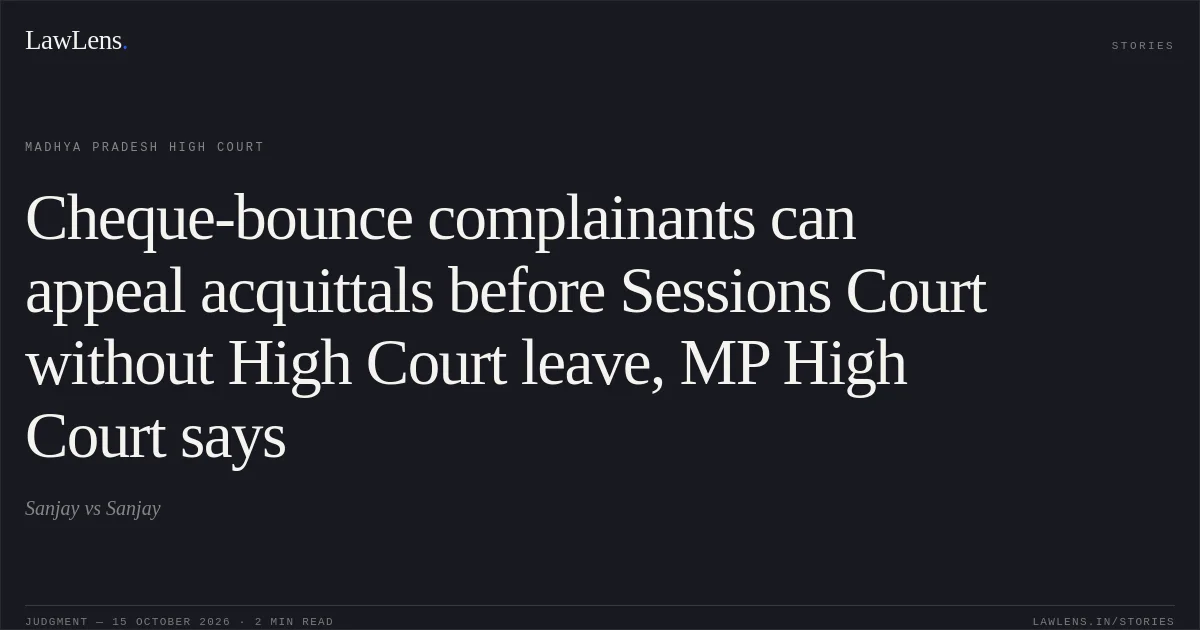
The complainant filed this petition seeking leave to appeal against the respondent’s acquittal under Section 138 of the Negotiable Instruments Act, 1881, by the JMFC, Neemuch, in Criminal Case No. 1598/2013.
Source reference: para. 2Counsel also sought a separate order transferring the proposed appeal to the concerned Sessions Court.
Source reference: para. 3The High Court considered the applicable transfer and victim-appeal provisions, together with the Supreme Court’s decision in M/s. Celestium Financial v. A. Gnanasekaran.
Source reference: paras. 3–5Issues
1. Whether the High Court could invoke Section 447 of the BNSS (corresponding to Section 407 of the CrPC) to transfer the proposed appeal to the Sessions Court.
Source reference: para. 32. Whether a complainant in a Section 138 NI Act case may appeal an acquittal as a victim under the proviso to Section 372 CrPC, corresponding to Section 413 BNSS, without seeking leave under Section 419(4) BNSS.
Source reference: paras. 4–5Law Applied
Section 447 BNSS (corresponding to Section 407 CrPC) empowers the High Court to transfer cases and appeals between subordinate criminal courts or to itself; it does not provide a basis for the requested transfer of this proposed appeal to the Sessions Court.
Source reference: para. 3In M/s. Celestium Financial v. A. Gnanasekaran, 2025 INSC 804, the Supreme Court held that a complainant under Section 138 of the NI Act is a “victim” within Section 2(y) BNSS (corresponding to Section 2(wa) CrPC) and may appeal an acquittal under Section 413 BNSS (corresponding to the proviso to Section 372 CrPC).
Source reference: para. 4Accordingly, such a complainant need not obtain leave under Section 419(4) BNSS.
Source reference: para. 5Reasoning
The Court rejected reliance on Section 447 BNSS as a route to transfer the proposed appeal to the Sessions Court, because that provision concerns transfers between criminal courts or to the High Court, rather than the transfer sought here.
Source reference: para. 3It then applied Celestium Financial to conclude that the complainant could pursue an acquittal appeal as a victim under the applicable appeal provision without first obtaining leave from the High Court.
Source reference: paras. 4–5The Court did not examine the merits of the acquittal.
Source reference: para. 11Holding
The petition was disposed of, with liberty to the petitioner to appeal the acquittal before the concerned Sessions Judge within 60 days of receiving the order.
The Sessions Court was directed not to insist on limitation if the appeal was filed within that period and to decide it in accordance with law.
Source reference: para. 7The Registry was directed to return the certified copy of the impugned judgment after retaining an attested photocopy, and the case record was to be sent back to the JMFC.
Source reference: paras. 8–9The High Court expressly left the merits open.
Source reference: para. 11Acts & Sections Cited
19 provisions across 3 statutes referred to in this judgment. Each provision opens on LawLens.
Negotiable Instruments Act, 18811
Code of Criminal Procedure, 19734
Bharatiya Nagarik Suraksha Sanhita, 2023
Original Court PDF
SanjayvsSanjay
Click to open original judgment
Original judgment, available to read, download and summarize on LawLens.in