Facts
The complainant alleged that the accused issued a cheque for ₹4,75,000 towards repayment of an investment.
Source reference: pp. 3–5, paras 3–6The cheque, dated 31 January 2017, was dishonoured for insufficient funds, and the complainant initiated proceedings under Section 138 of the Negotiable Instruments Act, 1881 (NI Act).
Source reference: pp. 3–5, paras 3–6The Trial Court convicted the accused and imposed a fine, but the First Appellate Court reversed the conviction and acquitted him, holding that the cheque had not been presented within its validity period.
Source reference: pp. 5–6, 9–10, paras 8–9, 17–18The complainant appealed, contending that the cheque had been presented on 27 April 2017, while 18 May 2017—the date relied on by the First Appellate Court—was the date of the bank’s return endorsement.
Source reference: pp. 6–8, 9–10, paras 10, 14–16Issues
Whether the First Appellate Court was justified in setting aside the conviction and acquitting the accused on the ground that the cheque was not presented within its validity period?
Source reference: p. 8, para 13; pp. 9–11, paras 14–19Law Applied
Section 138 of the NI Act requires, among other things, that a cheque be presented within its period of validity and be dishonoured for a qualifying reason.
Source reference: pp. 10–13, paras 18–23Sections 118 and 139 of the NI Act raise presumptions in favour of the holder regarding consideration and the discharge of a legally enforceable debt or liability; the accused may rebut those presumptions.
Source reference: pp. 10–13, paras 18–23No precedent was cited.
Source reference: no citationReasoning
The High Court found that the cheque itself bore an endorsement showing presentation on 27 April 2017, within its validity period.
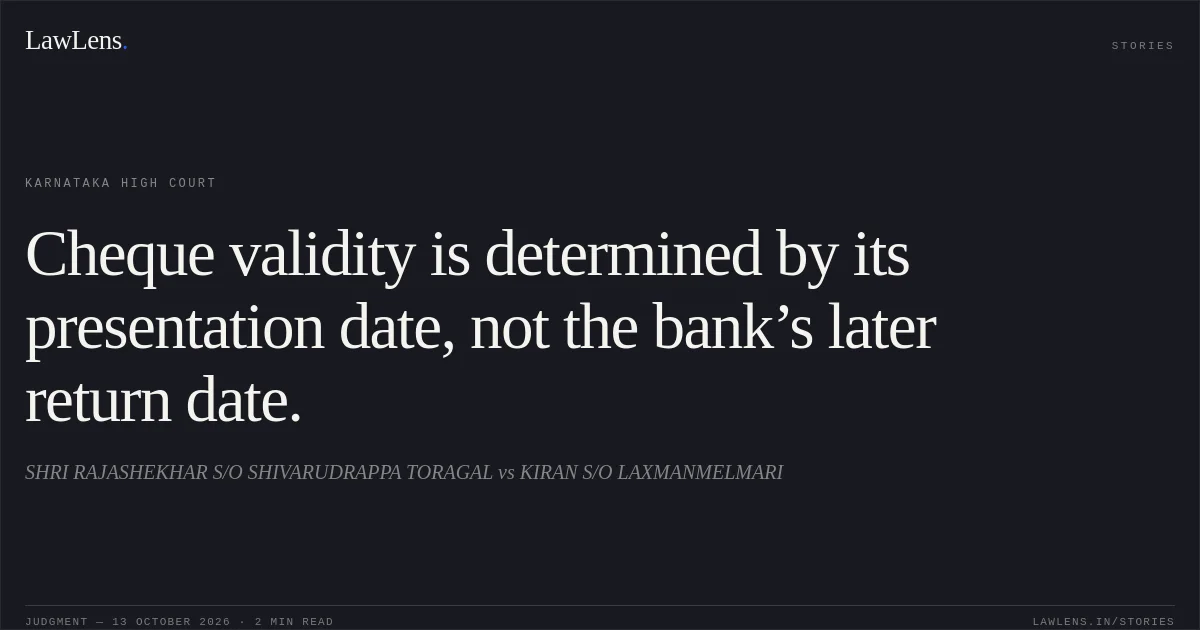
Source reference: pp. 9–11, paras 15–19The bank endorsement dated 18 May 2017 recorded the cheque’s return, not its presentation; the First Appellate Court had treated the return date as the presentation date and therefore erred in finding the presentation untimely.
Source reference: pp. 9–11, 13, paras 15–19, 23The First Appellate Court had otherwise accepted that the complainant proved the ingredients of Section 138.
Source reference: pp. 12–13, paras 18, 22–23The accused did not dispute issuance of the cheque or his signature, and had neither entered the witness box nor elicited evidence in cross-examination sufficient to rebut the statutory presumptions.
Source reference: pp. 12–13, paras 18, 22–23The High Court accordingly held that the acquittal could not stand.
Source reference: pp. 12–13, paras 18, 22–23Holding
The High Court answered the issue against the First Appellate Court and allowed the complainant’s appeal.
It set aside the acquittal dated 24 December 2021 and confirmed the Trial Court’s conviction and sentence dated 3 December 2018.
Source reference: p. 14, para 24Acts & Sections Cited
5 provisions across 3 statutes referred to in this judgment. Each provision opens on LawLens.
Code of Criminal Procedure, 19731
Negotiable Instruments Act, 18813
KARNATAKA STAMP ACT, 19571
Original Court PDF
SHRI RAJASHEKHAR S/O SHIVARUDRAPPA TORAGALvsKIRAN S/O LAXMANMELMARI
Click to open original judgment
Original judgment, available to read, download and summarize on LawLens.in