Facts
The parties married on 18 March 2012 and had a son, Anuraag, born on 16 March 2016. The child lived and studied in Pune until the parties moved to Singapore in July 2022, where he attended Wise Oaks International School. Following matrimonial discord, the appellant-mother returned to India with the child on 11 March 2025, and the child continuously remained in her custody thereafter.
Source reference: pp. 3–4, para 3.1–3.6The respondent-father instituted guardianship proceedings before the Family Court, Pune under Section 7 of the Guardians and Wards Act, 1890 (“GWA”), and sought interim custody and relocation of the child to Singapore under Section 12. The Family Court initially passed an access order on 19 May 2025. On the father’s appeal, the High Court remanded the matter on 13 February 2026 for fresh consideration of interim custody, directing the Family Court to focus on the welfare of the child and the comparative ability of each parent to care for him.
Source reference: p. 4, para 3.7–3.9; pp. 9–10, paras 6–7Meanwhile, the Singapore Family Justice Courts passed an order on 25 July 2025 granting custody to the father. On 16 May 2026, the Family Court, Pune allowed the father’s application under Section 12 and directed restoration of the child’s custody to him. The Family Court relied, inter alia, on allegations of parental alienation, denial of access, the father’s financial and residential circumstances, the Singapore custody order, and the principle of comity of courts.
Source reference: pp. 4–5, para 3.10–3.11; pp. 13–14, para 8.3.2The mother challenged that order before the Bombay High Court, contending that the Family Court had granted effectively final relief at an interlocutory stage without a proper welfare assessment, and had relied on speculative, unproved and gender-stereotyped findings.
Source reference: pp. 6–8, paras 5.2–5.7Issues
Whether the Family Court correctly exercised its jurisdiction under Section 12 of the GWA in directing an immediate change of the child’s interim custody from the mother to the father
Source reference: pp. 11–13, para 8.1–8.2; p. 24, para 9Whether the Family Court independently assessed the child’s physical, emotional, educational and psychological welfare, including the importance of stability and continuity, before ordering transfer of custody
Source reference: pp. 19–21, paras 8.3.9–8.3.11Whether reliance on the Singapore custody order and the principle of comity of courts could override the Indian court’s primary obligation to determine the welfare of the child
Source reference: pp. 22–24, para 8.3.12Whether the Family Court’s findings concerning parental alienation, denial of access, matrimonial conduct and the father’s financial circumstances were supported by legally relevant and reliable material at the interim stage
Source reference: pp. 14–21, paras 8.3.3–8.3.10Law Applied
The Court applied Section 12 of the Guardians and Wards Act, 1890, which empowers the court to order production of a minor and make appropriate arrangements for temporary custody and protection.
Source reference: p. 11, para 8.1The governing consideration in interim custody matters is the welfare and best interests of the child, which is the paramount and decisive criterion, rather than the legal status of either parent or the financial superiority of one parent, relying on Athar Hussain v. Syed Siraj Ahmed, (2010) 2 SCC 654.
Source reference: pp. 12–13, para 8.2The Court distinguished guardianship from custody: although the father may have a prima facie position as natural guardian under Section 19 of the GWA, custody must still be determined by the child’s welfare.
Source reference: p. 12, para 8.2A change in existing custody at the interim stage requires sufficient and compelling reasons, particularly where stability and consistency in the child’s routine are involved.
Source reference: p. 13, para 8.2Relying on Ruchi Majoo v. Sanjeev Majoo, (2011) 6 SCC 479, the Court held that comity of courts and foreign custody orders are relevant but cannot displace the Indian court’s independent and overriding duty, in its parens patriae jurisdiction, to determine the child’s welfare.
Source reference: pp. 22–24, para 8.3.12Reasoning
The High Court held that the Family Court had failed to comply with the remand directions requiring an independent assessment of the child’s welfare. Instead of identifying any imminent danger, neglect or circumstance making continuation of custody with the mother detrimental, the Family Court relied on speculative conclusions regarding parental alienation, unproved WhatsApp communications and alleged denial of access, while simultaneously observing that such matters required a full trial.
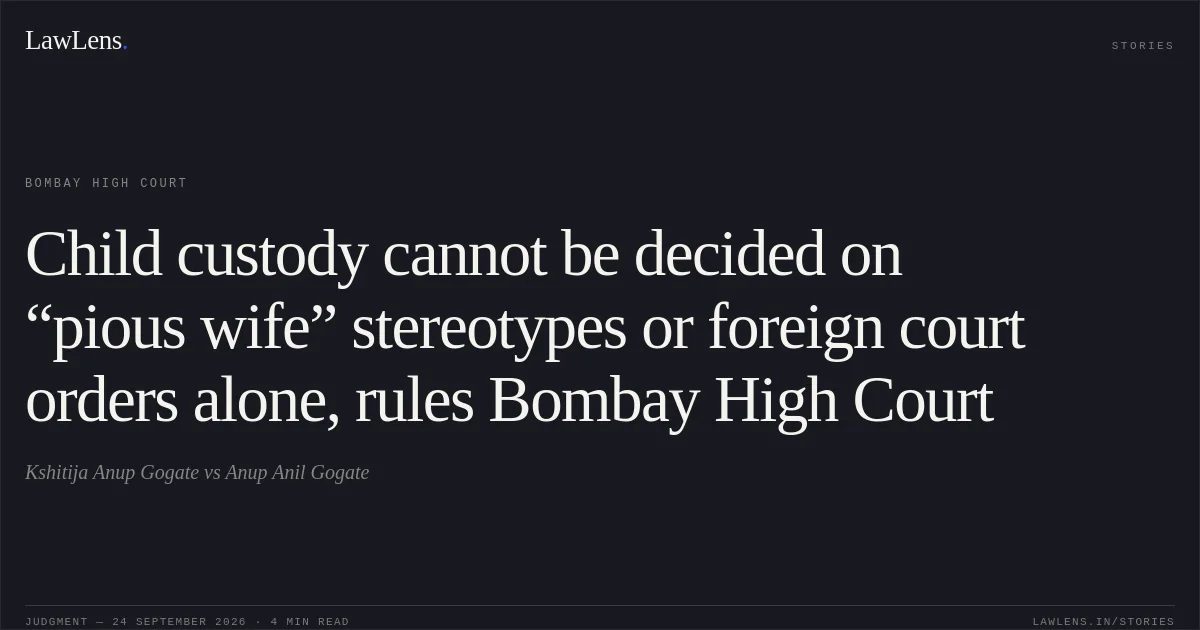
Source reference: pp. 14–16, paras 8.3.4–8.3.8Its reliance on the mother’s matrimonial conduct, including observations about the “pious duties” of a wife and daughter-in-law, was extraneous to the child’s welfare and reflected impermissible stereotypical reasoning.
Source reference: pp. 16–18, paras 8.3.5–8.3.7The Court also found the Family Court’s treatment of the child’s wishes internally contradictory and unsupported by recorded material.
Source reference: pp. 18–20, para 8.3.9Further, although the Family Court stated that financial capacity was not determinative, it relied on the father’s Singapore residence, domestic help, schooling facilities and ability to provide a Cambridge education, thereby effectively treating financial superiority as a material custody factor.
Source reference: pp. 19–20, para 8.3.10Since the child had remained continuously with the mother since March 2025, was settled in Pune and had educational, familial and social continuity there, the Family Court was required to justify why an immediate disruption of that arrangement was necessary. It failed to do so.
Source reference: pp. 20–21, para 8.3.11The Singapore order could not be treated as conclusive because comity remained subordinate to the paramount consideration of the child’s welfare.
Source reference: pp. 22–24, para 8.3.12Holding
The Bombay High Court allowed the appeal and set aside the Family Court’s order dated 16 May 2026 directing transfer of the child’s custody to the father.
Since the child was already in the mother’s custody, she was permitted to retain custody.
Source reference: p. 25, para 11(ii)The mother was directed to provide the father access to the child once every three months and additionally during vacations or holidays by mutual arrangement, keeping the child’s convenience in view. Weekly video-conferencing access was also directed.
Source reference: p. 25, para 11(iii)–(iv)The substantive proceedings before the Family Court were directed to be decided expeditiously, uninfluenced by the High Court’s observations on the merits.
Source reference: p. 25, para 11(v)–(vi)The connected contempt petitions were disposed of as having become infructuous.
Source reference: p. 26Acts & Sections Cited
4 provisions across 1 statute referred to in this judgment. Each provision opens on LawLens.
Guardians and Wards Act, 18904
Original Court PDF
Kshitija Anup GogatevsAnup Anil Gogate
Click to open original judgment
Original judgment, available to read, download and summarize on LawLens.in