Facts
The appellant was convicted by the learned Additional Sessions Judge, Tis Hazari Courts, for offences under Section 376(3) of the IPC and Section 6 of the POCSO Act, receiving a sentence of 20 years rigorous imprisonment
Source reference: p. 2On July 16, 2023, the 11-year-old victim, traveling alone by train to Bengal, met the 33-year-old appellant
Source reference: p. 2, 16The victim alleged that the appellant took her to the train’s lavatory and committed sexual assault
Source reference: p. 2-3They were apprehended by RPF staff at Old Delhi Railway Station, leading to a Zero FIR and subsequent medical examination, where the victim refused an internal examination
Source reference: p. 2-3In statements under Sections 161 and 164 of the CrPC, and during trial, the victim maintained that the appellant inserted his penis into her genitalia
Source reference: p. 3-4, 15The appellant, in his Section 313 CrPC statement, admitted to meeting and kissing the victim but denied any penetrative acts, claiming false implication
Source reference: p. 4-5Issues
1. Whether the trial court erred in convicting the appellant based on a child witness's testimony that was elicited through leading questions
Source reference: p. 142. Whether the absence of DNA evidence and the victim's refusal to undergo an internal medical examination create a reasonable doubt favoring acquittal
Source reference: p. 6-7, 163. Whether the prosecution successfully established the victim's age and the commission of aggravated penetrative sexual assault
Source reference: p. 9, 17Law Applied
The court primarily applied Section 376(3) of the IPC and Section 6 of the POCSO Act regarding aggravated penetrative sexual assault on a child under 12 years
Source reference: p. 2It relied on Section 118 of the Indian Evidence Act for the competency of child witnesses and Section 142 regarding the court's discretion to permit leading questions
Source reference: p. 10, 14-15The court followed the principles in State of M.P. v. Balveer Singh (2025), which dictates that a child’s testimony can be the sole basis for conviction if it is consistent and free from tutoring
Source reference: p. 10-13Furthermore, it applied Sections 29 and 30 of the POCSO Act, which mandate a legal presumption of guilt once foundational facts of the offence are established by the prosecution
Source reference: p. 6, 17Reasoning
The Court first confirmed the victim's age as approximately 11 years and 9 months based on school records produced by the Principal (PW-3), satisfying the threshold for Section 6 of the POCSO Act
Source reference: p. 9-10Regarding the testimony, the Court held that while leading questions were used, they were clarificatory and permitted by the trial court under Section 142 of the Evidence Act; since the victim’s account was consistent across her Section 161 and 164 statements and trial deposition, the evidentiary value remained intact
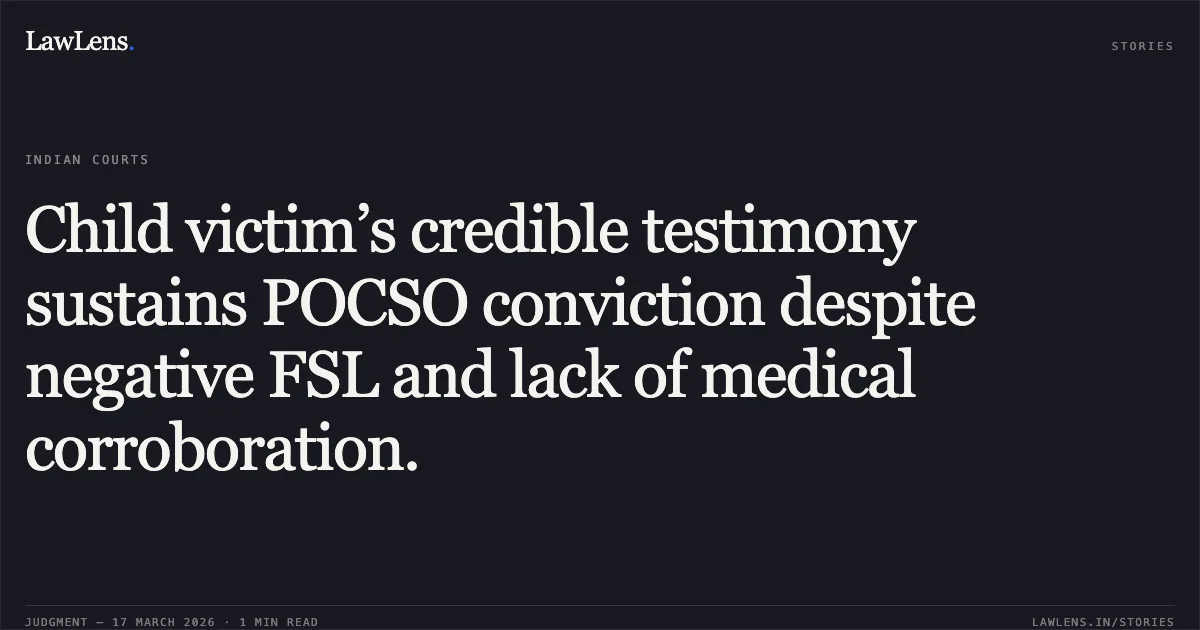
Source reference: p. 15-16The Court dismissed the appellant’s argument regarding the lack of DNA, noting that the victim's testimony described slight penetration without ejaculation, rendering the negative FSL result for semen immaterial
Source reference: p. 5-6, 16The Court emphasized the significant age gap (33 vs. 11) and the appellant’s own admission of physical interaction (kissing) as factors that negated any motive for false implication
Source reference: p. 16-17Consequently, the appellant failed to rebut the statutory presumptions under Sections 29 and 30 of the POCSO Act
Source reference: p. 17Holding
The High Court upheld the conviction and the 20-year sentence, finding no merit in the appeal
The Court held that the sole testimony of a child victim, if credible and consistent, is sufficient for conviction regardless of the absence of corroborative scientific evidence
Source reference: p. 13, 17The appeal was dismissed, and the trial court's order on sentence was affirmed
Source reference: p. 18Acts & Sections Cited
10 provisions across 3 statutes referred to in this judgment. Each provision opens on LawLens.
Indian Penal Code, 18601
Code of Criminal Procedure, 19734
Protection of Children from Sexual Offences Act, 20125
Original Court PDF
PraveenvsThe State Of Nct Of Delhi
Click to open original judgment
Original judgment, available to read, download and summarize on LawLens.in