Facts
The parties married on 18 June 2007 and had no children.
Source reference: paras. 3–20, 21–28The husband sought divorce under Section 13(1)(ia) of the Hindu Marriage Act, 1955, alleging, among other things, humiliation, suspicion, refusal of matrimonial companionship, desertion and an assault on 4 June 2016.
Source reference: paras. 3–20, 21–28The wife denied the allegations, attributed some disagreements to the husband’s drinking, and stated that she had undergone treatment for a uterine fibroid in the hope of conceiving.
Source reference: paras. 3–20, 21–28The Family Court dismissed the husband’s petition, finding the alleged cruelty insufficiently proved. He appealed to the Madras High Court.
Source reference: paras. 3–20, 21–28Issues
Whether the husband established that the wife had treated him with cruelty within the meaning of Section 13(1)(ia) of the Hindu Marriage Act, 1955.
Source reference: para. 34Whether the Family Court’s dismissal of the divorce petition warranted appellate interference.
Source reference: paras. 34, 38, 70Law Applied
Section 13(1)(ia) of the Hindu Marriage Act, 1955 permits divorce on the ground of cruelty.
Source reference: paras. 35–36The spouse alleging cruelty bears the burden of establishing it by acceptable evidence; cruelty must be assessed in light of the entire matrimonial relationship, but the underlying facts must first be proved.
Source reference: paras. 35–36Applying Samar Ghosh v. Jaya Ghosh, (2007) 4 SCC 511, the Court reiterated that there is no straitjacket formula for determining mental cruelty and that the cumulative effect of conduct is relevant, provided its factual foundation is established.
Source reference: para. 36Irretrievable breakdown of marriage, by itself, is not a statutory ground for divorce under Section 13(1)(ia).
Source reference: para. 66Reasoning
The Court found no basis to disturb the Family Court’s assessment that the alleged humiliation, assault, removal of the thali, and other acts had not been satisfactorily proved; the absence of corroboration, including the husband’s father not testifying to the alleged “impotent” insult, supported that conclusion.
Source reference: paras. 37–39, 63–64The wife’s visits to Dindigul and questions about the husband’s late return did not, on the evidence, establish cruelty.
Source reference: paras. 40–41The parties’ childlessness and the wife’s medical treatment did not establish that she had wilfully refused matrimonial life; the Court viewed her treatment and stated willingness to reunite as inconsistent with an intention to abandon the marriage.
Source reference: paras. 43–53, 54–61Separation alone could not supply the statutory ground of cruelty, and the Family Court’s findings disclosed no perversity or illegality warranting appellate intervention.
Source reference: paras. 57–60, 66, 69–70Holding
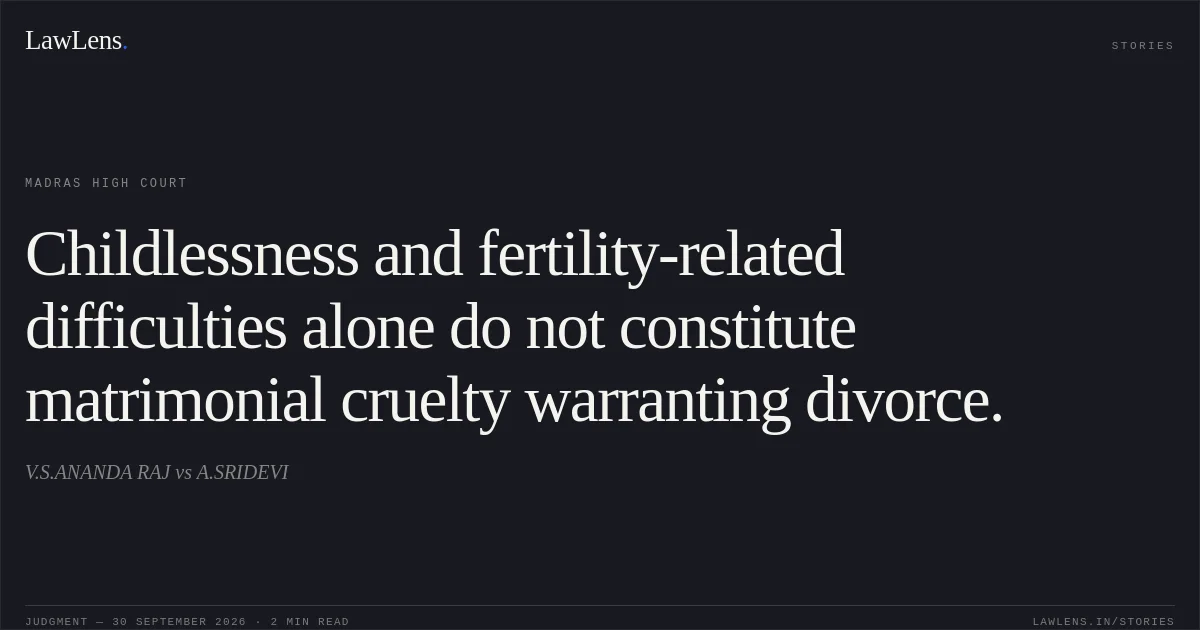
The Court held that the husband failed to prove cruelty under Section 13(1)(ia) and that the Family Court had correctly dismissed his divorce petition.
The appeal was dismissed, the Family Court’s judgment and decree were confirmed, and there was no order as to costs.
Source reference: para. 77Acts & Sections Cited
2 provisions across 2 statutes referred to in this judgment. Each provision opens on LawLens.
Family Courts Act, 19841
Hindu Marriage Act, 19551
Original Court PDF
V.S.ANANDA RAJvsA.SRIDEVI
Click to open original judgment
Original judgment, available to read, download and summarize on LawLens.in