Facts
The Appellant, originally belonging to the Hindu-Madiga community (a Scheduled Caste), had been practicing as a Christian Pastor for approximately ten years
Source reference: para 3, 41He alleged that in January 2021, the Respondents (belonging to the Reddy community) physically assaulted him, used caste-based slurs, and threatened his family due to his religious activities
Source reference: para 5-6An FIR was registered under Sections 3(1)(r), 3(1)(s), and 3(2)(va) of the SC/ST (Prevention of Atrocities) Act and Sections 341, 506, 323, and 34 of the IPC
Source reference: para 7The High Court of Andhra Pradesh quashed the proceedings, reasoning that the Appellant’s profession of Christianity disqualified him from claiming Scheduled Caste (SC) status
Source reference: para 11Issues
1. Whether a person born into a Scheduled Caste but professing Christianity can claim protection and benefits under the SC/ST (Prevention of Atrocities) Act, 1989
Source reference: para 252. Whether the High Court was justified in quashing the criminal proceedings for offences under the IPC alongside the SC/ST Act
Source reference: para 60, 63Law Applied
The Court primarily applied Article 341 of the Constitution and Clause 3 of the Constitution (Scheduled Castes) Order, 1950, which mandates that no person professing a religion other than Hindu, Sikh, or Buddhist shall be deemed a member of a Scheduled Caste
Source reference: para 34It relied on Punjabrao v. D.P. Meshram, which defined "profess" as a public declaration or outward manifestation of faith
Source reference: para 37The Court also applied the three-fold test for reconversion from K.P. Manu v. Scrutiny Committee, requiring proof of origin, bona fide reconversion, and community acceptance
Source reference: para 58For quashing of IPC offences, it applied the principles from State of Haryana v. Bhajan Lal, which allow quashing where allegations, even if accepted, do not prima facie constitute an offence
Source reference: para 62Reasoning
The Court determined that the Appellant, by serving as a Pastor and conducting Sunday prayers for a decade, publicly "professed" Christianity
Source reference: para 41-42Under Clause 3 of the 1950 Order, this profession resulted in the immediate loss of SC status, as Christianity is not one of the religions specified in the Order
Source reference: para 44, 56The Court rejected the Appellant’s reliance on State Government Order (G.O. Ms. No. 341), clarifying that executive orders can only grant non-statutory concessions and cannot override Presidential Orders or extend statutory SC status to converts
Source reference: para 47, 50The Court further distinguished Scheduled Tribes (ST) from SCs, noting that the Constitution (Scheduled Tribes) Order, 1950 does not contain a religion-based bar, whereas the SC Order does
Source reference: para 55(g)Regarding the IPC counts (Sections 341, 506, 323), the Court noted that the testimony of witnesses was inconsistent, the medical evidence showed only simple injuries, and no independent witness corroborated the specific overt acts attributed to the Respondents
Source reference: para 65-66Holding
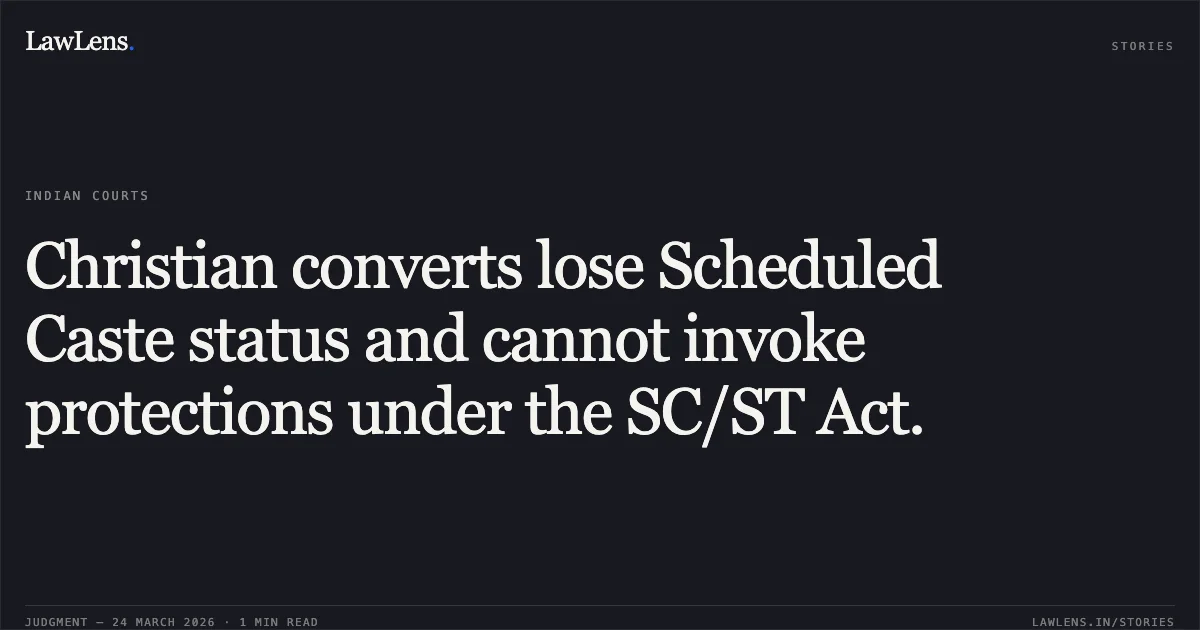
It held that the Appellant ceased to be a member of a Scheduled Caste upon converting to Christianity and, absent proof of reconversion and community acceptance, could not invoke the SC/ST Act
The IPC charges were quashed because the investigation material failed to provide a basic foundation for the alleged offences, rendering the continuation of the trial an abuse of the process of law
Source reference: para 67, 69The Supreme Court dismissed the appeal and upheld the High Court’s decision to quash the proceedings
Source reference: para 70Acts & Sections Cited
6 provisions across 3 statutes referred to in this judgment. Each provision opens on LawLens.
Indian Penal Code, 18604
Code of Criminal Procedure, 19731
Scheduled Castes and the Scheduled Tribes (Prevention of Atrocities) Act, 19891
Original Court PDF
Chinthada AnandvsState Of Andhra Pradesh
Click to open original judgment
Original judgment, available to read, download and summarize on LawLens.in


![Authorities must decide pensionary and retiral-benefit claims through a reasoned order within eight weeks.. Habibullah khan vs HOME DEPARTMENT. CAT - ['Srinagar']. LawLens](/stories/thumbnails/authorities-must-decide-pensionary-and-retiral-benefit-claims-through-a-reasoned-order-wit-d0cbe8a8119c48fbabe7df9f2d353488.webp)