Facts
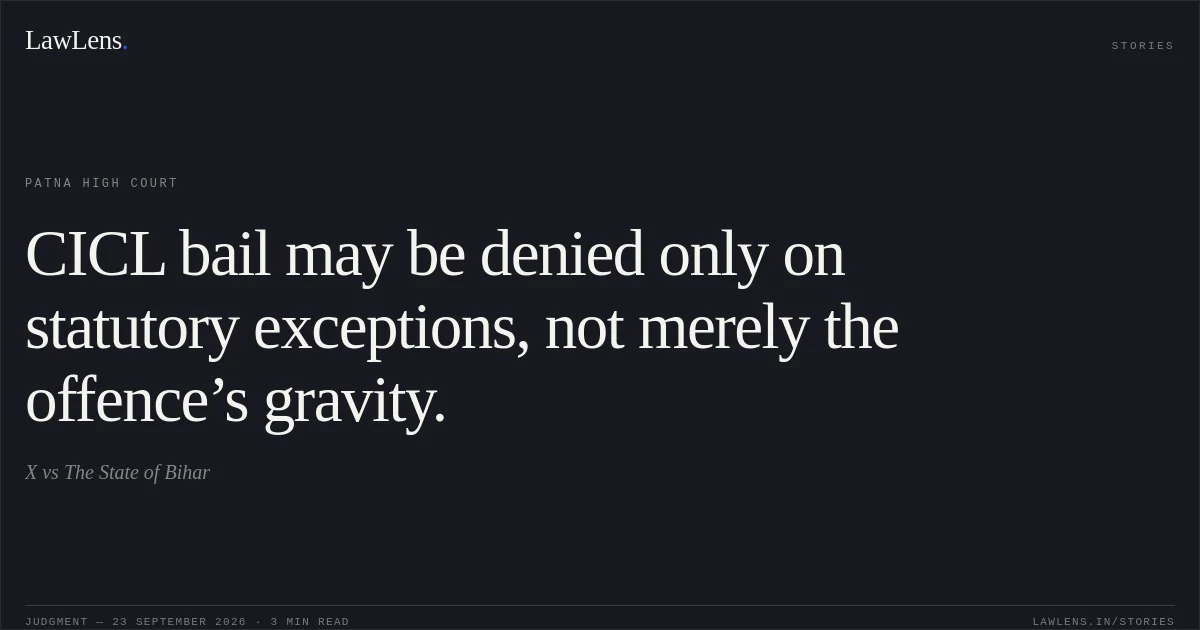
The petitioners, two brothers, were named in Muffasil P.S. Case No. 79 of 2025 for offences under Sections 191(2), 191(3), 190, 103(1) and 109 of the Bharatiya Nyaya Sanhita, 2023, and Section 27 of the Arms Act.
Source reference: p. 2, para. 3The prosecution alleged that the accused persons assembled at the house of the petitioners’ father and indiscriminately fired at the informant and his family members, resulting in the death of the informant’s son and firearm injury to another villager.
Source reference: p. 2, para. 3The petitioners were taken into custody on 16 March 2025 and subsequently declared Children in Conflict with Law after the Juvenile Justice Board determined their ages as 15 years 5 months 8 days and 14 years 7 months 3 days, respectively, on the date of the alleged offence.
Source reference: p. 2, paras. 4–5Their applications for bail were rejected by the Juvenile Justice Board on 15 July 2025 and by the appellate court on 27 August 2025.
Source reference: pp. 2–3, paras. 5–7They thereafter filed the present criminal revision, contending that the allegation of firing was general and that none of the statutory grounds for denying bail to a child under Section 12 of the Juvenile Justice (Care and Protection of Children) Act, 2015 was established.
Source reference: pp. 3–5, para. 8The State and informant opposed bail on the grounds of the seriousness of the accusation and the possibility of repetition of the offence.
Source reference: p. 5, para. 9Issues
Whether the petitioners, having been declared Children in Conflict with Law, could be denied bail under Section 12 of the Juvenile Justice (Care and Protection of Children) Act, 2015 in the absence of material showing that their release would expose them to criminal association, moral, physical or psychological danger, or defeat the ends of justice?
Source reference: pp. 6–7, paras. 11–13Whether the seriousness of the alleged offence and the general allegation of firing, without a specific attribution of injury to the petitioners, justified refusal of bail?
Source reference: p. 8, para. 14Law Applied
The Court primarily applied Section 12 of the Juvenile Justice (Care and Protection of Children) Act, 2015, under which a child alleged to be in conflict with law is ordinarily entitled to bail, unless release is likely to bring the child into association with known criminals, expose the child to moral, physical or psychological danger, or defeat the ends of justice.
Source reference: p. 6, para. 11The Court also relied on the child-friendly and rehabilitative scheme of the Act, particularly Section 3(iv) concerning the best-interest principle, Section 3(xii) treating institutionalisation as a measure of last resort, and Section 3(xiii) recognising the child’s right to family restoration and repatriation where consistent with the child’s best interests.
Source reference: pp. 6–7, paras. 12–13The governing principle was that seriousness or gravity of the alleged offence, by itself, cannot override the statutory presumption in favour of bail when none of the specific exceptions under Section 12 is established.
Source reference: p. 8, para. 14Reasoning
The Court found that although the petitioners were named in the FIR and allegations of firing were made against them, the allegations were not specific and did not attribute either of the firearm injuries to either petitioner.
Source reference: p. 8, para. 14More importantly, the orders of the courts below did not identify any cogent material demonstrating that release would expose the petitioners to known criminals, moral, physical or psychological danger, or otherwise defeat the ends of justice.
Source reference: p. 8, para. 14Applying the best-interest, rehabilitation and institutionalisation-as-last-resort principles under Section 3 of the Act, the Court held that continued institutional custody was not justified merely because the accusation involved a serious offence.
Source reference: p. 8, para. 14The Court also considered the petitioners’ status as juveniles, their family support, and the absence of material establishing any statutory ground for denial of bail.
Source reference: pp. 4–5, para. 8; p. 8, para. 14Holding
The Court allowed the criminal revision and set aside the appellate order dated 27 August 2025 and the Juvenile Justice Board’s order dated 15 July 2025 rejecting bail.
The petitioners were directed to be released on bail upon furnishing a bond of ₹10,000 each with two sureties of the like amount to the satisfaction of the Juvenile Justice Board, Munger.
Source reference: p. 9, para. 16One surety was required to be a parent and the other a relative without criminal antecedents, each undertaking to ensure the petitioners’ care and upkeep.
Source reference: p. 9, para. 16The petitioners were also directed to remain present before the Board on every date fixed in the case.
Source reference: p. 9, para. 16Acts & Sections Cited
7 provisions across 3 statutes referred to in this judgment. Each provision opens on LawLens.
Bharatiya Nyaya Sanhita, 20234
Arms Act, 19591
Juvenile Justice (Care and Protection of Children) Act, 2015.2
Original Court PDF
XvsThe State of Bihar
Click to open original judgment
Original judgment, available to read, download and summarize on LawLens.in