Facts
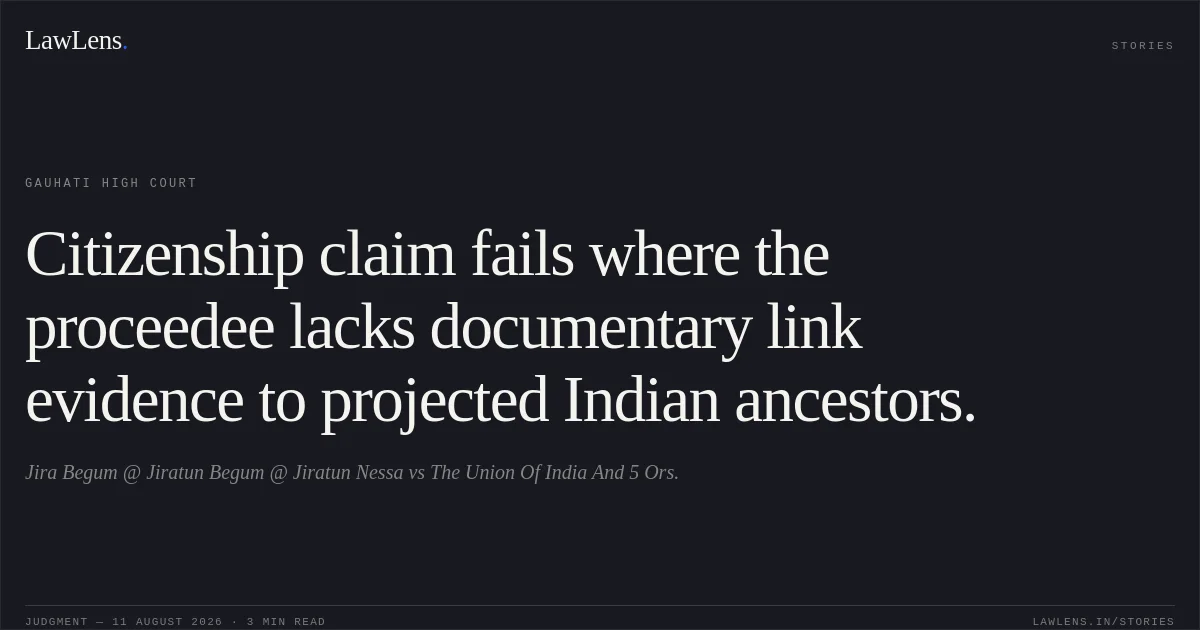
The petitioner challenged the judgment and opinion dated 4 October 2019 of the Foreigners Tribunal No. 5, Kamrup, Amingaon, in RFT Case No. 262R/2016, which declared her a foreigner belonging to the post-1971 stream under a reference made by the Superintendent of Police (B), Kamrup.
Source reference: para. 2–4She claimed Indian citizenship by birth, asserting that she was born in 1954 at Village No. 3 Hachang, that her father was Mohammad Ali, and that her grandfather was Tarap Ali.
Source reference: para. 5–7She relied on annual Khiraj Pattas of 1932–33 and 1933–34, a 1970 voters list showing Mohammad Ali as the son of Tarap Ali, subsequent electoral rolls, voter identity documents, a PAN card, and a Gaonburah’s residency certificate.
Source reference: para. 5–7She also examined herself, a projected brother, her son, and the Gaonburah in support of her claim.
Source reference: para. 4, 8–10The Tribunal rejected her evidence, principally for want of reliable linkage between the petitioner and her projected father and grandfather.
Source reference: no citationIssues
Whether the petitioner discharged the burden under Section 9 of the Foreigners Act, 1946, by establishing a credible documentary and evidentiary link with her projected father, Mohammad Ali, and grandfather, Tarap Ali.
Source reference: para. 16–20Whether the evidence relied upon by the petitioner—including the electoral records, voter identity card, PAN card, oral testimony, and Gaonburah certificate—was sufficient to establish her Indian citizenship and to warrant interference under Article 226 of the Constitution.
Source reference: para. 16–23Whether the Foreigners Tribunal’s opinion declaring the petitioner a foreigner of the post-1971 stream was legally unsustainable.
Source reference: para. 2, 23–24Law Applied
The Court applied Article 226 of the Constitution in reviewing the Foreigners Tribunal’s opinion and Section 9 of the Foreigners Act, 1946, under which the burden lies on the person proceeded against to establish that she is not a foreigner.
Source reference: para. 16It held, following Nur Begum v. Union of India, 2020 (3) GLT 347, that mere oral testimony is insufficient and that reliable linkage evidence, particularly documentary evidence, is necessary.
Source reference: para. 16It further relied on Md. Babul Islam v. State of Assam, WP(C) No. 3547/2016, 2018:GAU-AS:7084-DB, and Jabeda Begum v. Union of India, 2020 SCC OnLine Gau 4895 : (2021) 1 Gau LR 5, for the principle that voter identity cards and PAN cards are not standalone proof of citizenship.
Source reference: para. 18Relying on Khudeja Khatun v. Union of India, 2018 (3) GLT 347, the Court treated the Gaonburah certificate bearing the Ashoka emblem as suffering from an evidentiary/admissibility infirmity.
Source reference: para. 19Reasoning
The Court held that the Khiraj Pattas established, at most, the presence of Tarap Ali in Assam during 1932–34, but did not link him to the petitioner.
Source reference: para. 16Although the 1970 voters list indicated the presence of Mohammad Ali, son of Tarap Ali, it did not establish the petitioner’s relationship with either person.
Source reference: para. 17Her own electoral entries from 1997, 2005, and 2011 recorded her as “Jira Begum,” wife of Sayed Ali, rather than as the daughter of Mohammad Ali.
Source reference: para. 17The testimony of the projected brother was found unreliable because the petitioner’s written statement did not mention any sibling and because his statement that she married approximately 20 years earlier materially conflicted with her claim that she married in 1968.
Source reference: para. 14–15The son’s evidence merely repeated the name of his maternal grandfather and did not constitute sufficient linkage evidence.
Source reference: para. 21The Gaonburah lacked contemporaneous personal knowledge or documentary records supporting the petitioner’s birth and parentage; his testimony also contained internal inconsistencies regarding her alleged birth in the village and her father’s migration.
Source reference: para. 10, 19Consequently, the Court found no credible link between the petitioner and the projected father or grandfather and held that the burden under Section 9 had not been discharged.
Source reference: para. 20–22Holding
The Court answered the issues against the petitioner and upheld the Foreigners Tribunal’s judgment and opinion dated 4 October 2019 declaring her a foreigner of the post-1971 stream.
The writ petition was dismissed and disposed of, the interim order dated 11 May 2020 was vacated, and consequential steps were directed to follow in accordance with law.
Source reference: para. 23–25The original case records were ordered to be returned to the Tribunal.
Source reference: para. 23–25Acts & Sections Cited
1 provisions across 1 statute referred to in this judgment. Linked provisions open on LawLens.
Foreigners Act, 19461
Original Court PDF
Jira Begum @ Jiratun Begum @ Jiratun NessavsThe Union Of India And 5 Ors.
Click to open original judgment
Original judgment, available to read, download and summarize on LawLens.in