Facts
The plaintiffs instituted a partition suit concerning properties situated in Delhi and Ghaziabad and sought interim relief against the defendants.
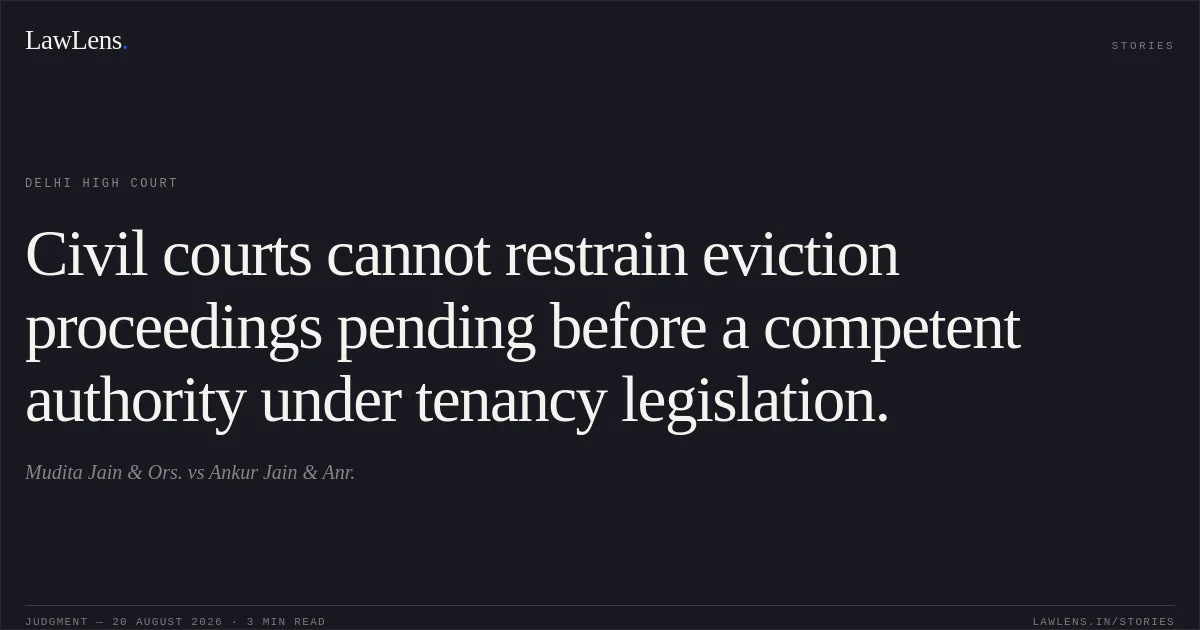
Source reference: p.1, paras. 1–3By order dated 20 May 2026, the Court had restrained the defendants from proceeding with eviction proceedings in Case No. D202611280000655, Nonika Jain & Anr. v. Mudita Jain & Anr., pending before the Rent Authority/Additional District Magistrate (City), Ghaziabad, under the Uttar Pradesh Regulation of Urban Premises Tenancy Act, 2021 (“Tenancy Act”).
Source reference: p.1, paras. 1–3The defendants sought early hearing and vacation of that restraint, contending that the eviction proceedings were before a competent statutory authority and could not be interfered with in the partition suit.
Source reference: p.2, paras. 4–5The plaintiffs relied upon Sections 16, 17 and 20 of the Code of Civil Procedure, 1908 (“CPC”), and two decisions of the Coordinate Bench, to contend that the Court could grant ancillary protective orders concerning the suit properties.
Source reference: p.2, para. 6In the interim-injunction application, the defendants undertook not to sell or create third-party rights in property bearing No. 82, Old Anarkali, Krishna Nagar, Delhi; they were also directed not to dispose of or sell two Ghaziabad properties pending further hearing.
Source reference: p.5, para. 17Issues
Whether the Court, in a partition suit, could restrain or otherwise interfere with eviction proceedings pending before the Additional District Magistrate (City), Ghaziabad, under the Tenancy Act.
Source reference: pp. 2–4, paras. 4–14Whether the Court could exercise jurisdiction under Sections 16, 17 and 20 CPC to grant interim protective orders concerning alienation or disposal of the properties forming the subject matter of the suit.
Source reference: pp. 2–5, paras. 6–9, 13 and 16–17Law Applied
The Court applied Sections 16, 17 and 20 CPC, recognising that a civil court may exercise jurisdiction concerning immovable properties and may grant ancillary interim orders, including restraints against alienation, in respect of properties forming the subject matter of the suit.
Source reference: p.3, paras. 8–9However, proceedings pending before a competent statutory authority under the Tenancy Act could not be interdicted by the civil court; interference lay only before the authorities appellate to that authority or the High Court exercising jurisdiction under Article 227 of the Constitution within whose territorial jurisdiction the authority was situated.
Source reference: p.3, para. 10The Court also considered the principles reflected in Sh. Ashok Rekhi v. Smt. Chanda Bhasin & Ors., CS(OS) 2192/2006, decided on 6 April 2015, and Ms. Ritu Sharma & Anr. v. Mr. Sandeep Sharma & Ors., CS(OS) 1226/1999, decided on 30 August 2011, regarding protective orders over suit properties.
Source reference: p.2, para. 6; p.3, para. 7The Court distinguished permissible protection of the suit property from an anti-suit injunction, particularly where no such relief was sought in the plaint.
Source reference: p.4, para. 12Reasoning
The Court accepted that Sections 16, 17 and 20 CPC empowered it to pass interim orders relating to the properties involved in the partition suit, including orders preventing alienation or creation of third-party rights.
Source reference: p.3, paras. 8–9That jurisdiction, however, did not extend to restraining eviction proceedings pending before the Additional District Magistrate under the Tenancy Act.
Source reference: pp. 3–4, paras. 10–12Although the plaintiffs characterised the earlier order as merely restraining the defendants rather than staying the statutory proceedings themselves, the Court held that its practical effect was to interfere with and interdict proceedings before a competent authority.
Source reference: pp. 3–4, paras. 10–12The suit was a partition action, not an anti-suit injunction proceeding, and neither the reliefs claimed nor the pleadings sought restraint against dispossession.
Source reference: p.4, para. 12Accordingly, the Court preserved its jurisdiction over the subject properties while declining jurisdiction to control the independent statutory eviction proceedings.
Source reference: p.4, para. 13Holding
The Court held that it could not interfere with or restrain the eviction proceedings pending before the Additional District Magistrate (City), Ghaziabad, under the Tenancy Act.
The restraint imposed by paragraph 6 of the order dated 20 May 2026 was therefore vacated to that limited extent, and the early-hearing application was disposed of.
Source reference: p.4, paras. 14–15Separately, in the interim-injunction application, the Court recorded the defendants’ statement that they would not sell or create third-party rights in property No. 82, Old Anarkali, Krishna Nagar, Delhi, and directed them not to dispose of or sell the two specified Nilaya Greens properties in Ghaziabad until the matter was next taken up.
Source reference: p.5, para. 17The matters were listed for 7 December 2026.
Source reference: p.5, para. 18Acts & Sections Cited
4 provisions across 1 statute referred to in this judgment. Each provision opens on LawLens.
Code of Civil Procedure, 19084
Original Court PDF
Mudita Jain & Ors.vsAnkur Jain & Anr.
Click to open original judgment
Original judgment, available to read, download and summarize on LawLens.in