Facts
The dispute concerns Plot No. 2280 in the Hill Drive Area, Bhavnagar.
Source reference: para. 3.0The Executive Magistrate, Bhavnagar, in Criminal Case No. 1/2004, initially passed an order under the Code of Criminal Procedure (CrPC) restricting Respondent No. 1 from trespassing, effectively recognizing the applicants' possession
Source reference: para. 3.0Respondent No. 1 challenged this before the Sessions Court, alleging that the applicants held possession through forged documents and that the property was subject to a cancelled sale transaction and sub judice matters
Source reference: para. 4.0The 2nd Additional Sessions Judge, Bhavnagar, in Criminal Revision Application No. 15/2005, set aside the Magistrate’s order and directed the Collector to appoint an independent Executive Magistrate to determine who held possession on the date of the original complaint while maintaining status quo
Source reference: para. 4.0The applicants moved the High Court to quash the Sessions Court’s order
Source reference: para. 1.0Issues
1. Whether the Executive Magistrate has the jurisdiction to determine questions of title or possessory title under Section 145 of the CrPC when the dispute is primarily civil in nature?
Source reference: para. 5.02. Whether the proceedings under Section 145 of the CrPC should continue when the inter se rights regarding title and possession are subject to determination by a Civil Court?
Source reference: para. 5.0Law Applied
The court applied Section 145 of the CrPC, which governs disputes likely to cause a breach of peace regarding immovable property.
Source reference: para. 5.0It relied on Section 54 of the Transfer of Property Act, noting that an Agreement of Sale does not create interest in the property
Source reference: para. 5.0The court further applied the principle established in Ram Sumer Puri Mahant v. State of U.P. [(1985) 1 SCC 427], Amresh Tiwari v. Lalta Prasad Dubey [(2000) 4 SCC 440], and Mohd. Abid & Ors. v. Ravi Naresh & Ors. [2022 LiveLaw (SC) 921], which holds that once a matter is of a civil nature or a Civil Court is seized of the matter, parallel proceedings under Section 145 CrPC regarding title or possession are unsustainable and must end, as these rights are to be determined exclusively by a Civil Court
Source reference: para. 5.0Reasoning
The Court observed that neither party could establish a clear legal title; Respondent No. 1 claimed possession via an Agreement of Sale (which creates no interest under Section 54 of the Transfer of Property Act), while the applicants’ claim was challenged on grounds of forgery
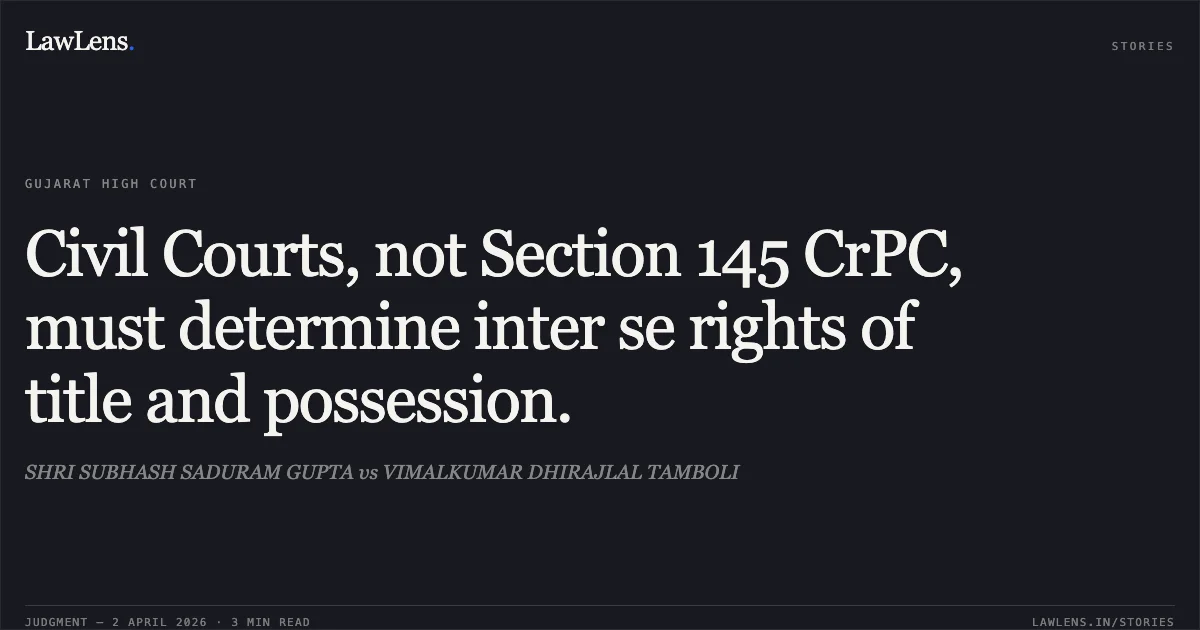
Source reference: para. 5.0The Court reasoned that Section 145 of the CrPC does not authorize an Executive Magistrate to adjudicate complex questions of title or possessory title
Source reference: para. 5.0Since the dispute involved allegations of forgery and rival claims of possession based on civil documents, the Court held that the appropriate recourse is for the parties to establish their rights in a Civil Court
Source reference: para. 5.0The Court found that the Sessions Court erred in directing a fresh inquiry into possession by an Executive Magistrate, as such inter se rights are subject to civil determination
Source reference: para. 5.0Holding
The High Court allowed the Revision Application and quashed the impugned order of the 2nd Additional Sessions Judge, Bhavnagar, dated 27.01.2006
The Court held that the directions regarding possession and status quo under Section 145 CrPC were unsustainable
Source reference: para. 6.0It clarified that any pending or future civil proceedings must be decided independently on their own merits without being influenced by this judgment
Source reference: para. 6.0Additionally, any criminal proceedings regarding the alleged forgery are to proceed independently before the competent authority
Source reference: para. 6.0Rule was made absolute
Source reference: para. 7.0Acts & Sections Cited
4 provisions across 2 statutes referred to in this judgment. Each provision opens on LawLens.
Code of Criminal Procedure, 19733
Transfer of Property Act, 18821
Original Court PDF
SHRI SUBHASH SADURAM GUPTAvsVIMALKUMAR DHIRAJLAL TAMBOLI
Click to open original judgment
Original judgment, available to read, download and summarize on LawLens.in


