Facts
The parties, members of the family of Mukkera Muthaiah, disputed succession to and partition of land situated in a Scheduled Area of Telangana.
Source reference: no citationThe appellants-plaintiffs instituted a suit for partition, separate possession and injunction, asserting that the properties remained joint-family properties.
Source reference: no citationThe trial court dismissed the suit, finding that partition had taken place during the lifetime of Muthaiah and that the branches were separately possessing their respective properties.
Source reference: pp. 2–4; para. 4The First Appellate Court reversed that decision and decreed the suit, holding that the properties were joint-family properties and that the Civil Court had jurisdiction because all parties were non-tribals.
Source reference: p. 4; para. 5In second appeal, the High Court held, relying on Nagarjuna Gramin Bank v. Medi Narayana, that the Civil Court lacked jurisdiction because the land was situated in a Scheduled Area where the Andhra Pradesh Civil Courts Act, 1972 did not apply, and set aside the appellate decree.
Source reference: p. 4; para. 6The Supreme Court examined whether the Civil Court could adjudicate a civil dispute concerning property in a Scheduled Area when all parties were non-tribals.
Source reference: p. 5; para. 7Issues
1. Whether Nagarjuna Gramin Bank v. Medi Narayana laid down a binding proposition of law that Civil Courts lack jurisdiction over civil disputes concerning land situated in Scheduled Areas.
Source reference: pp. 5–10; paras. 9–9.72. Whether, notwithstanding the exclusion of the Andhra Pradesh Civil Courts Act, 1972 from Scheduled Areas, a Civil Court has jurisdiction to adjudicate a partition and succession dispute between exclusively non-tribal parties concerning property situated in a Scheduled Area.
Source reference: pp. 11–25; paras. 10–13.43. Whether the jurisdictional position differs where one of the parties is a member of a Scheduled Tribe residing in the Scheduled Area.
Source reference: p. 26; para. 15Law Applied
The Court applied Section 1(3) and Section 3 of the Andhra Pradesh Civil Courts Act, 1972, under which the Act could be brought into force in notified areas and Civil Courts established under it could entertain suits and proceedings of a civil nature, noting that its operation had been excluded from Scheduled Areas by notification dated 30 October 1972.
Source reference: pp. 19–20; paras. 12.3–12.4It considered the historical protective framework for tribal areas under the Scheduled Districts Act, 1874, the Andhra Pradesh Agency Rules, 1924, and Article 244(1) read with the Fifth Schedule to the Constitution, which are intended principally to protect Scheduled Tribes, their land, customs and autonomy.
Source reference: pp. 11–20; paras. 11–12.3Applying Article 14, the Court held that a classification must rest on an intelligible differentia having a rational nexus with the object of the law, relying on State of Madras v. V.G. Row, Chitra Ghosh v. Union of India and State of Punjab v. Davinder Singh.
Source reference: pp. 21–24; paras. 13–13.3On precedent, it relied on the principles in Abdul Kayoom v. CIT, State of Gujarat v. Utility Users’ Welfare Assn. and Career Institute Educational Society v. Om Shree Thakurji Educational Society that only the legal principle necessary for the decision constitutes binding ratio, and that the ratio must be identified by examining whether the decision would have remained the same if the asserted proposition were removed.
Source reference: pp. 5–8; paras. 9.1–9.4Reasoning
The Court held that Nagarjuna Gramin Bank did not decide, through a legal analysis of the 1972 Act or the constitutional scheme, that Civil Courts were inherently barred from adjudicating all disputes in Scheduled Areas.
Source reference: pp. 8–10; paras. 9.5–9.7Its conclusion followed substantially from executive and governmental deliberations concerning the continued operation of the existing agency system, and therefore did not constitute a binding ratio on the jurisdictional question.
Source reference: pp. 8–10; paras. 9.5–9.7Although the exclusion of the 1972 Act from Scheduled Areas was designed to preserve protective mechanisms for tribal communities, the Court found no rational connection between that exclusion and the withdrawal of Civil Court jurisdiction over disputes exclusively between non-tribals.
Source reference: pp. 20–25; paras. 12.4–13.4Treating non-tribal parties as subject to special agency procedures merely because the land was geographically situated in a Scheduled Area would extend a protective law beyond its constitutional purpose and would raise an Article 14 concern.
Source reference: pp. 20–25; paras. 12.4–13.4Since the present dispute involved exclusively non-tribal parties and no tribal interest or restriction on tribal land transfer was implicated, the Civil Court possessed jurisdiction to entertain the partition suit.
Source reference: pp. 25–26; paras. 13.4–14Holding
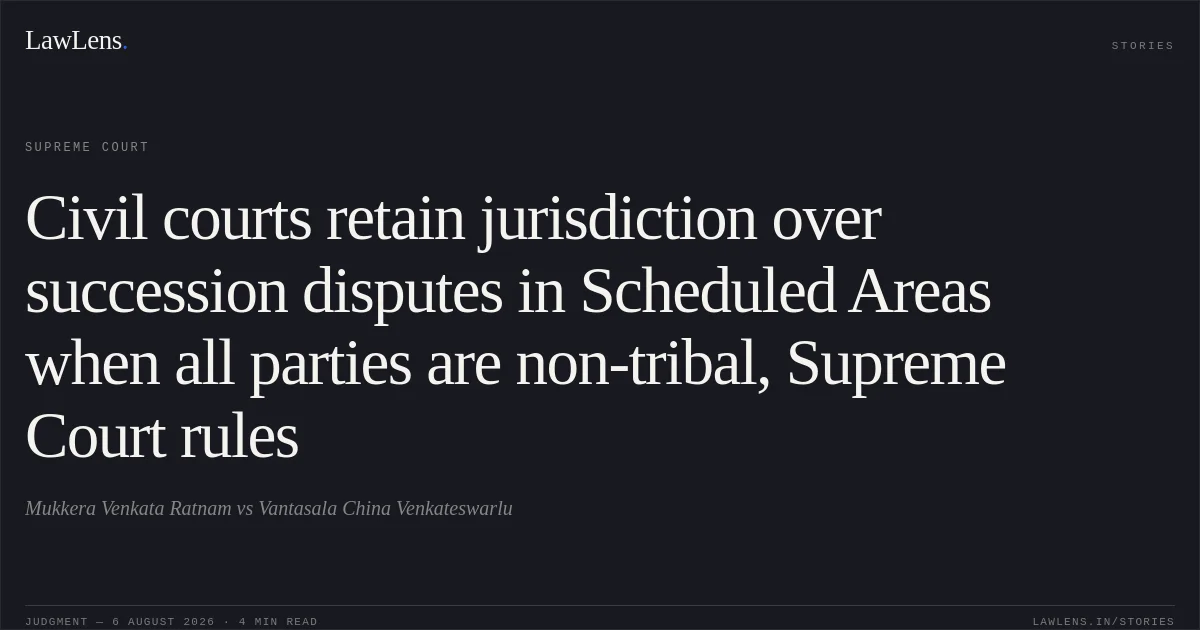
The Supreme Court held that Nagarjuna Gramin Bank v. Medi Narayana did not lay down a binding proposition that Civil Courts lack jurisdiction over every civil dispute concerning land in a Scheduled Area.
It further held that Civil Courts have jurisdiction over civil disputes and transactions involving exclusively non-tribal parties, even where the property is situated in a Scheduled Area; however, if even one party is a tribal residing in the Scheduled Area, the Agency Courts retain jurisdiction.
Source reference: p. 26; para. 15The High Court’s judgment was set aside, the second appeal was restored to its file for decision on merits consistently with the Supreme Court’s judgment, and the parties were directed to appear before the High Court on 24 August 2026.
Source reference: pp. 25–26; paras. 14–16The ruling was made applicable to pending and future cases, with no order as to costs.
Source reference: pp. 25–26; paras. 14–16Acts & Sections Cited
5 provisions across 3 statutes referred to in this judgment. Each provision opens on LawLens.
Code of Civil Procedure, 19081
Limitation Act, 19631
Original Court PDF
Mukkera Venkata RatnamvsVantasala China Venkateswarlu
Click to open original judgment
Original judgment, available to read, download and summarize on LawLens.in