Facts
The petitioner sought to quash FIR No. 1112/2022, the subsequent chargesheet, and criminal proceedings for offences under Sections 420, 34, 199, and 200 of the Indian Penal Code (IPC).
Source reference: para. 2The case arose from a transaction involving the sale of immovable property.
Source reference: para. 3The petitioner had executed a registered Power of Attorney (PoA) in favor of co-accused Manju Pandit to manage the sale.
Source reference: para. 3The petitioner alleged he cancelled the PoA on 31.10.2022; however, the co-accused proceeded to execute the sale deed on 09.11.2022 and received the consideration.
Source reference: para. 3The prosecution alleged that the complainant was induced to pay substantial sums, including Rs. 10,00,000/- credited to the joint account of the petitioner and his deceased mother.
Source reference: para. 4, 12The petitioner argued the dispute was purely civil, noting a pending civil suit for the cancellation of the sale deed.
Source reference: para. 5Issues
1. Whether the criminal proceedings are liable to be quashed on the ground that the dispute is purely civil in nature.
Source reference: para. 6, 162. Whether the material on record prima facie discloses the commission of cognizable offences by the petitioner.
Source reference: para. 7, 113. Whether the High Court should exercise its inherent powers under Section 528 of the Bharatiya Nagarik Suraksha Sanhita (B.N.S.S.) to quash the FIR and chargesheet at the threshold.
Source reference: para. 17, 20Law Applied
Section 528 of the B.N.S.S. (corresponding to Section 482 of the Cr.P.C.) regarding the inherent powers of the High Court to prevent abuse of process.
Source reference: para. 2, 17The court relied on the landmark parameters for quashing set out in State of Haryana v. Bhajan Lal (1992).
Source reference: para. 6, 18The principle that civil and criminal proceedings can proceed simultaneously if the facts disclose both civil liability and criminal culpability.
Source reference: para. 6, 8, 16, 18Reasoning
The court reasoned that the investigation material, including banking records showing a transfer of Rs. 10,00,000/- to the petitioner’s family account, established a prima facie financial link and nexus between the petitioner and the alleged fraudulent transaction.
Source reference: para. 12The court found that whether the PoA was validly cancelled or whether the petitioner had knowledge of the co-accused’s subsequent actions were disputed questions of fact that cannot be determined in a quashing petition and must be adjudicated during trial.
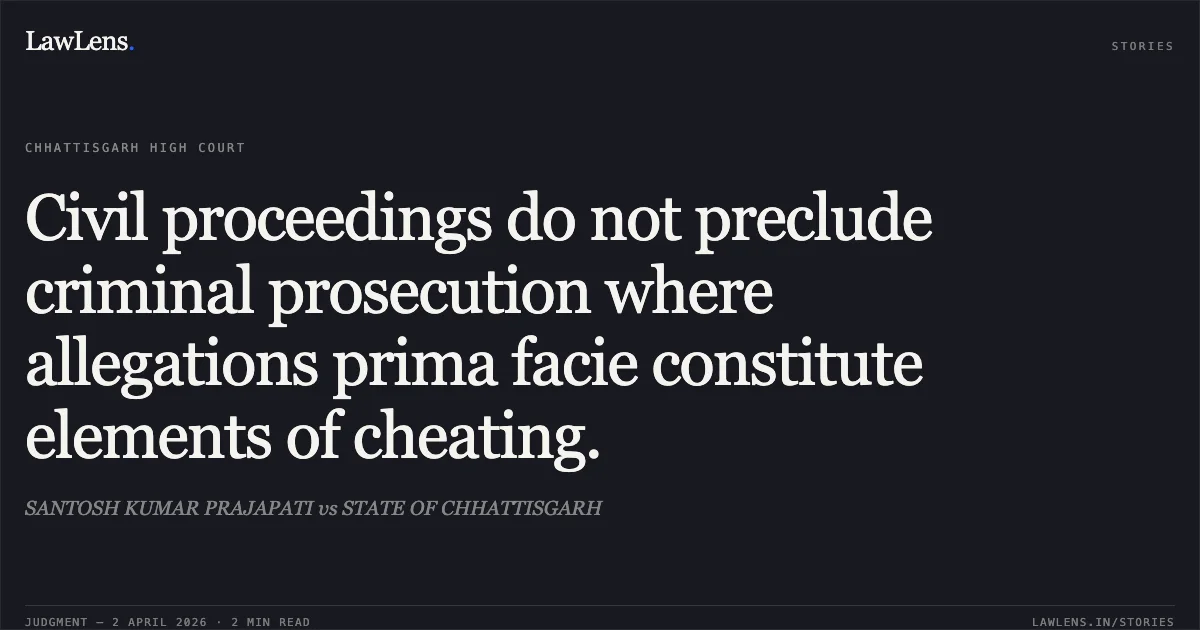
Source reference: para. 14, 19Regarding the civil nature of the dispute, the court held that the existence of a civil remedy or a pending civil suit does not preclude criminal prosecution if the ingredients of cheating and misrepresentation are prima facie present.
Source reference: para. 16It concluded that the inherent powers under Section 528 B.N.S.S. must be used sparingly and not to conduct a "roving enquiry" into the correctness of allegations when the material collected by the police is not deficient.
Source reference: para. 17-19Holding
The court held that the petitioner failed to meet the criteria for quashing the FIR and chargesheet as the allegations and evidence disclosed a prima facie case against him.
The petition was dismissed.
Source reference: para. 21Inherent powers to quash cannot be exercised when financial linkages and disputed facts necessitate a full-fledged trial to determine criminal intent.
Source reference: para. 13-14Acts & Sections Cited
6 provisions across 3 statutes referred to in this judgment. Each provision opens on LawLens.
Bharatiya Nagarik Suraksha Sanhita, 20231
Indian Penal Code, 18604
Code of Criminal Procedure, 19731
Original Court PDF
SANTOSH KUMAR PRAJAPATIvsSTATE OF CHHATTISGARH
Click to open original judgment
Original judgment, available to read, download and summarize on LawLens.in


