Facts
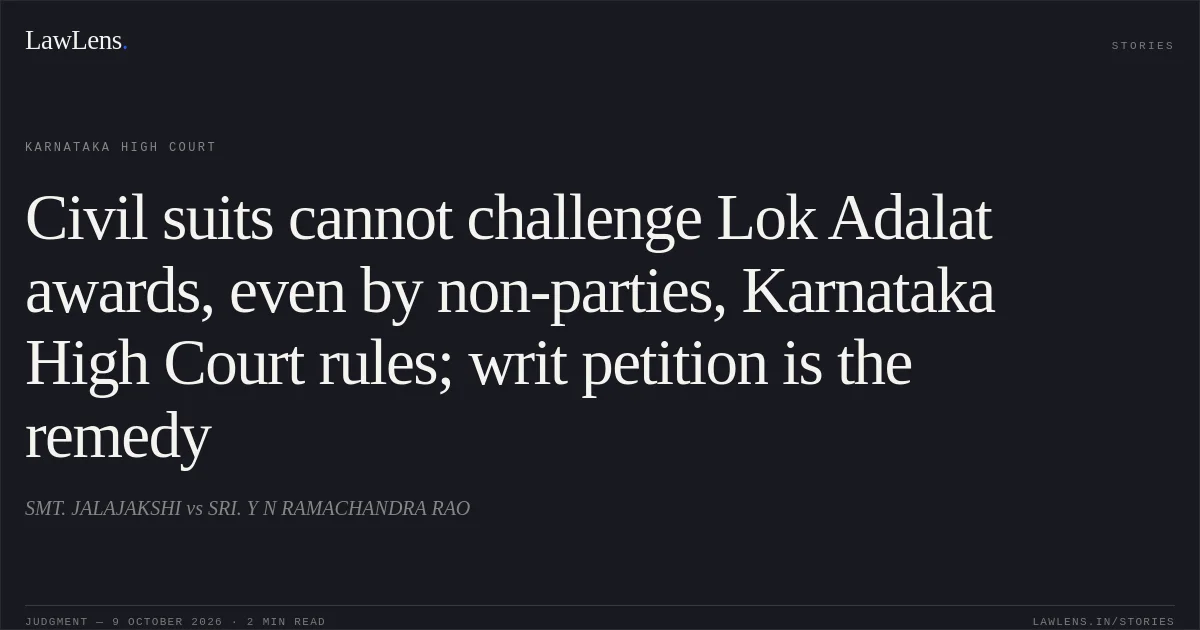
The plaintiff filed O.S. No. 936/2018 seeking a declaration that a compromise decree recorded by the Permanent Lok Adalat on 31 October 2008 was null and void and could not affect his rights in the ‘A’ schedule property, together with a permanent injunction restraining the defendants from transferring that property.
Source reference: pp. 4–5, para. 2Defendants Nos. 3, 5 to 10 applied under Order VII Rule 11(a) and (d) CPC for rejection of the plaint, contending that the suit was barred; the trial court dismissed the application.
Source reference: p. 5, paras. 3–5The defendants challenged that dismissal in this revision petition.
Source reference: p. 6, para. 5Issues
Whether a civil suit is maintainable to challenge a Lok Adalat award, including where the plaintiff claims that the award is not binding on him.
Source reference: pp. 7–8, para. 6; p. 11, paras. 10–11Whether rejecting the challenge to the award while leaving the injunction claim would amount to impermissible partial rejection of the plaint.
Source reference: pp. 8–9, para. 7; pp. 12–13, para. 12Law Applied
Order VII Rule 11 CPC permits rejection of a plaint where the pleaded case is barred by law; Order XXIII Rule 3A CPC bars a separate suit to set aside a compromise decree.
Source reference: pp. 5–6, paras. 3–4The Court applied the Supreme Court’s decision in Dilip Mehta v. Rakesh Gupta, which it understood to hold that a Lok Adalat award cannot be challenged through an ordinary civil suit and that any challenge to its validity must be pursued through the High Court’s constitutional jurisdiction; this applies to parties and third parties alike.
Source reference: pp. 7–8, para. 6; pp. 11–12, paras. 10–11The Court also applied the principle that an injunction dependent on the success of a substantive claim is consequential and cannot independently sustain the suit where the underlying claim is not maintainable.
Source reference: pp. 8–9, para. 7; pp. 12–13, para. 12Reasoning
The suit’s central relief sought to impeach the Lok Adalat award and prevent its asserted effect on the plaintiff’s property rights. The Court held that Dilip Mehta governed that challenge and foreclosed an ordinary civil suit, notwithstanding the plaintiff’s asserted non-party status; remand was unnecessary because the issue was one of law and the trial court could not reach a contrary result.
Source reference: pp. 11–12, para. 11The injunction claim was not independent: it depended on the plaintiff succeeding on the underlying challenge to the award. Accordingly, rejecting the plaint would not constitute partial rejection merely because the plaint also sought an injunction.
Source reference: p. 12, para. 12Holding
The Court held that the civil suit challenging the Lok Adalat award was not maintainable and that the consequential injunction claim did not prevent rejection of the plaint.
It set aside the trial court’s order, allowed I.A. No. XXVII under Order VII Rule 11 CPC, rejected the plaint, and allowed the civil revision petition.
Source reference: p. 13, OrderActs & Sections Cited
1 provisions across 1 statute referred to in this judgment. Each provision opens on LawLens.
Code of Civil Procedure, 19081
Original Court PDF
SMT. JALAJAKSHIvsSRI. Y N RAMACHANDRA RAO
Click to open original judgment
Original judgment, available to read, download and summarize on LawLens.in