Facts
The department issued a show-cause notice demanding service tax of Rs.44,81,113. The adjudicating authority dropped Rs.40,57,307 of the demand and confirmed the balance of Rs.4,23,806 on the basis that M/s. Shree Durga Enterprises had supplied manpower and that Dalmia Cement was liable to pay service tax under the reverse charge mechanism. The Commissioner (Appeals) dismissed the company’s appeal
Source reference: p.1Before the Tribunal, the company relied on a work order describing civil work at a railway siding, with payment calculated by the quantity of work completed rather than by the number of workers or man-days. It also argued that the demand was time-barred because the transactions were recorded in its books of account.
Source reference: p.2Issues
Whether the services provided by Shree Durga Enterprises were manpower supply services liable to service tax under the reverse charge mechanism, or civil works billed by reference to the work completed
Source reference: pp.2, 6Whether the confirmed demand was time-barred where the transactions were recorded in the company’s books of account and the company argued that no suppression could be alleged
Source reference: p.2; pp.5–6Law Applied
The Tribunal applied the service classification principle that the nature of a service must be determined from the contractual terms and the basis of consideration: a contract for civil work billed by reference to measured work, rather than manpower or man-days supplied, is not properly treated as manpower supply service
Source reference: p.5On limitation, it treated the recording of transactions in the appellant’s books, from which the demand was quantified, and the absence of a basis for alleging suppression as grounds to hold the demand time-barred
Source reference: p.5The Tribunal cited no specific statutory provision or precedent in its reasoning
Source reference: pp.5–6Reasoning
The work order showed that Shree Durga Enterprises was engaged to carry out civil work and would be paid at specified rates per square or cubic metre of work completed. It did not charge for manpower by reference to worker numbers or man-days, nor did it specify the number of workers deployed. The Tribunal therefore found that the service was not manpower supply and set aside the demand on merits
Source reference: p.5It also found the demand time-barred because the transactions were recorded in the appellant’s books and the demand was quantified from those records; accordingly, suppression could not be made out.
Source reference: p.5The Tribunal additionally observed that, as a manufacturer of dutiable goods, the appellant would have been eligible for Cenvat credit if service tax had been paid under reverse charge
Source reference: p.5Holding
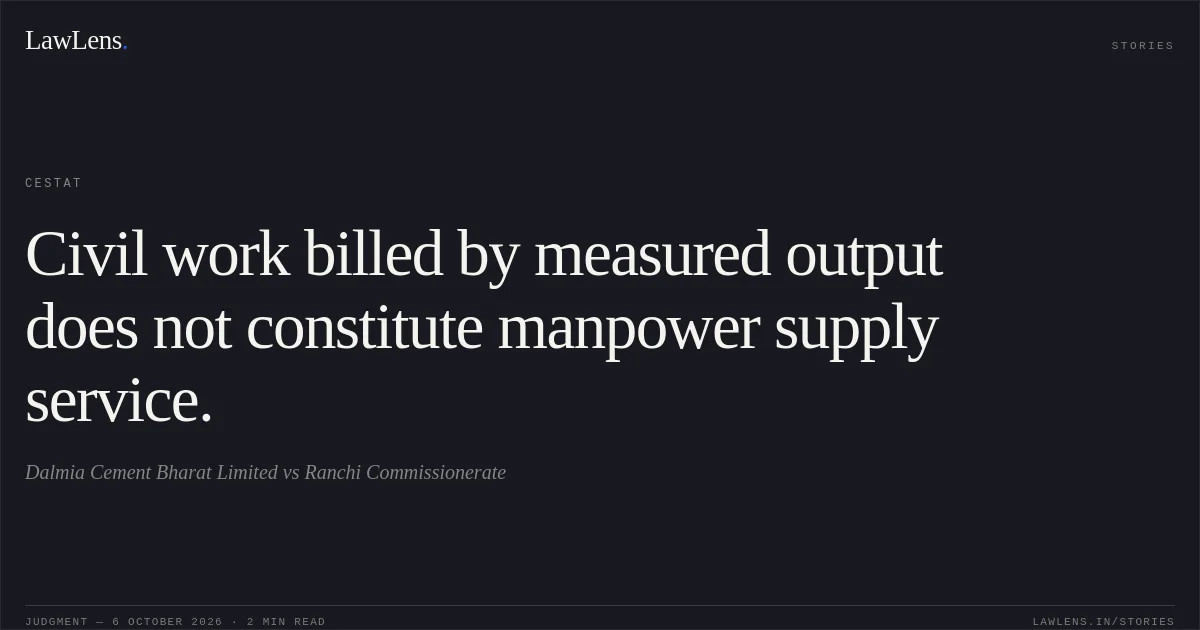
The Tribunal held that the services were civil work rather than manpower supply and that the demand was also time-barred.
It set aside the confirmed demand and allowed the appeal with consequential relief, if any, in accordance with law.
Source reference: pp.5–6Original Court PDF
Dalmia Cement Bharat LimitedvsRanchi Commissionerate
Click to open original judgment
Original judgment, available to read, download and summarize on LawLens.in
![HRA parity claims must be assessed against similarly situated employees, with reasoned orders where parity is denied.. Shaphaba Thokchom vs DY. COMPTROLLER AND AUDITOR GENERAL OF INDIA. CAT - ['Guwahati']. LawLens](/stories/thumbnails/hra-parity-claims-must-be-assessed-against-similarly-situated-employees-with-reasoned-orde-a9c45995b0704be18e4bcf7b91c8e507.webp)
![Article 311(2)(c) dismissal is valid where relevant material shows an inquiry would endanger security sources.. Mohd Rafi vs GENERAL ADMINITRATIVE DEPARTMENT. CAT - ['Jammu']. LawLens](/stories/thumbnails/article-311-2-c-dismissal-is-valid-where-relevant-material-shows-an-inquiry-would-endanger-58dabaa9372a4b41bd304e91e9ebe890.webp)