Facts
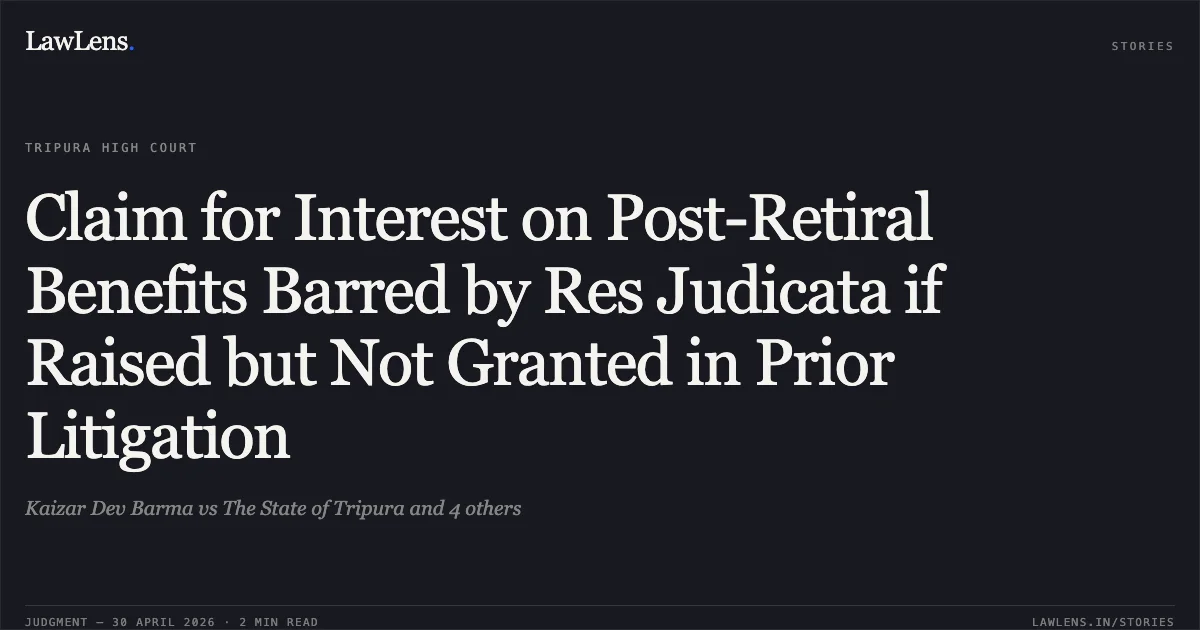
The Petitioner, a retired Additional Director in the Department of Industries Commerce, had his post-retiral benefits withheld due to a pending FIR under Section 409 of the IPC and the Prevention of Corruption Act.
Source reference: para. 2–4He initiated a previous writ petition, WP(C) No. 215 of 2024, specifically seeking a release of all retiral benefits along with 9% interest.
Source reference: para. 5A coordinate bench allowed the petition on December 4, 2024, directing the release of withheld amounts within two months but remained silent on the grant of interest.
Source reference: para. 6, 16–17Following this order, the department released the principal amounts for leave salary, gratuity, and commutation of pension.
Source reference: para. 7The Petitioner filed the present writ seeking interest on these delayed payments, arguing that the expiry of the limitation period for contempt and the subsequent nature of the disbursement constituted a fresh cause of action.
Source reference: para. 8–9Issues
1. Whether the present writ petition seeking interest on retiral benefits is barred by the principles of res judicata or constructive res judicata given the outcome of the earlier litigation.
Source reference: para. 182. Whether the non-grant of interest in a previous final judgment can be re-agitated in a fresh proceeding under Article 226 of the Constitution.
Source reference: para. 22Law Applied
The Court applied the doctrine of Res Judicata as embodied in Section 11 of the Code of Civil Procedure (CPC), specifically Explanation IV (Constructive Res Judicata) and Explanation V (Relief not granted deemed refused).
Source reference: para. 13, 22M. Nagabhushana v. State of Karnataka (2011) 3 SCC 408, which holds that res judicata applies to writ petitions to prevent abuse of process and protect public policy.
Source reference: para. 11, 19Direct Recruit Class II Engg. Officers' Assn. v. State of Maharashtra (1990) 2 SCC 715, establishing that adjudication is final not only for matters determined but for every matter parties "ought to have litigated".
Source reference: para. 13K.K. Modi v. K.N. Modi (1998) 3 SCC 573 to emphasize that re-litigating the same issue constitutes an abuse of the court's machinery.
Source reference: para. 21Reasoning
The Court observed that the Petitioner had explicitly prayed for "9% interest" in his previous writ petition, WP(C) No. 215/2024.
Source reference: para. 15The coordinate bench’s final order directed only the release of principal withheld amounts and did not grant the interest requested.
Source reference: para. 16Under Explanation V to Section 11 of the CPC, any relief prayed for in a petition but not expressly granted is deemed to have been refused.
Source reference: para. 22The Court reasoned that the Petitioner’s failure to challenge the previous order via appeal meant the refusal of interest had attained finality.
Source reference: para. 17The Petitioner cannot use the subsequent disbursement of principal amounts as a "new cause of action" to bypass the finality of the earlier judgment, as the issue of interest was "clearly part of the subject-matter" of the first litigation.
Source reference: para. 20–22Holding
The Court held that the petition is barred by the principles of res judicata and constructive res judicata.
The Court answered that once a competent court omits a specific relief (interest) in a final judgment, that issue cannot be re-agitated in a subsequent writ petition.
Source reference: para. 22The writ petition was dismissed with no order as to costs.
Source reference: para. 23Acts & Sections Cited
3 provisions across 3 statutes referred to in this judgment. Each provision opens on LawLens.
Indian Penal Code, 18601
Prevention of Corruption Act, 19881
Code of Civil Procedure, 19081
Original Court PDF
Kaizar Dev BarmavsThe State of Tripura and 4 others
Click to open original judgment
Original judgment, available to read, download and summarize on LawLens.in