Facts
The petitioners were initially appointed as daily-rated employees in the Water Resources Department and were subsequently classified as permanent employees (Sthai Karmi). They were working as Field Assistant and Copyist against Class III posts in Sub-Division Seoni, Madhya Pradesh.
Source reference: para. 2The State Government enhanced the general age of superannuation from 60 to 62 years by notification dated 31 March 2018, amending the Madhya Pradesh Government Servants (Superannuation Age) Act, 1967.
Source reference: para. 3Despite this amendment, the petitioners were retired upon attaining 60 years by order dated 30 August 2018. They sought quashing of the retirement order, reinstatement, continuation in service up to 62 years, and consequential reliefs.
Source reference: para. 1During the pendency of the petition, a Division Bench of the High Court held that the State could not prescribe different retirement ages for Class III and Class IV Sthai Karmis.
Source reference: para. 5Issues
Whether the petitioners, being Class III Sthai Karmis, could lawfully be superannuated at 60 years notwithstanding the enhancement of the retirement age to 62 years and the Division Bench ruling invalidating the distinction between Class III and Class IV Sthai Karmis.
Source reference: paras. 3, 5–6Whether the petitioners were entitled to 100% back wages for the period during which they were prematurely retired before attaining the lawful age of superannuation.
Source reference: paras. 7–10Law Applied
The Court applied the Madhya Pradesh Government Servants (Superannuation Age) Act, 1967, as amended by the notification dated 31 March 2018, which substituted 62 years for 60 years as the age of superannuation.
Source reference: para. 3It relied on the Division Bench decision in W.A. No. 1715 of 2024 and connected matters, decided on 2 February 2026, which held that the State could not prescribe different retirement ages for Class III and Class IV Sthai Karmis where their pay scales and other relevant service conditions were not materially different.
Source reference: para. 5The Court also relied on Shobha Ram Raturi v. Haryana Vidyut Prasaran Nigam Ltd., (2016) 16 SCC 663, which recognises that an employee prevented from working by an unlawful premature-retirement order is entitled to consequential benefits, including wages, and that the principle of “no work, no pay” cannot be invoked by the employer in such circumstances.
Source reference: para. 9It further followed the Madhya Pradesh High Court Division Bench decision in W.A. No. 743 of 2026, which awarded 100% back wages in a similar case.
Source reference: para. 8Reasoning
The Court held that the petitioners’ premature retirement was based on the State’s impermissible distinction between Class III and Class IV Sthai Karmis. Since the applicable policy provided the same pay scale and substantially similar service conditions, there was no rational basis for fixing the retirement age of Class III Sthai Karmis at 60 years while allowing 62 years for other employees.
Source reference: para. 5Following the binding Division Bench ruling, the Court declared the retirement order dated 30 August 2018 unsustainable and set it aside.
Source reference: para. 6On back wages, the Court found that the petitioners were willing to continue working but were prevented from doing so solely because of the unlawful retirement order.
Source reference: para. 7Applying Shobha Ram Raturi and the subsequent Division Bench decision, it concluded that the petitioners were entitled to full salary for the period from premature retirement until the date on which they would have actually retired.
Source reference: paras. 7–10Holding
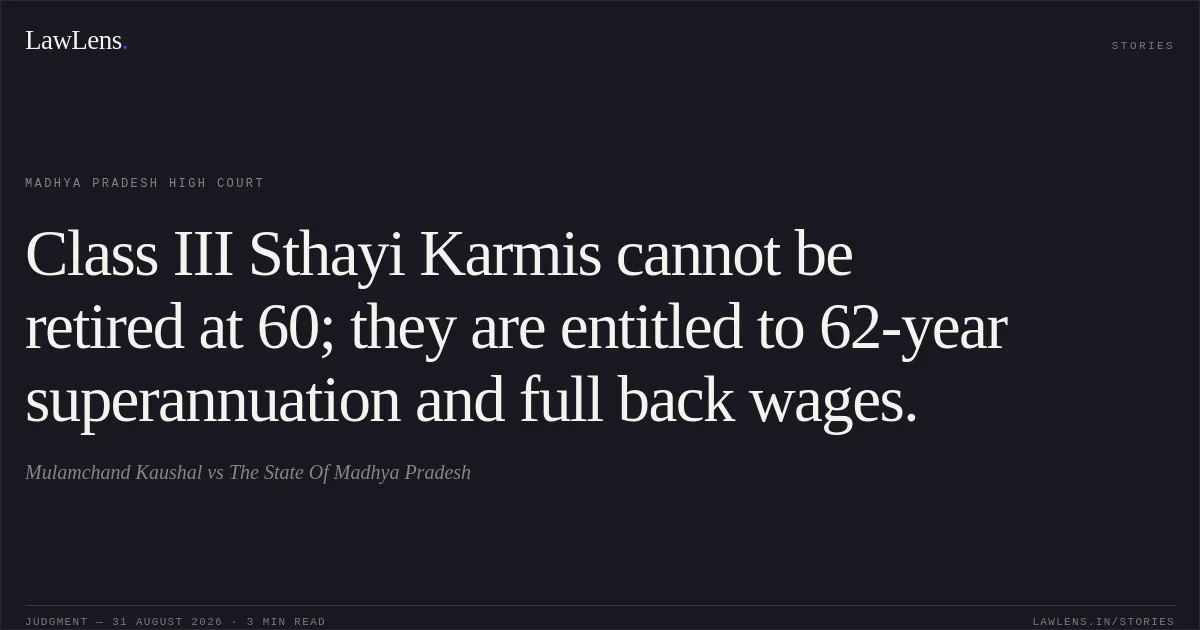
The High Court allowed the petition to the extent that it quashed the order dated 30 August 2018 retiring the petitioners at 60 years.
It held that the petitioners were entitled to 100% back wages for the intervening period between their premature retirement and their lawful date of superannuation.
Source reference: para. 10The respondents were directed to pay the requisite salary/back wages within four months from the date of production of a certified copy of the order. The petition was accordingly disposed of.
Source reference: paras. 10–11Original Court PDF
Mulamchand KaushalvsThe State Of Madhya Pradesh
Click to open original judgment
Original judgment, available to read, download and summarize on LawLens.in
![Failure to upload Form-1 cannot defeat eligibility where the original is produced at verification.. E ILAYABHARATHI vs D/o Posts. CAT - ['Chennai']. LawLens](/stories/thumbnails/failure-to-upload-form-1-cannot-defeat-eligibility-where-the-original-is-produced-at-verif-bdf805e3bec24a0ba3fcd7f3143f95ad.webp)
![Pre-regularisation RTP service cannot be counted for retrospective service benefits.. C Sudaravadivelu vs DEPARTMENT OF POSTS. CAT - ['Chennai']. LawLens](/stories/thumbnails/pre-regularisation-rtp-service-cannot-be-counted-for-retrospective-service-benefits-509e5c61e6574eca984a689620be1a9f.webp)
![Temporary-status casual labourers completing qualifying service are entitled to family pension despite non-regularisation.. R MALA vs M/o Personnel, Public Grievances and Pensions. CAT - ['Chennai']. LawLens](/stories/thumbnails/temporary-status-casual-labourers-completing-qualifying-service-are-entitled-to-family-pen-d6aa2d1c850b45ca8f32cc2cfb18ddf4.webp)