Facts
The petitioner, a classified employee, filed a writ petition seeking a Mandamus to direct the respondents to pay the minimum pay scale (Rs. 5200-20200 with Grade Pay Rs. 1900/- and Rs. 4440/- with Grade Pay Rs. 1300/-) from the date of his classification in 2011.
Source reference: para. 1He further claimed arrears of salary from the date of classification until October 7, 2016, citing the precedent in Ram Naresh Rawat v. Ashwani Devi.
Source reference: para. 1The State contended that since the petitioner opted for the benefits of the State’s policy dated October 7, 2016—which categorized daily wagers into skilled, semi-skilled, and unskilled brackets—he was ineligible for the minimum regular pay scale per the decision in Chetan Lal Gupta v. State of M.P.
Source reference: para. 2Issues
1. Whether a daily wager classified as a permanent employee is entitled to the minimum of the regular pay scale after the implementation of the State policy dated October 7, 2016?
Source reference: para. 2-32. Whether the petitioner is entitled to arrears of salary based on the minimum pay scale from the date of his classification until the implementation of the 2016 policy?
Source reference: para. 2Law Applied
State Government Policy dated October 7, 2016, which formulated specific pay categories for daily wagers who could not be regularized under the mandate of Secretary, State of Karnataka v. Uma Devi (2006) 4 SCC 1.
Source reference: para. 3Principle from Ram Naresh Rawat v. Ashwani Devi (2017) 3 SCC 436, which entitles classified employees to the minimum of the pay scale.
Source reference: para. 2The recent coordinate bench ruling in Chetan Lal Gupta v. State of M.P. (W.P. No. 39586 of 2024), which held that categorization under the 2016 Scheme entitles employees only to the wages prescribed for their specific category (skilled/unskilled), not the scale of the regular post.
Source reference: para. 3Reasoning
The court reasoned that because the petitioner accepted the benefits of the October 7, 2016 policy, his entitlement to a pay scale is governed by the specific categories (skilled, semi-skilled, or unskilled) defined therein.
Source reference: para. 2Following the logic in Chetan Lal Gupta, the court held that the 2016 Scheme was a distinct beneficial framework; therefore, the petitioner cannot claim the regular minimum pay scale of a post once classified under this scheme.
Source reference: para. 3The court determined that for the interval between the date of the petitioner's initial classification (2011) and the effective date of the 2016 policy, the petitioner remains entitled to arrears based on the minimum of the pay scale as per the established law in Ram Naresh Rawat.
Source reference: para. 2Holding
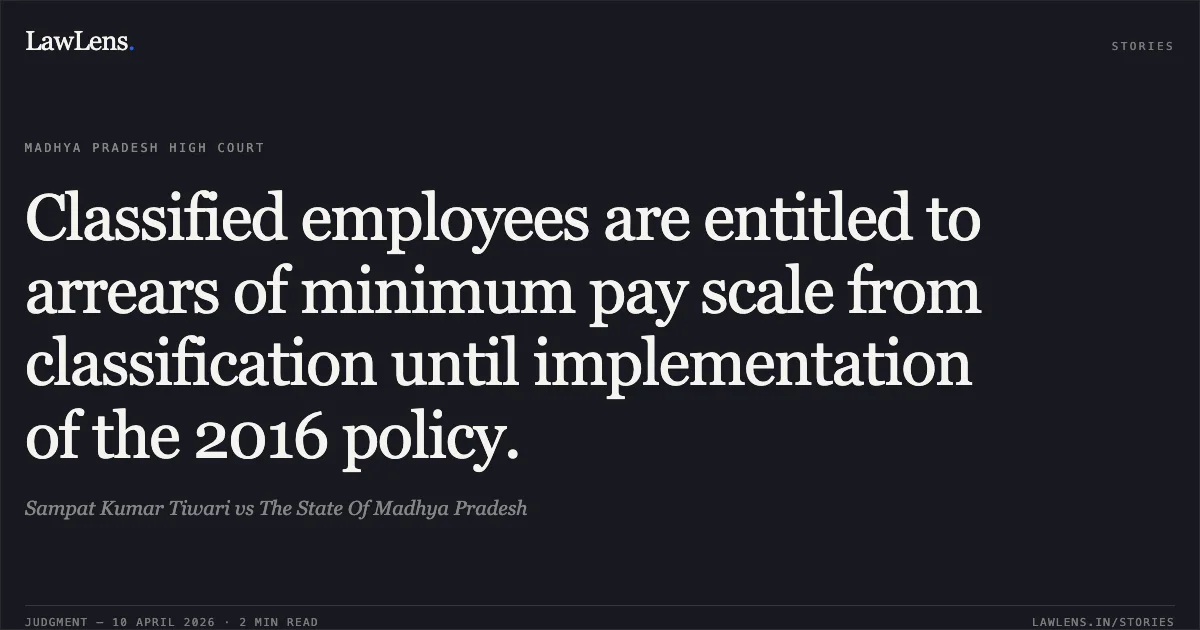
The court held that while the petitioner cannot claim the regular minimum pay scale after the 2016 policy, he is entitled to arrears from the date of classification until the policy's commencement.
The court disposed of the petition by directing the petitioner to file a comprehensive representation to Respondent No. 2 (Engineer-in-Chief, Water Resources Department) within 10 days. Respondent No. 2 was directed to pass a speaking order within 90 days, verify if the petitioner’s classification remains intact, and extend the eligible benefits/arrears accordingly.
Source reference: para. 4No order as to costs was made.
Source reference: para. 5Original Court PDF
Sampat Kumar TiwarivsThe State Of Madhya Pradesh
Click to open original judgment
Original judgment, available to read, download and summarize on LawLens.in


![Subsequent exoneration does not retrospectively invalidate a finalized promotion select list.. UNNIKRISHNAN M vs M/o Environment And Forests. CAT - ['Ernakulam']. LawLens](/stories/thumbnails/subsequent-exoneration-does-not-retrospectively-invalidate-a-finalized-promotion-select-li-ce80a0e84f2f4887857271e8b4341c42.webp)