Facts
The respondent awarded the petitioner a construction contract for a memorial in Punjab on 20.12.2011
Source reference: para 2On 18.04.2019, the respondent unilaterally appointed a sole arbitrator whose award, dated 09.05.2020, was eventually set aside by the Court in a Section 37 appeal on 02.04.2025 for violating Section 12(5) of the Arbitration and Conciliation Act, 1996 ("the Act")
Source reference: para 2.1, 2.2Subsequently, the petitioner issued a Section 21 notice and filed the present petition under Section 11(6) for the appointment of an independent arbitrator
Source reference: para 2.2The respondent opposed the petition, citing Clause 48 of the contract, which stipulated that arbitration must be conducted by the respondent’s Managing Director/Chief Engineer or their nominee, and if such appointment is not possible, the dispute "shall not be referred to arbitration at all"
Source reference: para 3Issues
1. Whether a contractual clause that forecloses the right to arbitration if the contractee's specific appointment mechanism fails is legally enforceable in a public-private contract
Source reference: para 4, 6.12. Whether the Court can exercise powers under Section 11(6) to appoint an independent arbitrator by severing the void portions of an arbitration agreement
Source reference: para 6.1Law Applied
The court primarily applied Section 11(6) and Section 18 of the Arbitration and Conciliation Act, 1996, which mandate the appointment of arbitrators and equal treatment of parties, respectively
Source reference: para 1, 6.1It relied heavily on the precedent established in Hindustan Construction Company Ltd. v. Bihar Rajya Pul Nirman Nigam Limited and Others (2025), which held that clauses vesting exclusive appointment power in one party while foreclosing arbitration in default are violative of Article 14 of the Constitution of India
Source reference: para 4, 6.1The court utilized the "doctrine of severability," affirming that while a unilateral appointment mechanism may be void, the substantive agreement to arbitrate survives
Source reference: para 6.1Reasoning
The court rejected the respondent's contention that the absence of arbitration was mandated by Clause 48
Source reference: para 7Applying the Hindustan Construction Company precedent, the court reasoned that in public-private contracts, an "absolute veto" over arbitration—embodied in the phrase "if for any reason... the matter shall not be referred to arbitration"—fails the test of manifest arbitrariness under Article 14 and violates the mandate of Section 18
Source reference: para 6.1The court clarified that the intention to arbitrate (Section 7) is derived from the surviving part of the arbitration clause after severing the unconstitutional appointment mechanism
Source reference: para 8It further dismissed the respondent's argument that the precedent was distinguishable based on "consent," noting that the validity of the arbitration agreement is a matter of law and statutory interpretation of the surviving clause, not merely the parties' conduct during proceedings
Source reference: para 7, 8Holding
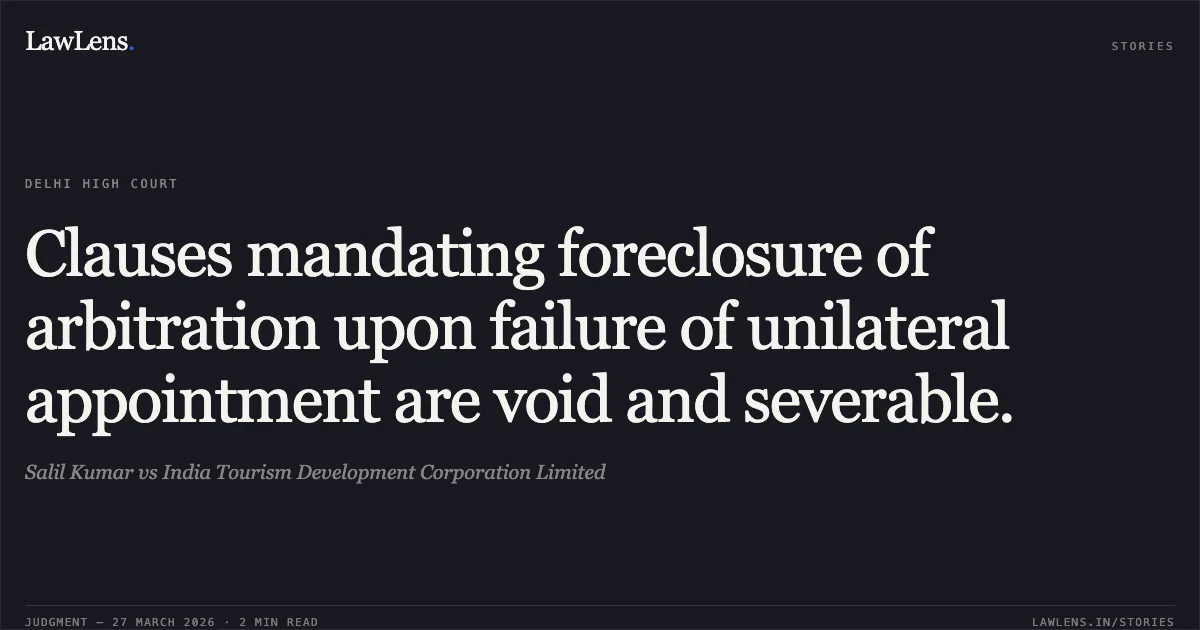
The court allowed the petition, holding that the exclusionary part of the arbitration clause was void and severable, leaving a valid and subsisting agreement to arbitrate
The court appointed Justice Mr. Krishna Kumar Lahoti (Retd.) as the sole arbitrator to adjudicate the disputes
Source reference: para 9It directed that the arbitrator’s fees be governed by Schedule IV of the Act and mandated compliance with Section 12 disclosures before entering the reference
Source reference: para 10All rival claims and counterclaims were left open for consideration by the learned arbitrator on merits
Source reference: para 11Acts & Sections Cited
7 provisions across 1 statute referred to in this judgment. Each provision opens on LawLens.
Arbitration and Conciliation Act, 19967
Original Court PDF
Salil KumarvsIndia Tourism Development Corporation Limited
Click to open original judgment
Original judgment, available to read, download and summarize on LawLens.in