01Facts
The petitioner, a partnership firm represented by its Managing Partner, Arun Kumar M., availed an overdraft facility from the respondent-Bank, renewed since 2016.
The "schedule property" (a residential house at Site No. 86, 3rd Main, 4th Cross, Dollars Layout, J.P. Nagar, Bengaluru) was mortgaged as collateral, with the mortgage deed dated 27.07.2017 and subsequent enhancement memoranda.
¶ 4–5The Bank's statement of account before the DRT showed Rs. 2,93,89,685.90, which the petitioner paid. The petitioner alleges the actual liability was Rs. 1,14,66,013.08, leaving an excess of about Rs. 1,79,23,672.82 that was shown as a credit balance but not refunded.
¶ 6–7The petitioner also states that a separate loan of Rs. 2,08,59,000 was closed and a closure letter issued, with an understanding that the securities would be released.
¶ 8Relying on an alleged assurance, the petitioner sold the schedule property for Rs. 3,30,00,000 under a sale deed dated 09.12.2024 and paid the proceeds to the Bank, but the Bank has not discharged the mortgage or returned the title deeds.
¶ 10–11The Bank contends that the schedule property also secures a second memorandum of deposit of title deeds dated 12.12.2019 for Rs. 10,00,00,000 availed by M/s Power Systems, which remains unpaid. It denies any sale permission or assurance.
¶ 12–13The Bank has invoked SARFAESI Sections 13 and 14 for the second loan, and the DRT proceedings are pending.
¶ 16, 31In W.P. No. 12521/2026, Arun Kumar filed an affidavit undertaking to comply with the DRT payment schedule and to surrender possession on default. He has allegedly not complied, and contempt proceedings (C.C.C. No. 594/2026) are pending.
¶ 14–1702Issues
i.1. Whether the petitioner is entitled to a writ of mandamus directing the Bank to refund the alleged excess amount and execute a deed of discharge and return the original title deeds of the schedule property, notwithstanding the admitted subsistence of the second mortgage and the liability secured thereunder?
¶ 19ii.2. Whether the petitioner has established an enforceable legal right to discharge of the mortgage, given that the schedule property secures a second, undischarged loan and the Bank's sale permission is disputed?
¶ 25, 29–30, 39iii.3. Whether the disputed claim for refund of the alleged excess can be adjudicated in writ jurisdiction?
¶ 34–36, 4003Law Applied
The discretionary writ jurisdiction under Article 226 of the Constitution requires an enforceable legal right and a corresponding legal duty; mandamus does not lie where those are absent.
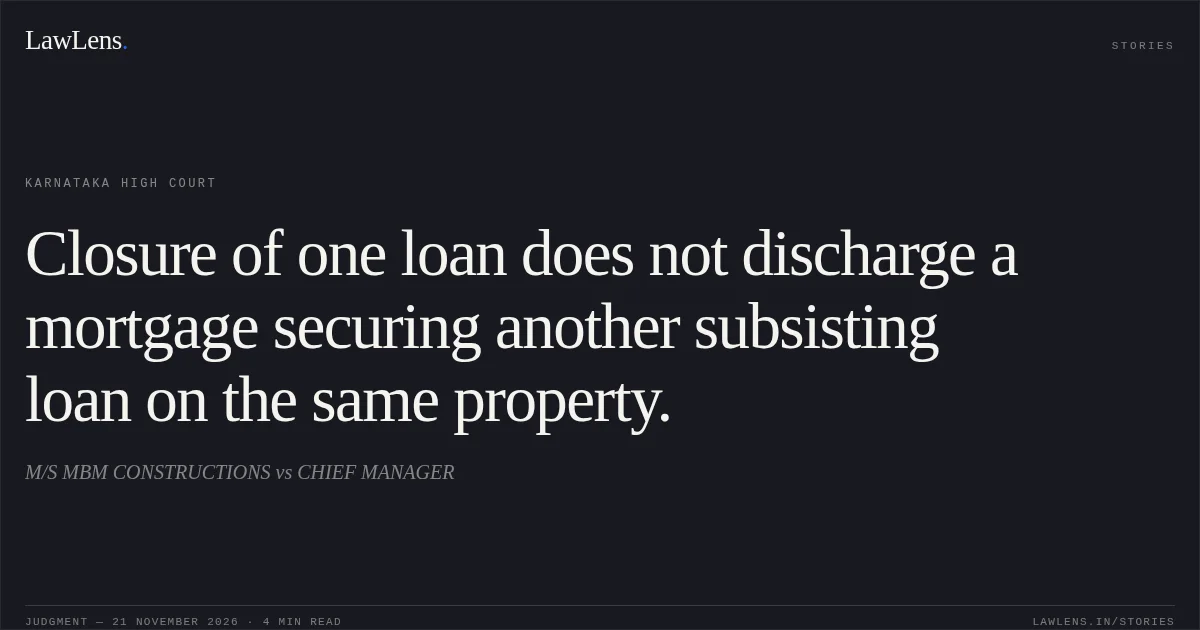
¶ 30, 36, 39, 41A mortgage securing more than one liability must be assessed by reference to the mortgage instruments and the liabilities they secure, so discharge of one loan does not extinguish a mortgage securing another undischarged liability.
¶ 24, 26–28The requirement of the Bank's consent to a sale of mortgaged property is treated as a matter of documentary proof, not presumption.
¶ 25The SARFAESI Act, 2002, Sections 13 and 14, and the statutory DRT remedy apply; a party must ordinarily use that mechanism rather than Article 226 when the Bank has invoked it.
¶ 31, 36–37The doctrine against approbating and reprobating applies, based on the affidavit given in W.P. No. 12521/2026.
¶ 33Writ jurisdiction does not extend to adjudicating disputed questions of account reconciliation and adjustment.
¶ 35–36A Supreme Court decision in a Central Bank of India matter and a Bombay High Court (Nagpur Bench) order in W.P. No. 32/2022, relied on by the petitioner, are distinguishable.
¶ 18, 38Provisions in the judgment · 2 · Linked ones open on LawLens
Securitisation and Reconstruction of Financial Assets and Enforcement of Security Interest Act, 2002 Section 13Section 14
04Reasoning
The schedule property secured two distinct loans: the first (Rs. 1,50,00,000 under Annexure-R1) and the second (Rs. 10,00,00,000 under the 12.12.2019 memorandum for M/s Power Systems).
¶ 22–23Because the second liability admittedly remains unpaid, the closure of the first loan did not extinguish the mortgage over the property.
¶ 24, 28On the claimed sale assurance, the Bank's letter dated 26.09.2024 (Annexure-H) grants no permission or no-objection for sale, and the petitioner produced no other evidence of assurance. A sale and payment of the sale price do not, by themselves, extinguish the security interest.
¶ 25, 38–39The petitioner had no enforceable right to discharge, so no mandamus could issue.
¶ 29–30, 39The amount due, the adjustment of payments, and the correctness of the statement of account are disputed factual matters requiring reconciliation, which writ jurisdiction does not suit.
¶ 34–35, 40The Bank's SARFAESI proceedings provide a statutory remedy that the Court weighed in deciding whether to exercise writ jurisdiction.
¶ 31, 36–37Arun Kumar's undertaking in W.P. No. 12521/2026, and his alleged non-compliance with it, were treated as relevant to discretionary relief, without expressing any view on the contempt proceedings.
¶ 32–33The cited precedents were distinguishable because they did not involve a subsisting second mortgage or the absence of sale permission.
¶ 3805Holding
The point framed in para. 19 is answered in the negative. The petitioner failed to establish an enforceable legal right to discharge of the mortgage and return of title deeds while the second mortgage subsists, and no corresponding legal duty arose on the Bank.
¶ 39, 41The refund claim of Rs. 1,79,23,672.80 is not crystallised and cannot be directed in this writ.
¶ 40No equitable ground for discretionary relief under Article 226 is found, given the SARFAESI proceedings and the conduct regarding the earlier undertaking.
¶ 41The writ petition is dismissed with no order as to costs. The findings are confined to this writ and do not prejudice the pending DRT, SARFAESI, or contempt proceedings.
¶ 42 · Order (i)–(ii) · ¶ 43Original Court PDF
M/S MBM CONSTRUCTIONSvsCHIEF MANAGER
Click to open original judgment
Original judgment, available to read, download and summarize on LawLens.in