Facts
The petitioners claimed settled possession of houses situated on land at Village Nagarnaar, District Bastar, relying on revenue records, property-tax receipts and other documents.
Source reference: p.3In Civil Suit No. 45-A/2005, a decree dated 31 January 2008 was passed in favour of Respondent No. 5 concerning Khasra No. 1473, pursuant to which Execution Case No. 04/2011 was initiated.
Source reference: p.3During execution proceedings, the Civil Court issued a notice dated 18 August 2026 to the Tahsildar under Section 384 of the Bharatiya Nagarik Suraksha Sanhita, 2023, and consequential notices were issued by the revenue authorities proposing the petitioners’ dispossession, with police assistance allegedly being provided.
Source reference: p.3–4The petitioners challenged these notices, contending that execution of a decree for possession over immovable property must follow Order XXI of the Code of Civil Procedure, 1908, and that they had not been given a reasonable opportunity to present their defence.
Source reference: p.4–5They also asserted that the decree was ex parte and that they lacked proper knowledge of the proceedings.
Source reference: p.5–6The State opposed the petition on the ground that the Tahsildar’s action was pursuant to the Civil Court’s orders and that the petitioners had an efficacious remedy before the competent Civil Court.
Source reference: p.5Issues
1. Whether the petitioners could challenge, in writ jurisdiction, the show-cause notice issued to the Tahsildar and the consequential notices proposing their dispossession pursuant to the execution proceedings.
Source reference: p.3–52. Whether the petitioners were entitled to protection from coercive dispossession while obtaining the relevant records and approaching the competent Civil Court against the alleged ex parte decree and consequential execution proceedings.
Source reference: p.6–73. Whether the petitioners should be granted liberty to avail the appropriate remedy before the competent Civil Court within a specified period.
Source reference: para. 8Law Applied
The Court considered the principle that execution of a decree for possession of immovable property is governed by Order XXI of the Code of Civil Procedure, 1908, as asserted by the petitioners.
Source reference: p.4The petitioners also challenged the invocation of Section 384 of the Bharatiya Nagarik Suraksha Sanhita, 2023, in the execution-related proceedings; however, the Court did not finally determine the applicability or validity of that provision.
Source reference: p.3–4The Court applied the principle that where an efficacious remedy is available before the competent Civil Court, particularly in relation to an alleged ex parte decree and execution proceedings, the writ petition may be disposed of by granting liberty to pursue that remedy.
Source reference: p.5, para. 8Interim protection may be granted for a limited period to enable the affected parties to approach the competent forum, without adjudicating the merits or title of the parties.
Source reference: para. 8–9Reasoning
The Court noted that the petitioners’ principal grievance arose from an alleged ex parte decree and the consequential execution proceedings, matters for which an appropriate remedy lay before the competent Civil Court.
Source reference: para. 8Since the petitioners claimed lack of proper knowledge of the decree and sought time to obtain the relevant records and formulate their legal challenge, the Court considered it appropriate not to examine the merits of the decree, the execution proceedings, or the legality of the notices in writ jurisdiction.
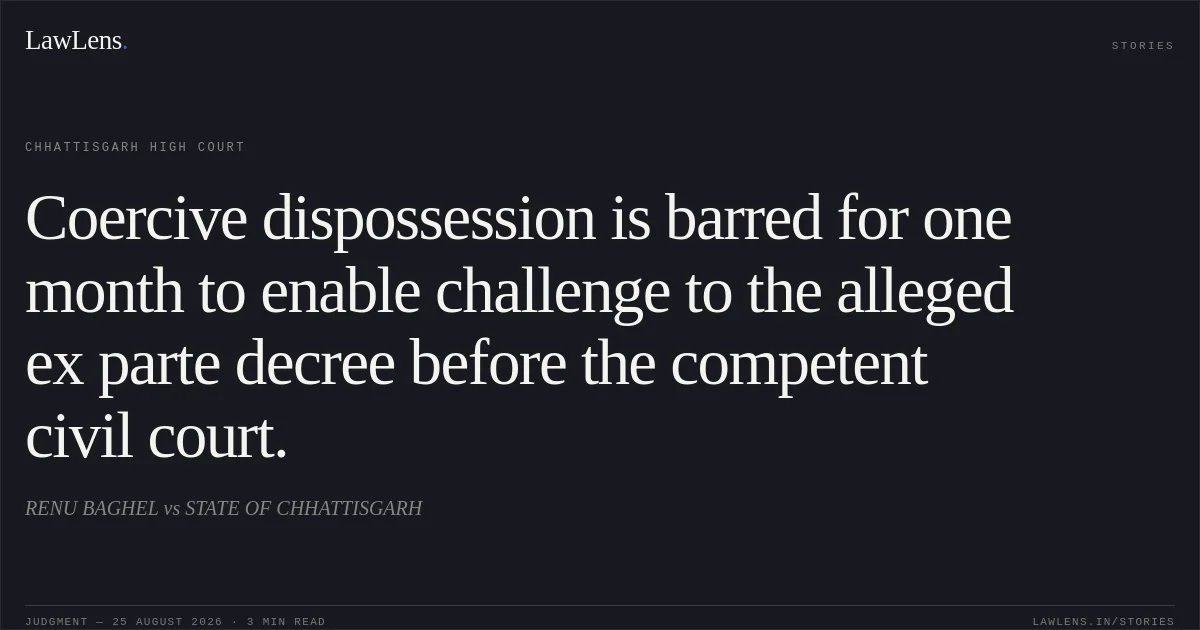
Source reference: para. 6–8Balancing the proposed dispossession with the petitioners’ request to pursue their civil remedy, the Court granted them one month to approach the competent Civil Court and restrained the Tahsildar from taking coercive steps during that period.
Source reference: para. 8–9The Court expressly clarified that it had not expressed any opinion on the merits or on the parties’ rights and contentions.
Source reference: para. 9Holding
The writ petition was disposed of with liberty to the petitioners to approach the competent Civil Court and avail the remedy available in law within one month from 25 August 2026.
Until expiry of that period, the Tahsildar was directed not to take coercive steps to dispossess the petitioners from the subject property.
Source reference: para. 9The interim protection was to automatically lapse after one month, and no opinion was expressed on the merits of the dispute or the rights of the parties.
Source reference: para. 9There was no order as to costs.
Source reference: para. 10Acts & Sections Cited
1 provisions across 1 statute referred to in this judgment. Linked provisions open on LawLens.
Bharatiya Nagarik Suraksha Sanhita, 20231
Original Court PDF
RENU BAGHELvsSTATE OF CHHATTISGARH
Click to open original judgment
Original judgment, available to read, download and summarize on LawLens.in
![Courts will not interfere with transfers absent mala fides or violation of statutory rules.. M Ramya vs EMPLOYEES STATE INSURANCE CORPORATION (ESIC). CAT - ['Chennai']. LawLens](/stories/thumbnails/courts-will-not-interfere-with-transfers-absent-mala-fides-or-violation-of-statutory-rules-a6845e9ca6f548fca284c51c8351957f.webp)
![Courts cannot direct one-time recruitment age relaxation absent authority in the governing rules or advertisement.. UT OF PUDUCHERRY vs M ANDAL. CAT - ['Chennai']. LawLens](/stories/thumbnails/courts-cannot-direct-one-time-recruitment-age-relaxation-absent-authority-in-the-governing-895d78fde47143e2a8ed0207c4b6a44f.webp)
![A review cannot correct an allegedly erroneous decision absent an error apparent on the record.. Ajit Kumar Jha vs RAILWAY BOARD. CAT - ['Delhi']. LawLens](/stories/thumbnails/a-review-cannot-correct-an-allegedly-erroneous-decision-absent-an-error-apparent-on-the-re-8ac952fd4eba470c92f7da20af72a220.webp)