Facts
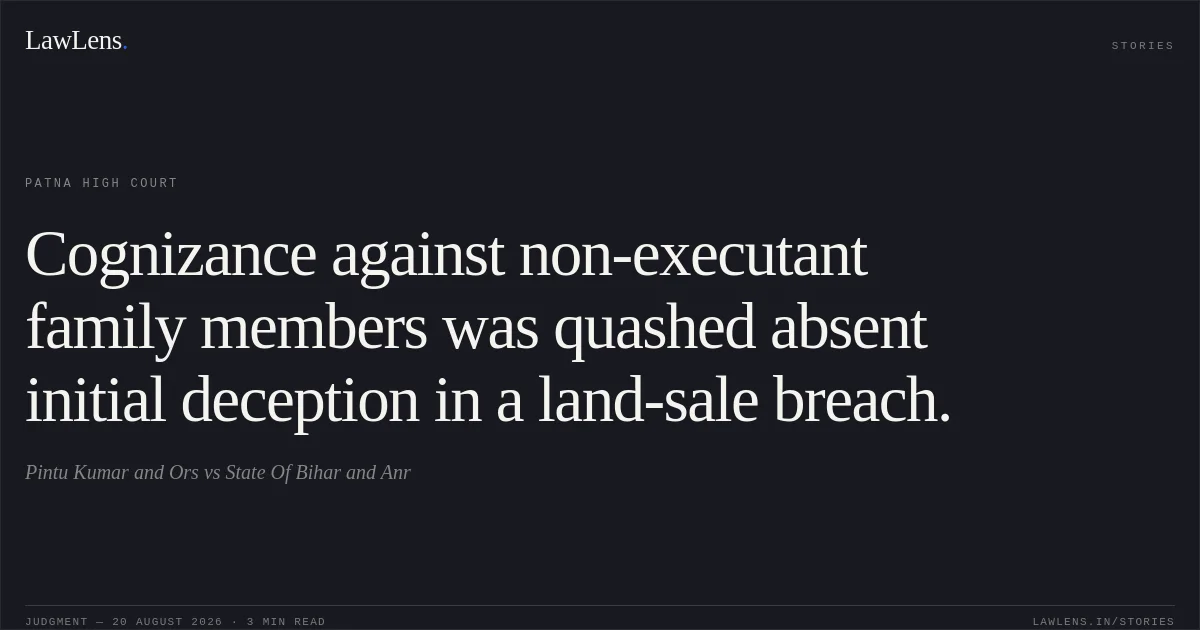
The complainant entered into an agreement for sale with co-accused Pawan Kumar in respect of land for a consideration of ₹32 lakhs and allegedly paid the entire consideration. Despite receiving the money, Pawan Kumar allegedly evaded execution of the sale deed. The petitioners, who were family members of Pawan Kumar, were alleged to have joined him in inducing the complainant to part with the money
Source reference: p. 2The Additional Chief Judicial Magistrate-III, Patna, took cognizance against the petitioners for offences under Sections 420 and 34 of the Indian Penal Code by order dated 15 February 2018 in Complaint Case No. 3582(C) of 2017
Source reference: p. 2The petitioners sought quashing of the cognizance order, contending that they were neither parties to the agreement nor recipients of any money and had been implicated merely because they were related to Pawan Kumar.
Source reference: pp. 2–4The complainant, Opposite Party No. 2, did not appear, and despite opportunities, no application was filed for impleading the immediate family members of the deceased complainant.
Source reference: p. 1Issues
1. Whether the allegations against the petitioners disclosed the offences of cheating under Section 420 read with Section 34 IPC when the petitioners were neither executants of the agreement nor recipients of the consideration amount?
Source reference: pp. 2–4, 52. Whether continuation of the criminal proceedings against the petitioners, arising primarily from non-execution of a sale deed after payment of consideration, would amount to an abuse of the process of the court?
Source reference: pp. 3–5Law Applied
The Court considered Sections 420 and 34 of the Indian Penal Code: Section 420 requires dishonest or fraudulent inducement, ordinarily involving deception at the inception of the transaction, while Section 34 requires a shared intention and participation in the criminal act.
Source reference: pp. 3–4The Court relied on Mala Chaudhary & Anr. v. State of Telangana, 2025 INSC 870, for the principle that a land transaction involving staggered or completed payments and subsequent non-execution of a sale deed does not, without an allegation of initial deception, fraud, or misrepresentation, automatically constitute a criminal offence; such a dispute may remain civil in nature.
Source reference: pp. 3–4The Court further applied its jurisdiction to prevent continuation of criminal proceedings where the allegations, even if accepted in their entirety, do not make out the alleged offences and continuation would constitute an abuse of process.
Source reference: p. 5Reasoning
The Court found that the petitioners were not executants of the sale agreement and that no part of the consideration had been transferred to their accounts.
Source reference: p. 5The allegations primarily concerned Pawan Kumar’s failure to execute the sale deed after allegedly receiving the full consideration. There was no specific allegation that the petitioners themselves made any fraudulent representation, induced the complainant to pay money, or received any amount.
Source reference: pp. 3–5In the absence of initial deception and given that the dispute essentially arose from breach or non-performance of an agreement for sale, the Court held that the ingredients of cheating and common intention were not prima facie established against the petitioners.
Source reference: pp. 3–5Applying the principle in Mala Chaudhary, the Court concluded that the criminal proceeding against the family members was a civil dispute given a criminal colour.
Source reference: pp. 3–5Holding
The Court allowed the application and quashed the order dated 15 February 2018 taking cognizance under Sections 420 and 34 IPC insofar as it related to the petitioners.
The proceedings against co-accused Pawan Kumar were expressly permitted to continue.
Source reference: p. 5Acts & Sections Cited
2 provisions across 1 statute referred to in this judgment. Each provision opens on LawLens.
Indian Penal Code, 18602
Original Court PDF
Pintu Kumar and OrsvsState Of Bihar and Anr
Click to open original judgment
Original judgment, available to read, download and summarize on LawLens.in