Facts
The petitioner, alleged to be a political worker, was accused of entering and using a Government guest house at village Barbaspur for political activities on 15 October 2020, during the State Legislative Assembly by-elections, allegedly in violation of the Model Code of Conduct.
Source reference: para. 2An FIR under Section 188 of the Indian Penal Code was registered on the complaint of a peon and pursuant to a letter issued by the Sub-Divisional Officer (Revenue)-cum-Returning Officer.
Source reference: para. 2The police filed the charge-sheet on 27 August 2023, and the trial court took cognizance on 4 November 2023.
Source reference: para. 3The petitioner challenged the cognizance order, contending that the prosecution was barred by limitation under Section 468 of the Code of Criminal Procedure, 1973 (“CrPC”).
Source reference: para. 3The Revisional Court rejected the challenge, holding that the period during which the petitioner allegedly avoided arrest was excludable under Section 470(4)(b) CrPC.
Source reference: paras. 3–5Issues
Whether cognizance of the offence under Section 188 IPC was barred by limitation under Section 468 CrPC, when the alleged offence occurred on 15 October 2020 but the charge-sheet was filed in August 2023 and cognizance was taken on 4 November 2023?
Source reference: paras. 3, 6, 12Whether the period from the alleged commission of the offence until the petitioner’s appearance before the police could be excluded under Section 470(4)(b) CrPC on the ground that he had absconded or concealed himself?
Source reference: paras. 5, 7–10Whether the trial court had validly extended the limitation period under Section 473 CrPC, despite the absence of a specific and reasoned order explaining the delay and recording that extension was necessary in the interests of justice?
Source reference: para. 11Law Applied
The Court applied Section 188 IPC, under which the offence is punishable with imprisonment of up to one month, or up to six months where the disobedience causes or tends to cause danger to human life, health or safety.
Source reference: paras. 3, 6Consequently, Section 468(2)(b) CrPC prescribed a limitation period of one year for taking cognizance of the offence.
Source reference: paras. 3, 6Section 470(4)(b) CrPC permits exclusion of time during which the accused has been absconding or concealing himself, but such exclusion must be supported by material establishing such conduct.
Source reference: paras. 5, 7Section 473 CrPC empowers the cognizance-taking court to extend limitation where the delay has been properly explained and extension is necessary in the interests of justice.
Source reference: para. 11As held in State of Himachal Pradesh v. Tara Dutt, (2000) 1 SCC 230, such extension must be exercised judicially through a positive, speaking order recording satisfaction on both requirements.
Source reference: para. 11Reasoning
The Court held that the one-year limitation period under Section 468(2)(b) CrPC had expired well before the filing of the charge-sheet and taking of cognizance.
Source reference: paras. 6–10The prosecution could not rely on Section 470(4)(b) merely because the petitioner appeared before the police after receiving a notice under Section 41(1) CrPC on 27 August 2023.
Source reference: paras. 6–10The notice was issued nearly three years after registration of the FIR, and the record contained no material showing that the petitioner had absconded or concealed himself during the intervening period.
Source reference: paras. 6–10Further, neither the charge-sheet nor the cognizance order recorded any declaration of the petitioner as an offender or initiation of proceedings under Sections 82 or 83 CrPC.
Source reference: para. 10The Revisional Court had therefore erred in inferring that limitation stood extended under Section 473 CrPC.
Source reference: para. 11In the absence of a specific, reasoned order by the trial court explaining the delay and recording that extension was necessary in the interests of justice, the requirements identified in Tara Dutt were not satisfied.
Source reference: para. 11Holding
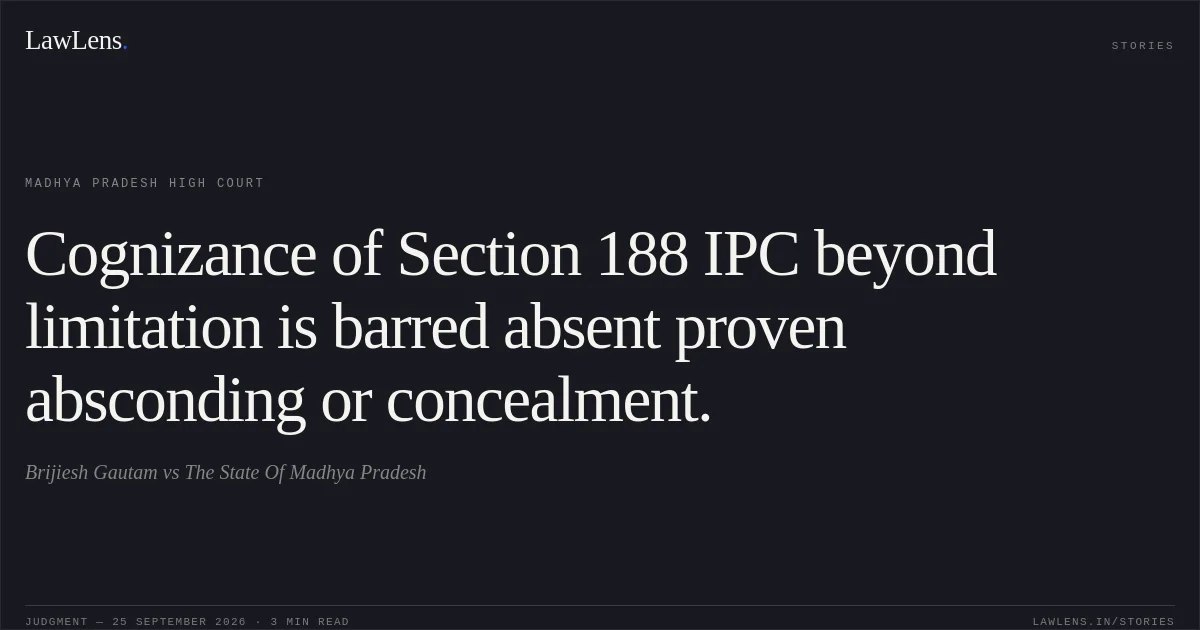
The High Court held that cognizance of the offence under Section 188 IPC was taken beyond the statutory limitation period under Section 468 CrPC.
The alleged period of non-appearance could not be excluded under Section 470(4)(b) CrPC, and there was no valid extension of limitation under Section 473 CrPC.
Source reference: paras. 12–13Accordingly, the petition was allowed, and both the trial court’s cognizance order dated 4 November 2023 and the Revisional Court’s order dated 20 July 2024 were set aside.
Source reference: paras. 12–13Acts & Sections Cited
9 provisions across 3 statutes referred to in this judgment. Each provision opens on LawLens.
Bharatiya Nagarik Suraksha Sanhita, 20231
Indian Penal Code, 18601
Code of Criminal Procedure, 19737
Original Court PDF
Brijiesh GautamvsThe State Of Madhya Pradesh
Click to open original judgment
Original judgment, available to read, download and summarize on LawLens.in