Facts
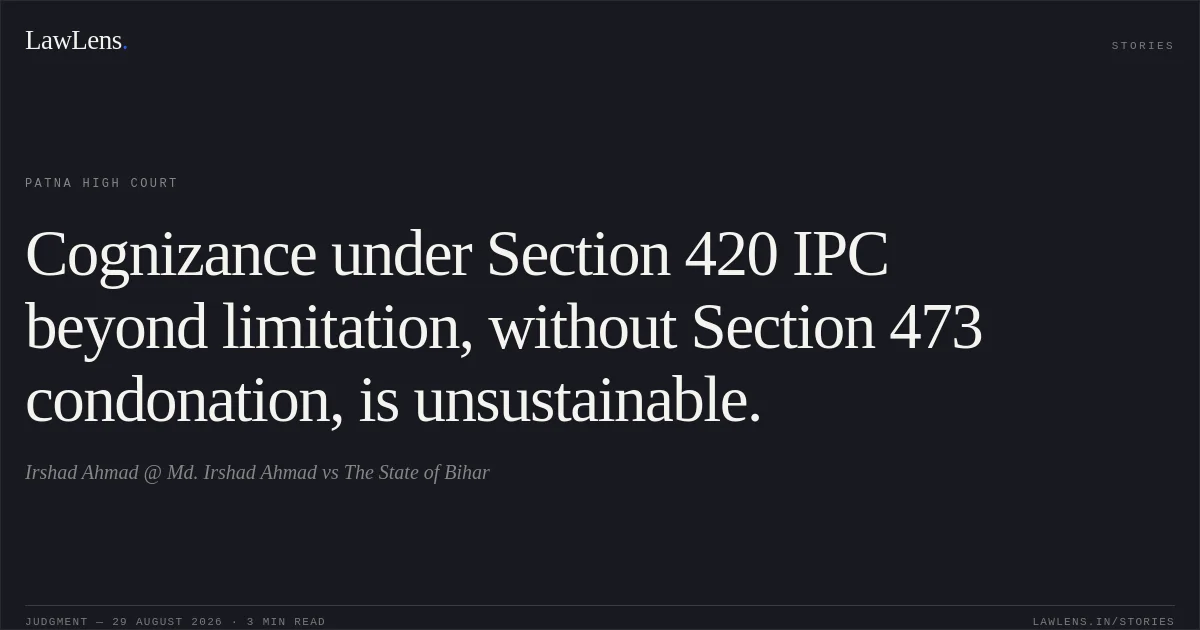
The five petitions arose from the same Complaint Case No. 51 of 2018, Samastipur, and challenged the order dated 13 July 2018 passed by the Additional Chief Judicial Magistrate-I, Dalsingsarai, whereby cognizance was taken under Section 420 of the Indian Penal Code against the petitioners.
Source reference: paras. 2–3; p. 3The complaint alleged large-scale illegal appointments of Block and Panchayat Teachers in Chak Bahauddin Panchayat in collusion with the then Mukhiya, Panchayat Secretary and other officials.
Source reference: para. 4; pp. 3–5It was alleged that several appointees were ineligible or had discrepancies in their educational qualifications and dates of birth, resulting in wrongful payment of salaries and financial loss to the State.
Source reference: para. 4; pp. 3–5The petitioners included the Panchayat Secretary, former Mukhiya, two appointed teachers and the then Block Education Officer.
Source reference: para. 5; p. 5The alleged appointments and irregularities related to the year 2006, whereas the complaint was filed in 2018 and cognizance was taken in 2018.
Source reference: paras. 5.2, 8; pp. 6, 9–10Issues
Whether cognizance under Section 420 IPC could validly be taken in 2018 for alleged acts occurring in 2006 when the delay had not been condoned under Section 473 Cr.P.C.
Source reference: paras. 5.1–5.5, 8; pp. 5–6, 9–10Whether the Magistrate’s order taking cognizance and issuing process demonstrated the requisite application of judicial mind and prima facie satisfaction based on the complaint and supporting materials.
Source reference: paras. 5.8, 9–10; pp. 8–11Whether the allegations and surrounding circumstances justified exercise of the High Court’s inherent jurisdiction to quash the proceedings against the petitioners.
Source reference: paras. 5.6–5.7, 8–10; pp. 8–11Law Applied
The Court applied Section 420 IPC, which criminalises cheating and dishonestly inducing delivery of property and carries a maximum punishment of seven years.
Source reference: paras. 5.2, 8; pp. 6, 9–10It relied on Sections 468 and 473 Cr.P.C., under which cognizance after expiry of the prescribed limitation period is barred unless the delay is properly condoned for recorded reasons in the interests of justice.
Source reference: paras. 5.1–5.4, 8; pp. 5–7, 9–10Relying on Mrs. Sarah Mathew v. Institute of Cardio Vascular Diseases, (2014) 2 SCC 62, the Court noted that limitation ordinarily runs from the date of commission of the offence, not from the date of the complainant’s knowledge, subject to condonation under Section 473 Cr.P.C. where legally justified.
Source reference: para. 5.4; pp. 6–8Under Pepsi Foods Ltd. v. Special Judicial Magistrate, (1998) 5 SCC 749, a summoning order is not mechanical; the Magistrate must apply judicial mind and find sufficient prima facie grounds for proceeding.
Source reference: paras. 5.8–5.9; pp. 8–11The Court also relied on Deputy Chief Controller of Imports and Exports v. Ranjeet Kumar Acharya, (2003) 4 SCC 139, requiring careful scrutiny of a private complaint and positive material disclosing a prima facie criminal act, and referred to the categories in State of Haryana v. Bhajan Lal, 1992 Supp. (1) SCC 335, concerning quashing where no offence is made out or proceedings are malicious or vexatious.
Source reference: paras. 5.7, 9; pp. 8–11Reasoning
The Court found that the alleged occurrence took place in 2006, but the complaint was instituted and cognizance was taken only in 2018, well beyond the applicable limitation period for the alleged Section 420 IPC offence.
Source reference: paras. 5.2, 8; pp. 6, 9–10The Magistrate had neither considered the question of limitation nor invoked and applied Section 473 Cr.P.C. by recording reasons for condoning the delay.
Source reference: paras. 5.3–5.5, 8; pp. 6–10The impugned order merely stated that materials were available against the accused and directed issuance of summons, without demonstrating meaningful consideration of the complaint, the evidence recorded, the delay or the basis for individual prima facie satisfaction.
Source reference: paras. 5.4, 9–10; pp. 7–11Applying Sarah Mathew, Pepsi Foods and Ranjeet Kumar Acharya, the Court held that the belated cognizance, absence of reasoned condonation and mechanical nature of the order rendered the proceedings jurisdictionally defective.
Source reference: paras. 5.4, 5.8–5.9, 8–10; pp. 7–11The Court also noted that the allegations appeared vexatious in the context of serious litigation between some of the parties.
Source reference: para. 8; p. 10Holding
The Court answered the issues in favour of the petitioners.
It held that cognizance under Section 420 IPC was barred by limitation and that the delay had not been condoned under Section 473 Cr.P.C.; further, the order taking cognizance suffered from non-application of judicial mind and failure to follow the prescribed criminal procedure.
Source reference: para. 10; p. 11Accordingly, the order dated 13 July 2018 in Complaint Case No. 51 of 2018, Tr. No. 885 of 2018, was quashed insofar as it concerned the five petitioners.
Source reference: para. 10; p. 11The proceedings against the remaining co-accused were expressly permitted to continue, and all five applications were allowed.
Source reference: para. 10; p. 11Acts & Sections Cited
4 provisions across 2 statutes referred to in this judgment. Each provision opens on LawLens.
Indian Penal Code, 18601
Code of Criminal Procedure, 19733
Original Court PDF
Irshad Ahmad @ Md. Irshad AhmadvsThe State of Bihar
Click to open original judgment
Original judgment, available to read, download and summarize on LawLens.in
![A police constable cannot be removed for unauthorized absence without a Rule 359-compliant inquiry.. Mohammad Sidiq Khan vs D/o Home Ut Of Jammu & Kashmir. CAT - ['Srinagar']. LawLens](/stories/thumbnails/a-police-constable-cannot-be-removed-for-unauthorized-absence-without-a-rule-359-compliant-7b43fc316bd94f22a62676153bbc9d54.webp)
![A Review DPC lacks authority to determine or alter inter se seniority.. SAURABH KUMAR vs REVENUE. CAT - ['Patna']. LawLens](/stories/thumbnails/a-review-dpc-lacks-authority-to-determine-or-alter-inter-se-seniority-4b21640f20af46fcabdfc8273d2ce959.webp)