Facts
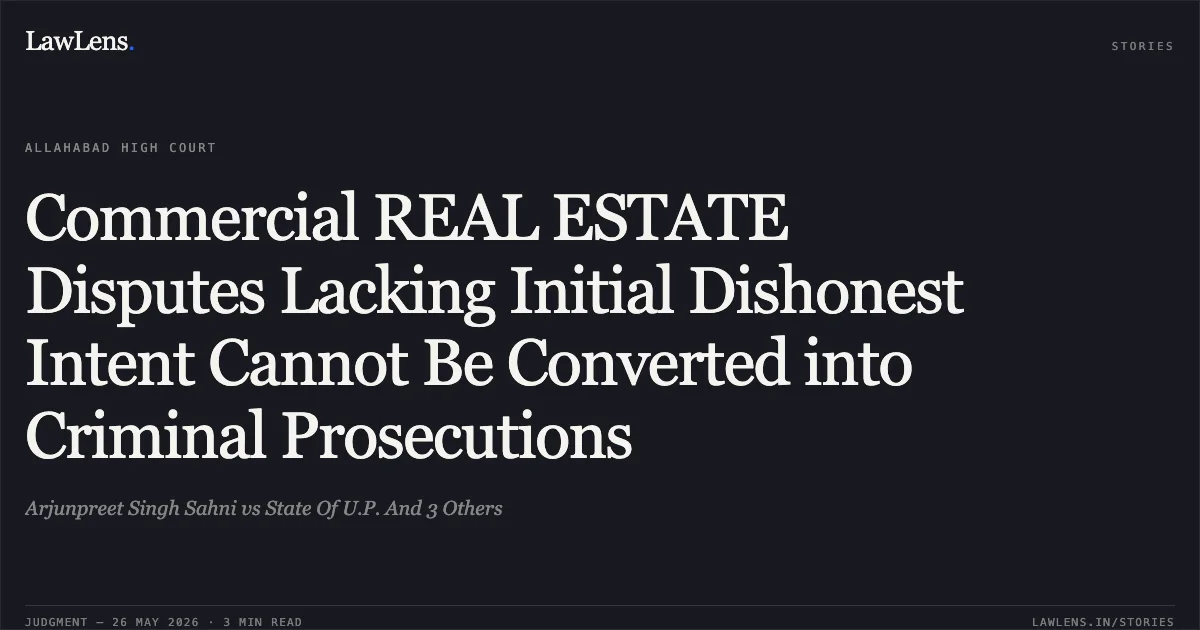
The petitioners (Directors/entities of Solitarian Group and Prasandi Infotech Park) challenged an FIR (Case Crime No. 227/2025) registered under Sections 406, 420, 467, 468, 469, 471, and 120-B of the IPC.
Source reference: para. 1-2The Complainant (Respondent No. 4) alleged that after booking three commercial units in 2008 and experiencing delays, the accused induced him to accept a fourth unit (Shop No. 12) in 2015/2022 in lieu of "assured returns".
Source reference: para. 10-12It was alleged that after paying over Rs. 48 lakhs, the Complainant discovered Shop No. 12 was a non-existent common passage and that the allotment documents were fabricated.
Source reference: para. 18-19The petitioners argued that the dispute was purely commercial, arising from a project with layered management transitions (ERA to SREI/BNF to Solitarian), and that possession of the original units had already been delivered via sub-lease deeds in 2022.
Source reference: para. 7-8, 27Issues
1. Whether the allegations in the FIR, taken at face value, satisfy the essential ingredients of cheating, criminal breach of trust, and forgery under the IPC.
Source reference: para. 582. Whether the dispute is essentially civil/commercial in nature, warranting the quashing of criminal proceedings.
Source reference: para. 583. Whether the existence of an arbitration clause and specialized statutory remedies under the RERA Act bars or discourages criminal prosecution in real estate disputes.
Source reference: para. 41, 93Law Applied
The Court applied the standards for quashing an FIR established in State of Haryana v. Bhajan Lal, emphasizing that proceedings may be quashed if allegations do not constitute an offence or are maliciously instituted.
Source reference: para. 60It relied on Neeharika Infrastructure Pvt. Ltd. v. State of Maharashtra regarding the limits of interfering with investigations.
Source reference: para. 61For Section 420 IPC (Cheating), it applied Hridaya Ranjan Prasad Verma v. State of Bihar, holding that dishonest intention must exist at the inception of the transaction.
Source reference: para. 73, 82Regarding the conversion of civil disputes to criminal cases, the Court cited Indian Oil Corpn. v. NEPC India Ltd. and V.Y. Jose v. State of Gujarat, which warn against using criminal law as a shortcut for contractual enforcement.
Source reference: para. 73-74It also referenced the Real Estate (Regulation and Development) Act, 2016 (RERA) as the specialized regulatory framework for builder-buyer grievances.
Source reference: para. 93Reasoning
The Court observed that the parties shared a long-standing commercial relationship since 2008, and the fact that possession was offered in 2012 and sub-lease deeds were executed in 2022 for the original units negated any "dishonest intention at inception" required for Section 420.
Source reference: para. 66, 83The dispute regarding the "fourth unit" emerged from accounting disagreements over "assured returns," which is a contractual matter.
Source reference: para. 68-70Regarding forgery (Sections 467-471), the Court noted the document relied upon by the Complainant was unsigned by the petitioners and arose during a period when management control rested with SREI/BNF, not the current petitioners.
Source reference: para. 87-91The Court emphasized that the agreement contained an arbitration clause (Clause 7, Heading X) and that the grievances fell squarely under the specialized adjudicatory mechanism of RERA Sections 31 and 71.
Source reference: para. 71, 93-94It concluded that the FIR was an attempt to criminalize a regulatory and contractual default.
Source reference: para. 96Holding
The Court answered the issues in the affirmative for the petitioners, holding that the dispute was predominantly civil and the FIR lacked the foundational ingredients of the alleged crimes.
Framing the matter as an abuse of the process of law, the High Court allowed the writ petitions and quashed FIR Case Crime No. 227/2025 and all consequential proceedings against the petitioners.
Source reference: para. 108-109The Court clarified that the Complainant remains free to pursue civil or statutory remedies before the appropriate forums.
Source reference: para. 103, 110Acts & Sections Cited
17 provisions across 3 statutes referred to in this judgment. Each provision opens on LawLens.
Indian Penal Code, 1860
Code of Criminal Procedure, 19735
Real Estate (Regulation and Development) Act, 2016.2
Original Court PDF
Arjunpreet Singh SahnivsState Of U.P. And 3 Others
Click to open original judgment
Original judgment, available to read, download and summarize on LawLens.in