Facts
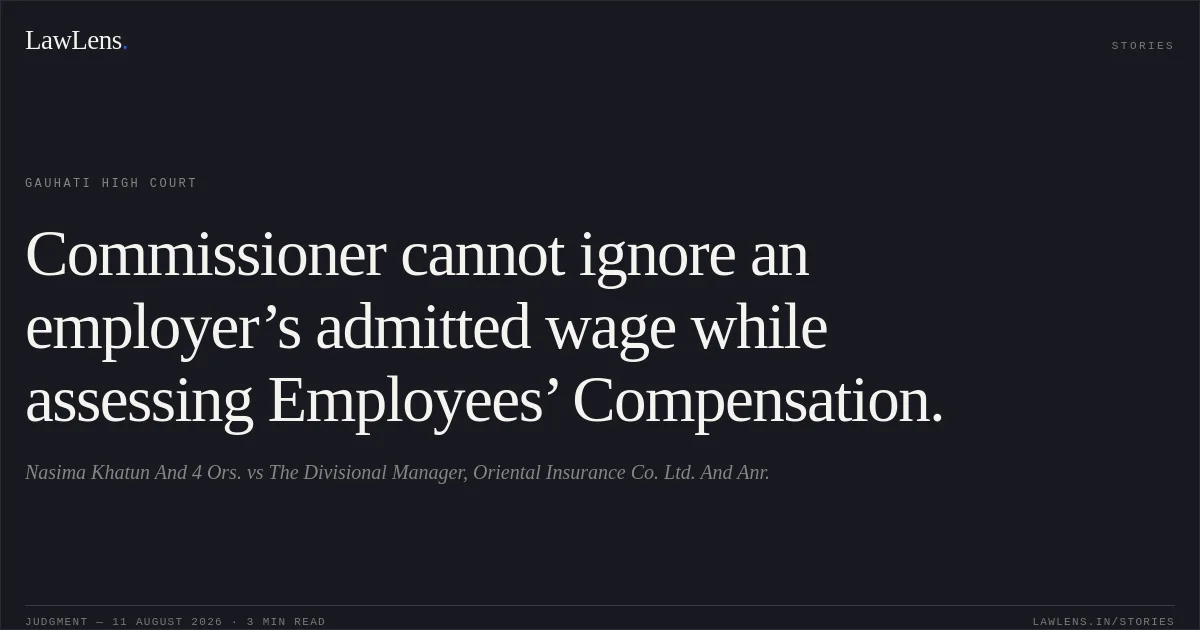
Late Haraj Ali was employed as a driver by respondent No. 2, Rafiqul Mandal, to drive vehicle No. AS-15-C-3135 at a claimed monthly salary of ₹12,000; the owner, however, admitted in his written statement that the salary was ₹8,000 per month.
Source reference: paras. 3, 5During the course of employment, the vehicle met with an accident on 23.06.2013, resulting in Haraj Ali sustaining serious injuries and subsequently dying; the judgment records the date of death as 26.03.2013.
Source reference: para. 4His widow, children and father filed a claim under the Employees’ Compensation Act, 1923.
Source reference: no citationThe Commissioner awarded ₹5,81,280, calculating the deceased’s monthly income at ₹5,500.
Source reference: para. 2The claimants appealed under Section 30 of the Act, contending that the Commissioner had ignored the salary certificate marked Exhibit-4 and the owner’s admission regarding the deceased’s wages.
Source reference: paras. 7–10The insurer argued that Exhibit-4 should not be relied upon because the owner had not been examined and that the written statement disclosed a salary of only ₹8,000.
Source reference: paras. 11–12Issues
1. Whether the Commissioner acted perversely and unlawfully by holding that no salary certificate had been produced and by assessing the deceased driver’s monthly income at ₹5,500 despite the materials on record?
Source reference: paras. 7, 14, 222. Whether the deceased’s monthly salary should be assessed at ₹12,000 on the basis of Exhibit-4 or at ₹8,000 on the basis of the employer’s admission in the written statement?
Source reference: paras. 18–23Law Applied
The appeal was governed by Section 30 of the Employees’ Compensation Act, 1923, which permits an appeal to the High Court on a substantial question of law.
Source reference: para. 7The Court applied the doctrine of perversity: a finding is perverse where relevant evidence is ignored, irrelevant material is considered, or the conclusion is so irrational that no reasonable person could have reached it.
Source reference: paras. 15–17Relying on Associate Builders v. DDA, (2015) 3 SCC 49, including the principles drawn from Excise and Taxation Officer-cum-Assessing Authority v. Gopi Nath & Sons and Kuldeep Singh v. Commissioner of Police, the Court held that a finding based on no evidence or rendered by ignoring vital evidence is legally infirm.
Source reference: para. 16The Court also applied the principle that admitted facts need not be proved, and treated the employer’s admission of ₹8,000 monthly wages as material evidence.
Source reference: para. 20Compensation was recalculated under the applicable provisions of the Employees’ Compensation Act, including the statutory compensation formula and funeral-expense provision under Section 4.
Source reference: para. 23Reasoning
The Commissioner’s finding that the claimants had produced no salary certificate was demonstrably incorrect because Exhibit-4 had been exhibited by the claimant while deposing as PW-1.
Source reference: paras. 8, 18Although the Court accepted that Exhibit-4 could potentially be discarded because the employer who issued it was not examined, the employer’s written statement independently contained a clear admission that Haraj Ali was employed as the vehicle’s driver for ₹8,000 per month.
Source reference: paras. 19–20That admission was not effectively denied by the insurer and could not lawfully be ignored.
Source reference: paras. 19–20Consequently, while the evidence did not justify accepting the disputed figure of ₹12,000, it also did not justify resorting to the minimum wage of ₹5,500 in disregard of the admitted wage.
Source reference: paras. 21–23The Commissioner’s assessment was therefore perverse.
Source reference: paras. 21–23Applying the statutory factor of 209.92 to 50% of the accepted monthly wage of ₹8,000, the Court calculated compensation at ₹8,39,680 and directed payment of the enhanced amount together with funeral expenses.
Source reference: paras. 21–24Holding
The substantial question of law was answered in favour of the claimants.
The High Court held that the Commissioner had perversely ignored relevant evidence and the employer’s admission regarding the deceased’s wages.
Source reference: para. 22The deceased’s monthly salary was fixed at ₹8,000, rather than ₹12,000 or ₹5,500, and the compensation was enhanced to ₹8,43,680.
Source reference: para. 23The amount was directed to carry interest at 9% per annum after one month from the date of the Commissioner’s award until realization.
Source reference: para. 24Oriental Insurance Company was directed to deposit the amount before the Commissioner, Workmen’s Compensation, Barpeta within four weeks, after which it was to be disbursed among the claimants in the proportions specified in the original award.
Source reference: para. 25The appeal was accordingly allowed and the original records were directed to be returned to the Commissioner.
Source reference: paras. 26–27Acts & Sections Cited
2 provisions across 1 statute referred to in this judgment. Linked provisions open on LawLens.
Employee2
Original Court PDF
Nasima Khatun And 4 Ors.vsThe Divisional Manager, Oriental Insurance Co. Ltd. And Anr.
Click to open original judgment
Original judgment, available to read, download and summarize on LawLens.in