Facts
The petitioner challenged the SDJM, Jagatsinghpur’s order dated 6 July 2026, which took cognizance of offences under Sections 68(a), 68(b) and 69 of the Bharatiya Nyaya Sanhita (BNS) and directed the clerk to transmit the record to the Sessions Court
Source reference: p.1, para. 1; p.3, para. 3In an earlier revision, the High Court had set aside the prior cognizance order and remitted the matter for fresh consideration; on reconsideration, the SDJM again took cognizance but did not conduct committal proceedings
Source reference: pp.2–3, para. 3The petitioner’s limited grievance in the present revision was the omission of that procedure
Source reference: p.2, para. 3Issues
Whether the SDJM could transmit the case to the Sessions Court without following the committal procedure for an offence triable exclusively by the Court of Session
Source reference: pp.2–3, paras. 3–4Whether the SDJM’s cognizance of offences under Sections 68(a) and 68(b) BNS should be set aside in this revision, given the petitioner’s reliance on observations in the earlier revision
Source reference: p.4, para. 4Law Applied
The revision was brought under Sections 401 and 397 of the Code of Criminal Procedure, corresponding, as stated in the judgment, to Sections 442 and 438 of the Bharatiya Nagarik Suraksha Sanhita
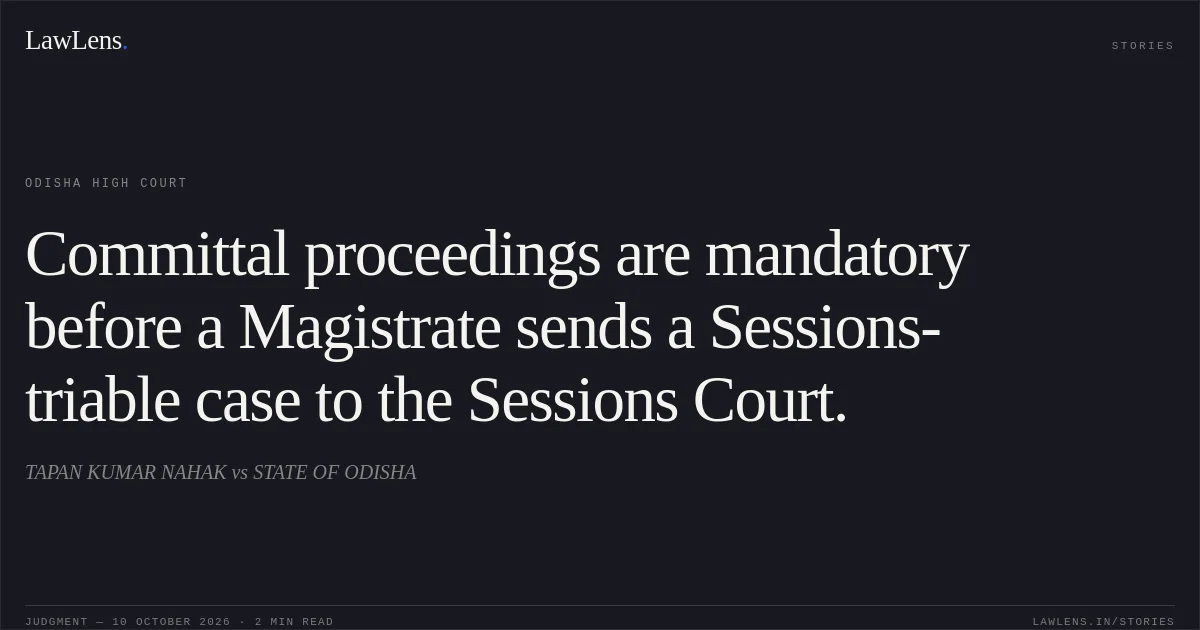
Source reference: p.1The Court held that committal procedure must be followed where an offence is exclusively triable by the Court of Session; it is not an empty formality and is a valuable procedural right of the accused.
Source reference: p.3, para. 4Where the law prescribes that an act be done in a particular way, it must be done in that way, and revisional jurisdiction may be exercised to rectify a jurisdictional error
Source reference: p.3, para. 4The Court did not identify a specific committal-procedure provision
Source reference: no citationReasoning
The SDJM’s direction to the dealing clerk merely to transmit the record did not constitute compliance with the committal procedure required for a Sessions-triable case
Source reference: p.3, paras. 3–4The Court therefore found an error warranting revision and directed the SDJM to follow the prescribed procedure
Source reference: p.4, para. 4As to Sections 68(a) and 68(b) BNS, the Court noted the petitioner’s reliance on the earlier revision’s observations but left the issue open for consideration at the charge-framing stage if the case is committed to the Sessions Court
Source reference: p.4, para. 4Holding
The revision was allowed, and the impugned order was modified to require the SDJM to conduct committal proceedings
If the record had already been transmitted to the Sessions Court, it was to be returned to the SDJM. The petitioner was directed to appear before the SDJM on 3 November 2026; the Court directed that no further adjournment be granted to the accused for the committal procedure
Source reference: pp.4–5, para. 5Acts & Sections Cited
4 provisions across 2 statutes referred to in this judgment. Each provision opens on LawLens.
Code of Criminal Procedure, 19732
Bharatiya Nagarik Suraksha Sanhita, 20232
Original Court PDF
TAPAN KUMAR NAHAKvsSTATE OF ODISHA
Click to open original judgment
Original judgment, available to read, download and summarize on LawLens.in