Facts
The complainant, a former employee of the insurance company, alleged that he resigned because of the petitioners’ conduct and that the company failed to pay amounts due to him, including provident fund, salary, gratuity and reimbursement of certain bills.
Source reference: p. 2–3The Chief Judicial Magistrate took cognizance against the petitioners under Sections 406, 504 and 506 IPC and issued summons; the District Judge dismissed their criminal revision.
Source reference: p. 2–3The petitioners then sought quashing of both orders under Section 482 CrPC.
Source reference: p. 6Issues
1. Whether the complaint and the complainant’s statement disclosed the offences alleged under Sections 406, 504 and 506 IPC against the petitioners.
Source reference: p. 2–3, 5–62. Whether the petitioners could be prosecuted in connection with the company’s alleged non-payment when the company itself had not been arrayed as an accused.
Source reference: p. 3–53. Whether the orders taking cognizance and dismissing the revision warranted interference under Section 482 CrPC.
Source reference: p. 5–6Law Applied
The Court considered Sections 406, 504 and 506 IPC, under which the complaint alleged criminal breach of trust, intentional insult and criminal intimidation, and exercised its quashing jurisdiction under Section 482 CrPC.
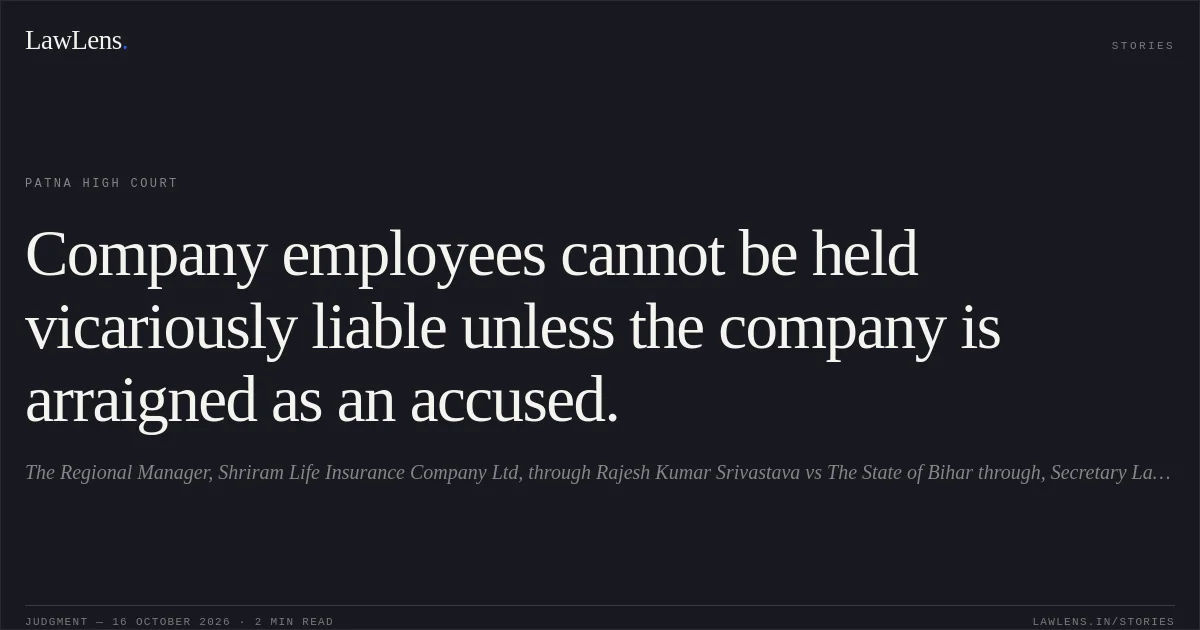
Source reference: no citationRelying on Aneeta Hada v. M/s Godfather Travels and Tour Private Limited, (2012) 5 SCC 661, and Sharad Kumar Sanghi v. Sangita Rane, (2015) 12 SCC 781, the Court stated that employees would not be vicariously responsible for an offence in the absence of the company being arraigned as an accused.
Source reference: p. 4It also relied on M/s Pepsi Foods Ltd. v. Judicial Magistrate, (1998) 5 SCC 749, for the principle that taking cognizance and issuing summons are serious judicial acts requiring application of mind and should not be undertaken mechanically.
Source reference: p. 5Reasoning
The Court read the complaint and the complainant’s statement as alleging non-payment of employment-related dues by the company, rather than facts establishing criminal conduct by the petitioners.
Source reference: p. 4–5It noted that the company was not made an accused and applied the cited authorities to conclude that the petitioners could not be held vicariously responsible in these circumstances.
Source reference: p. 4–5It further considered the alleged unpaid dues to be matters for alternative civil or labour remedies and found no criminal intent or other allegations sufficient to make out the charged offences.
Source reference: p. 5–6The cognizance order was also found to have been passed mechanically, without adequate judicial application of mind.
Source reference: p. 5–6Holding
The Court held that the allegations did not disclose the offences alleged against the petitioners and that the complaint suffered from a fundamental defect because the company was not arrayed as an accused.
It allowed the application under Section 482 CrPC, quashed the orders dated 24 November 2021 and 3 July 2019, and quashed the prosecution arising from the complaint.
Source reference: p. 6Acts & Sections Cited
1 provisions across 1 statute referred to in this judgment. Each provision opens on LawLens.
Code of Criminal Procedure, 19731
Original Court PDF
The Regional Manager, Shriram Life Insurance Company Ltd, through Rajesh Kumar SrivastavavsThe State of Bihar through, Secretary Law Department, Bihar
Click to open original judgment
Original judgment, available to read, download and summarize on LawLens.in