Facts
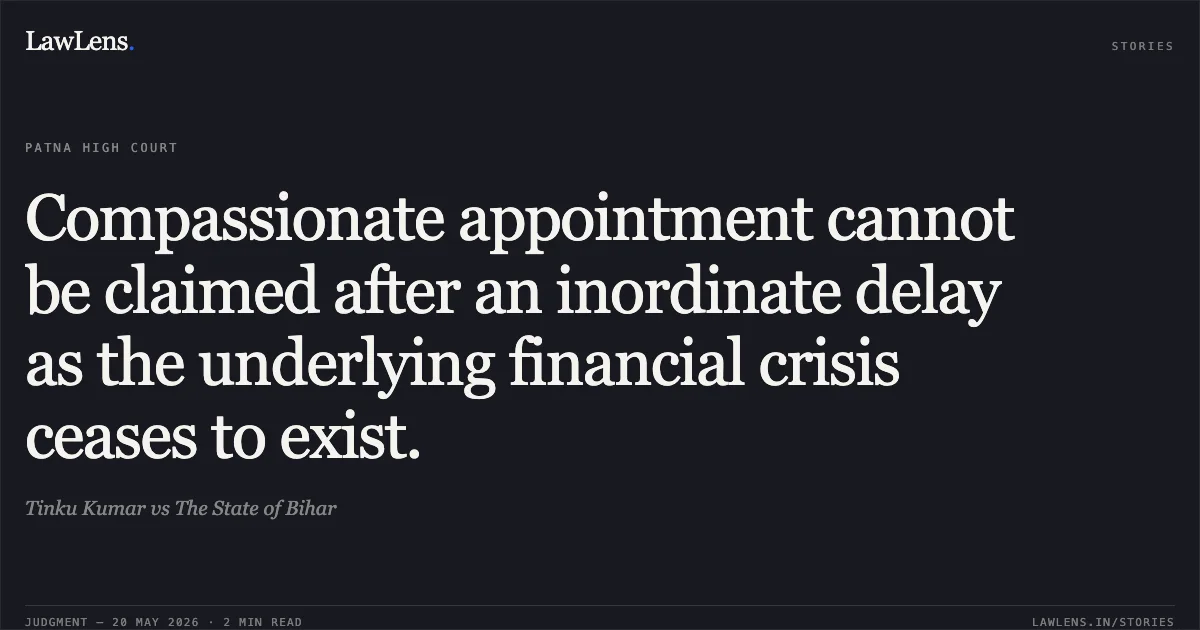
The petitioner’s father, a Sweeper at Patna Medical College and Hospital (PMCH), died in harness on July 23, 2009.
Source reference: para. 2The petitioner applied for compassionate appointment on October 22, 2010, but was initially rejected for lack of requisite educational qualifications. After subsequently passing the Madhyama Examination, he submitted his certificate and continued to file representations, including one to the District Magistrate in 2025.
Source reference: para. 2-3The petitioner approached the High Court in 2026—17 years after his father's death—seeking a writ of mandamus to command the respondents to consider his appointment due to the family's financial hardship.
Source reference: para. 2, 6Issues
1. Whether a claim for compassionate appointment can be entertained after a significant lapse of time (17 years) from the date of the employee's death.
Source reference: para. 6, 8Law Applied
Compassionate appointment is not a vested right or an alternative mode of recruitment, but a provision to provide immediate relief to a family in financial crisis following the death of a breadwinner.
Source reference: para. 8-10The court relied on Umesh Kumar Nagpal v. State of Haryana (1994) 4 SCC 138, which held that such employment cannot be claimed after the crisis is over.
Source reference: para. 8Jagdish Prasad v. State of Bihar (1996) 1 SCC 301, which emphasized the objective of relieving "unexpected immediate hardship".
Source reference: para. 9Local Administration Department v. M. Selvanayagam (2011) 13 SCC 42, noting that delayed appointments conflict with Articles 14 and 16 of the Constitution.
Source reference: para. 10Reasoning
The court reasoned that the primary objective of compassionate appointment is to provide "immediate succour" to a family in dire straits.
Source reference: para. 10In this case, there was a delay of nearly 17 years between the death of the father (2009) and the filing of the writ petition (2026). The court found that because the family had survived for nearly two decades, the immediate financial crisis intended to be mitigated by the policy no longer existed.
Source reference: para. 6, 8Granting relief after such a long duration would treat the scheme as a regular source of recruitment rather than an exception, which is legally impermissible.
Source reference: para. 9The court noted its own recent precedent in Janki Ballabh v. State of Bihar (2026), where claims were rejected on grounds of delay and laches.
Source reference: para. 11Holding
The court held that the petitioner’s claim was not fit for consideration due to the extensive delay and the settled legal position that compassionate appointment cannot be granted after a reasonable period has lapsed.
The writ petition was dismissed as lacking merit. All pending applications were disposed of accordingly.
Source reference: para. 12, 13Original Court PDF
Tinku KumarvsThe State of Bihar
Click to open original judgment
Original judgment, available to read, download and summarize on LawLens.in