Facts
The appellant’s father, an employee of TANGEDCO, died in service on 16.02.2013
Source reference: p. 2At that time, the appellant was a minor, aged 13. He submitted an initial application for compassionate appointment on 03.11.2014, which was rejected on 12.01.2015 due to his minority
Source reference: p. 2Upon attaining majority, six years after his father’s death, the appellant submitted a second application on 14.10.2019
Source reference: p. 2This application was rejected because it was not filed within the mandated three-year period from the date of the employee's death. The appellant challenged this via W.P.No.6728 of 2022, which was dismissed on 24.03.2022
Source reference: p. 1-2The present matter is an intra-court appeal against that dismissal.
Source reference: no citationIssues
1. Whether an application for compassionate appointment can be entertained if submitted beyond the stipulated three-year period from the date of the employee's death
Source reference: p. 32. Whether compassionate appointment is an absolute right or a concession governed strictly by the terms of the scheme
Source reference: p. 3-4Law Applied
The court applied the principle that compassionate appointment is a concession and not an absolute right, intended to alleviate immediate indigent circumstances rather than serve as a secondary mode of recruitment
Source reference: p. 3it held that such schemes must be implemented strictly according to their specific terms and conditions, specifically the limitation period for applications
Source reference: p. 3The court further noted that compassionate appointments are technically violative of Articles 14 and 16 of the Constitution of India as they bypass merit-based assessment and rules of reservation; therefore, they must be construed narrowly
Source reference: p. 4Reasoning
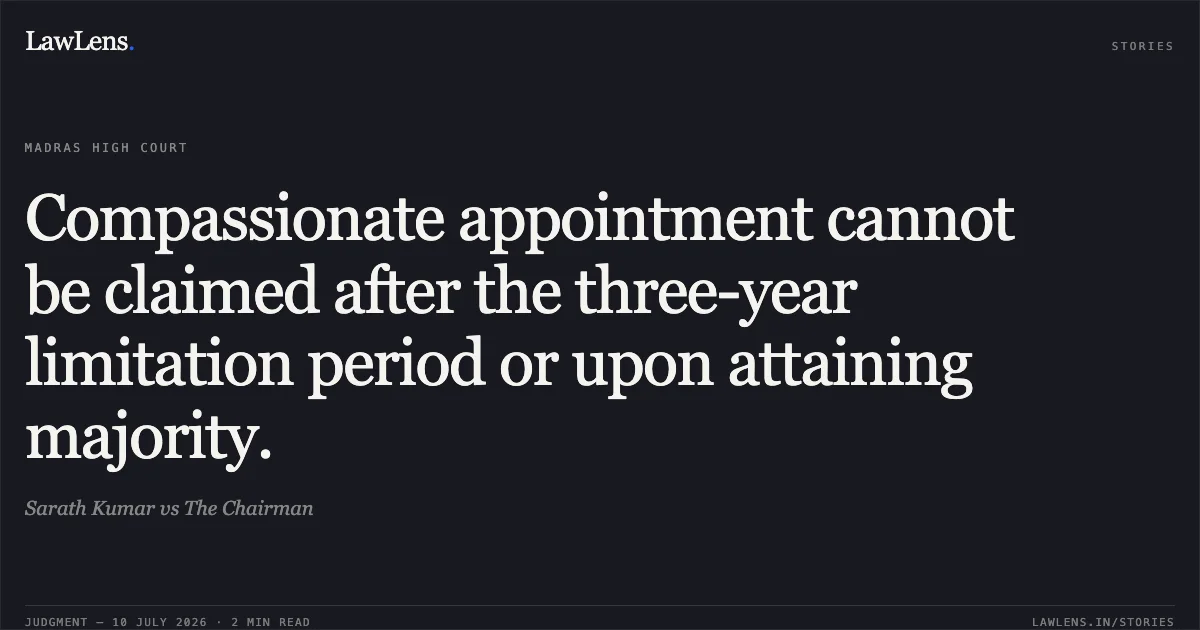
The Court reasoned that the limitation period of three years is reckoned strictly from the date of the death of the employee, not from the date the legal heir attains majority
Source reference: p. 3Since the appellant’s second application was filed six years after the death, it fell outside the permissible window of the TANGEDCO scheme
Source reference: p. 3The Court emphasized that for an application to be valid, the legal heir must be eligible and apply within the three-year window
Source reference: p. 3Furthermore, the Court observed that "indigent circumstances" must be factually verified by authorities and are not proven solely by a Tahsildar’s certificate
Source reference: p. 4Because the scheme is an exception to the constitutional mandates of equality in public employment under Articles 14 and 16, any deviation from the scheme's strict timelines cannot be permitted
Source reference: p. 4Holding
The Court answered the issues in the negative, holding that there was no infirmity in the Writ Court's order
The Court affirmed that the three-year limitation period is mandatory and the appellant's delay of six years rendered the application inadmissible
Source reference: p. 3The Writ Appeal was dismissed, and the request for compassionate appointment was denied
Source reference: p. 4No costs were ordered
Source reference: p. 4Acts & Sections Cited
1 provisions across 1 statute referred to in this judgment. Linked provisions open on LawLens.
Letters Patent1
Original Court PDF
Sarath KumarvsThe Chairman
Click to open original judgment
Original judgment, available to read, download and summarize on LawLens.in


