Facts
The respondent’s father was appointed as a daily wager in 1987 and regularized in 1990 at a Medical College Hospital in Bhagalpur
Source reference: para. 3(i)Following the detection of large-scale irregularities in Health Department appointments, a High-Level Five-Men Committee (constituted per court orders) categorized his appointment as "illegal" in 2008
Source reference: para. 3(iii)Although his termination was initially set aside by a Single Judge in 2009 and he was reinstated subject to the outcome of a Letters Patent Appeal (L.P.A.), he died in harness on 15.04.2012
Source reference: para. 3(vi)The State extended death-cum-retiral benefits under contempt pressure
Source reference: para. 3(vi)His son (respondent) applied for compassionate appointment, which the State rejected based on the father's "illegal" appointment status
Source reference: para. 4A Single Judge allowed the son's writ petition in 2025, holding the rejection unjustified
Source reference: para. 2Issues
1. Whether the law laid down in Kirti Narayan Prasad and Devendra Sharma (holding such appointments illegal) applies to the respondent despite him/his father not being parties to those specific cases?
Source reference: para. 10(i) / 122. Whether the services of the deceased can be declared "illegal" posthumously without a hearing?
Source reference: para. 10(ii) / 133. Whether extending retiral benefits creates an estoppel against the State from treating the appointment as illegal?
Source reference: para. 10(iii) / 144. Whether the respondent is entitled to compassionate appointment and parity with others similarly situated?
Source reference: para. 10(iv-v) / 15-16Law Applied
The court applied the mandate of the Constitution Bench in Secretary, State of Karnataka v. Uma Devi (3), which distinguishes between "regular" and "illegal" appointments
Source reference: para. 3(ii)It relied heavily on State of Bihar v. Kirti Narayan Prasad (2019) and State of Bihar v. Devendra Sharma (2020), which established that appointments made without sanctioned posts or due process are void ab initio and ineligible for regularization
Source reference: para. 3(vii-viii)The court invoked the principle from Rita Mishra v. Director Primary Education (1987) that service benefits spring only from valid appointments
Source reference: para. 15.2Regarding Article 14, it applied the doctrine from Basawaraj v. Special Land Acquisition Officer (2013) and R. Muthukumar v. TANGEDCO (2022), stating that there is no "negative equality" and an illegality cannot be perpetuated by claiming parity
Source reference: para. 16.1-16.3Reasoning
The court reasoned that the High-Level Committee’s findings, which categorized the father’s appointment as "illegal," were expressly upheld by the Supreme Court in Kirti Narayan Prasad, making that determination a judgment in rem regarding that class of employees
Source reference: para. 12.10It held that disciplinary or inquiry proceedings do not abate upon death if the inquiry concluded during the employee's lifetime; here, the Committee’s report was finalized in 2008 while the father was alive
Source reference: para. 13.5-13.9The court found that the payment of salary and retiral benefits was provisional and subject to the pending L.P.A., thus it did not validate an inherently void appointment
Source reference: para. 14.1-14.4Since the father’s entry was a "back-door" illegal appointment, no right to compassionate appointment could flow to his heirs, as such rights only stem from a lawful underlying service
Source reference: para. 15.3Finally, the court rejected the plea of parity with one Munna Kumar, holding that even if the State erroneously granted appointment to another, the court cannot compel the State to repeat the illegality
Source reference: para. 16.5Holding
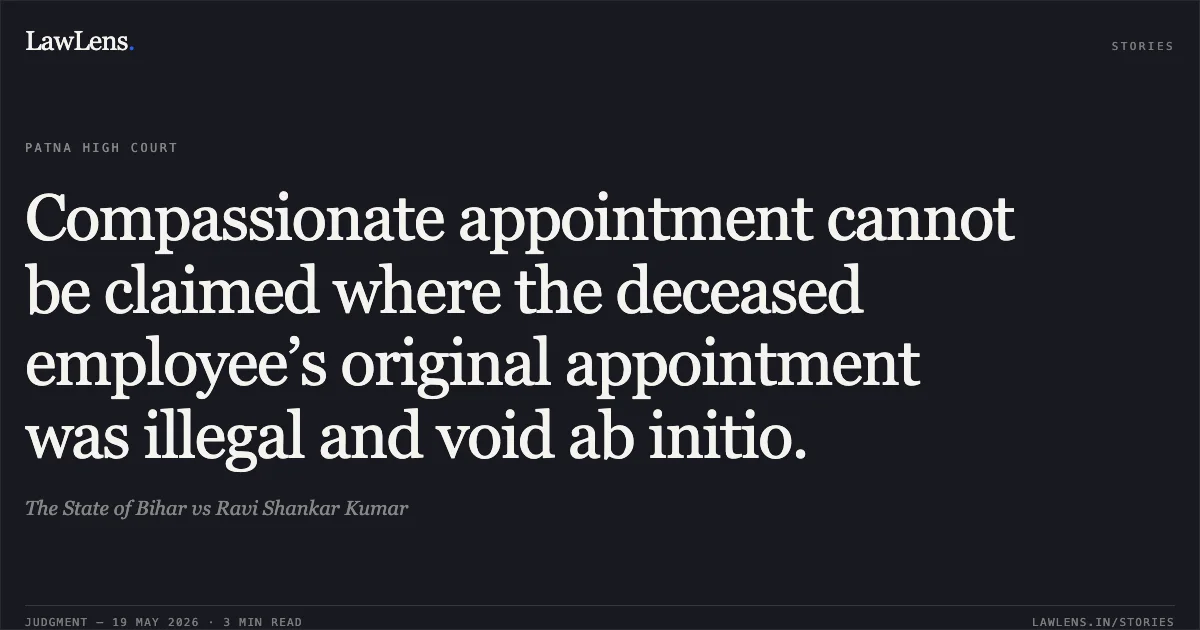
(i) the father's appointment was void ab initio per Supreme Court precedents, (ii) death does not cure a foundational illegality in appointment, and (iii) compassionate appointment is not a vested right and cannot be granted based on an illegal tenure
The Court allowed the Letters Patent Appeal and set aside the Single Judge's order. The writ petition filed by the respondent was dismissed.
Source reference: para. 18-19Acts & Sections Cited
1 provisions across 1 statute referred to in this judgment. Each provision opens on LawLens.
Code of Criminal Procedure, 19731
Original Court PDF
The State of BiharvsRavi Shankar Kumar
Click to open original judgment
Original judgment, available to read, download and summarize on LawLens.in


![Authorities must decide pensionary and retiral-benefit claims through a reasoned order within eight weeks.. Habibullah khan vs HOME DEPARTMENT. CAT - ['Srinagar']. LawLens](/stories/thumbnails/authorities-must-decide-pensionary-and-retiral-benefit-claims-through-a-reasoned-order-wit-d0cbe8a8119c48fbabe7df9f2d353488.webp)