Facts
The appellant’s father, a police employee, died in service on 16 April 1999. The appellant stated that an application for compassionate appointment had been submitted in 1993; however, the authorities did not consider it because the deceased employee had two wives and a family dispute existed at the relevant time.
Source reference: p.2, para.2The appellant’s mother subsequently submitted representations in 2011 and 2021, which were rejected on the ground that they were made beyond the prescribed period of three years. The appellant’s writ petition challenging the non-consideration of her claim was dismissed on 19 July 2023 in W.P. No. 21247 of 2023. She thereafter preferred the present writ appeal.
Source reference: p.1, para.1; p.2, para.2By the time of decision, approximately 24 years had elapsed from the employee’s death and the appellant was about 44 years old.
Source reference: p.3–4, para.4Issues
Whether the appellant could claim compassionate appointment approximately 24 years after the death of the government employee, despite the prescribed limitation and the passage of substantial time.
Source reference: p.2–4, paras.2–4Whether the appellant’s claim could be granted consistently with the limited and exceptional nature of compassionate appointment and the constitutional requirements of Articles 14 and 16.
Source reference: p.2–3, paras.2–3Law Applied
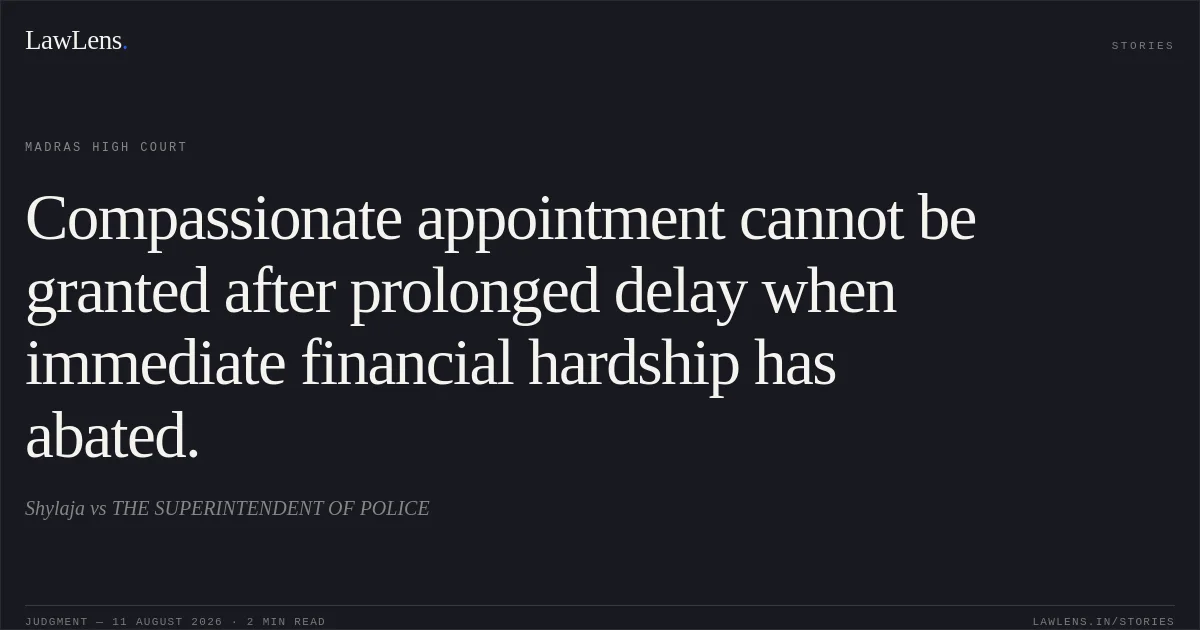
Compassionate appointment is a concession and not a constitutional or vested right of appointment.
Source reference: p.2, para.3It is an exceptional scheme intended to mitigate the immediate penurious circumstances caused by the sudden death of a government employee, and must be implemented strictly in accordance with its terms.
Source reference: p.2–3, para.3Since such appointments dispense with ordinary merit assessment, recruitment procedures, and—in the court’s discussion—the usual operation of reservation, they must be narrowly confined so as not to infringe the equality and equal-opportunity guarantees under Articles 14 and 16 of the Constitution.
Source reference: p.2–3, para.3The claim must therefore be considered within a reasonable period; prolonged delay may support a factual inference that the financial crisis arising from the employee’s death has ceased.
Source reference: p.3–4, para.4Reasoning
Applying these principles, the Court held that the appellant’s claim could not be entertained after approximately 24 years from the employee’s death.
Source reference: p.3–4, para.4The purpose of the scheme was to provide immediate relief from financial hardship, not to secure an appointment for a member of the deceased employee’s family at any subsequent point of time.
Source reference: p.4, para.4The prolonged delay itself indicated that the penurious circumstances which justified compassionate appointment had ceased. The Court also noted that granting appointment at this stage, particularly when the appellant was approximately 44 years old, would be inconsistent with the scheme’s limited purpose and could adversely affect the equal opportunity of candidates seeking public employment through open competition.
Source reference: p.3–4, paras.3–4Holding
The Court answered the issues against the appellant and held that her claim for compassionate appointment was unsustainable due to the excessive delay, the disappearance of the immediate penurious circumstances, and the limited nature of the compassionate appointment scheme.
The writ appeal was dismissed, with no order as to costs, and the connected miscellaneous petition was closed.
Source reference: p.4, para.5Original Court PDF
ShylajavsTHE SUPERINTENDENT OF POLICE
Click to open original judgment
Original judgment, available to read, download and summarize on LawLens.in