Facts
The applicant's father, a Technician, went missing on October 7, 1984, during his service.
Source reference: no citationHis mother subsequently filed a case for declaration of death, and the Additional Munsif Magistrate-VI, Ballia, declared his death on July 9, 1993.
Source reference: p.1After attaining majority on July 28, 2002, the applicant submitted an application for compassionate appointment on August 3, 2002, to Respondent No. 4.
Source reference: p.1He submitted another application with an affidavit on March 2, 2006, after turning 21, but no action was taken.
Source reference: p.1The applicant's mother also submitted representations on January 7, 2009.
Source reference: p.2The Assistant Director Telecom (Administration) sought guidance regarding the applicant's case on July 3, 2009, and reiterated it on July 18, 2013.
Source reference: p.2Details regarding the applicant's financial status and relevant documents were requested on December 28, 2013.
Source reference: p.2-3The applicant sent a final reminder on April 15, 2015.
Source reference: p.2Respondent No. 4 rejected the applicant's claim for compassionate appointment via order dated April 6, 2016, citing delay in submission and the mother receiving family pension.
Source reference: p.2-3The respondents stated that the applicant applied approximately 21 years after his father's death, indicating no immediate financial need.
Source reference: p.3-4The Circle High Power Committee (CHPC) initially recommended condoning a negative score due to the belated request on June 4, 2014.
Source reference: p.3However, the BSNL Corporate Office, on August 8, 2014, informed that there was no provision for condoning delay in compassionate appointment guidelines and that the applicant's application after 21 years clearly indicated no immediate financial distress.
Source reference: p.3The CHPC again considered the case on December 16, 2015, and, applying the BSNL weightage point system, the applicant secured only 18 points, below the rejection threshold of 54 points.
Source reference: p.4The family received approximately Rs. 20,000/- in terminal benefits and resided in their own house.
Source reference: p.4Issues
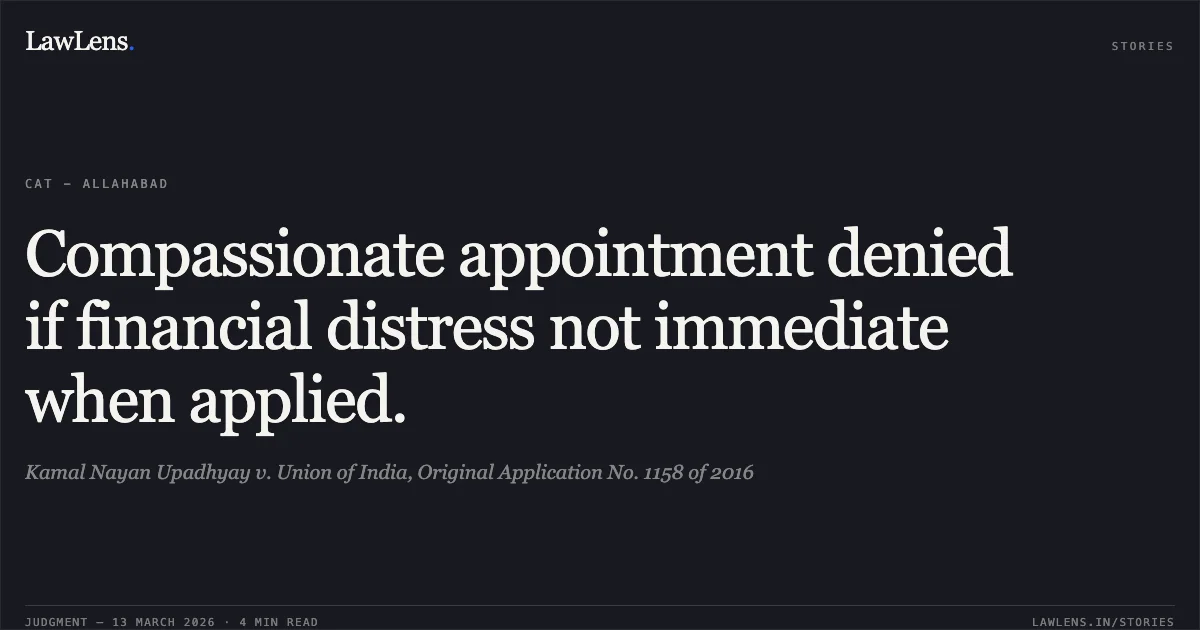
Whether the rejection of the applicant's claim for compassionate appointment on grounds of delay and insufficient weightage points was justified.
Source reference: p.2, 3-4Whether the long delay in seeking compassionate appointment negates the purpose of providing immediate financial relief.
Source reference: p.5Law Applied
The court applied the Department of Personnel & Training (DoPT) guidelines dated October 9, 1998, and the weightage point system adopted by BSNL vide letter dated June 27, 2007, for objective assessment of the financial condition of the family seeking compassionate appointment.
Source reference: p.4The core principle established is that compassionate appointment is intended to provide immediate financial relief to families of government servants who die in harness, leaving them in indigent circumstances, and is not a vested right.
Source reference: p.5The court referred to the Hon'ble Apex Court's observations in *Tinku vs State of Haryana & Ors* (Civil appeal No. 8540 of 2024), stating that compassionate appointment is not a vested right but an exception given on strict scrutiny to help a family out of sudden pecuniary financial destitution.
Source reference: p.5-6It also relied on *Umesh Kumar Nagpal vs State of Haryana* (1994) 4 SCC 138, which clarified that the object of compassionate employment is to enable the family to tide over sudden crisis, not to provide a post, and that financial condition must be examined to determine if the family cannot meet the crisis without employment.
Source reference: p.6-7The principle from *Bhawani Prasad Sonkar vs Union of India and Others* (2011) 4 SCC 209, emphasizing that compassionate employment is solely on humanitarian grounds to provide immediate relief and cannot be claimed as a matter of right, was also referenced.
Source reference: p.7-8Reasoning
The court found that the father of the applicant went missing in 1984 and was declared dead in 1993, yet the applicant's mother did not apply for compassionate appointment immediately but waited for the applicant to attain majority.
Source reference: p.8The applicant first applied for compassionate appointment in 2002 and again in 2006, approximately 21 years after his father went missing, and long after the declaration of death.
Source reference: p.3, 8This significant delay indicated that the family was not in immediate financial distress, thereby undermining the fundamental purpose of compassionate appointment, which is to provide immediate succor.
Source reference: p.3, 5-6, 8The BSNL Corporate Office's policy explicitly includes a negative score of 35 points for belated requests made 10 years or more after the employee's death.
Source reference: p.4-5Consequently, applying this policy, the applicant secured only 18 weightage points, which was well below the required threshold of 54 points for consideration, leading to the rejection of his claim.
Source reference: p.4, 8The court emphasized that compassionate appointment cannot be claimed as a vested right to be exercised at one's convenience after a large delay when the financial crisis is presumably over.
Source reference: p.8Holding
The Original Application is dismissed.
The court held that there was no merit in the applicant's claim as his request for compassionate appointment was made after an inordinate delay, and the family's financial crisis was not immediate.
Source reference: p.8The rejection order dated April 6, 2016, by Respondent No. 4, was upheld as it was based on the applicable rules and policy guidelines, including the deduction of 35 negative points for delay, resulting in the applicant falling below the qualifying weightage points.
Source reference: p.4, 8All pending MAs, if any, stand disposed of.
Source reference: p.9Acts & Sections Cited
1 provisions across 1 statute referred to in this judgment. Each provision opens on LawLens.
Administrative Tribunals Act, 19851
Original Court PDF
Kamal Nayan Upadhyay v. Union of India, Original Application No. 1158 of 2016
Click to open original judgment
Original judgment, available to read, download and summarize on LawLens.in