Facts
The petitioner was appointed as an Assistant Teacher for specified periods after his father, a Senior Lecturer at the College, died in service.
Source reference: para. 2–4By a separate appointment letter dated 30 July 1999, he was appointed to work in the College library on a temporary, ad hoc basis, terminable without notice or reasons.
Source reference: para. 2–4The Committee of Management terminated his services on 14 November 2003. He challenged the termination, seeking reinstatement and consequential benefits; during the proceedings, he died and his sisters were substituted as legal heirs, who sought compensation instead of reinstatement.
Source reference: para. 2–4, 8The respondents maintained that the College was unaided and that, at termination, the petitioner held only the temporary library appointment.
Source reference: para. 9–10Issues
Whether the petitioner’s library appointment was regular or otherwise protected from termination without notice, having regard to his compassionate entry into service and earlier Assistant Teacher appointments.
Source reference: para. 11–16Whether termination of the petitioner’s temporary, ad hoc appointment required a prior hearing or approval of the District Inspector of Schools.
Source reference: para. 17–20Whether the termination was amenable to challenge under Article 226 and, following the petitioner’s death, entitled his legal heirs to compensation.
Source reference: para. 21–24Law Applied
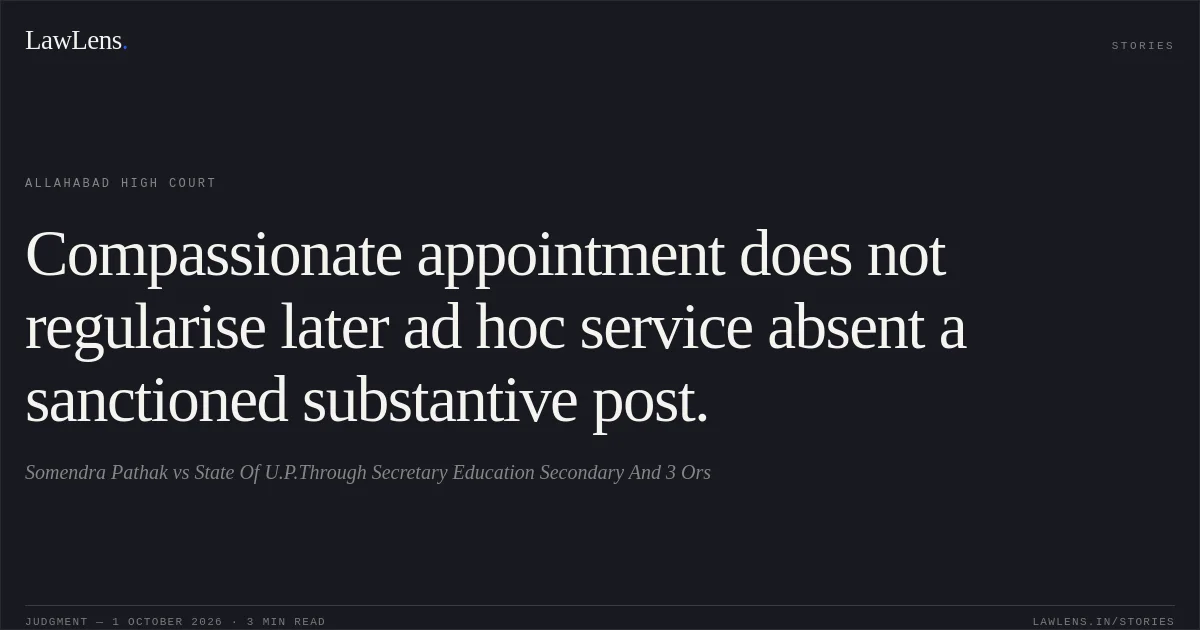
The nature of an appointment is determined by the governing statutory provisions and the terms of the appointment order; length of service alone does not convert a temporary appointment into a permanent one.
Source reference: para. 11Compassionate appointment is an exception to ordinary recruitment intended to provide immediate assistance, but the character of the particular appointment must be established under the applicable rules and appointment order.
Source reference: para. 14–16A temporary appointment expressly terminable without notice may be ended without a disciplinary inquiry or prior hearing where the termination is simpliciter, non-punitive and not founded on misconduct.
Source reference: para. 17–18A recognised educational institution may be subject to writ jurisdiction when it fails to perform a statutory or public duty, but the petitioner must identify the statutory obligation to be enforced.
Source reference: para. 21–22The Court considered Ravi Kiran Singh v. State of U.P. on compassionate appointment, and distinguished Calvin School Society v. Anil Kumar Sharma and Raj Kumar v. State of U.P. on prior approval; it found those authorities did not establish a right to relief on these facts.
Source reference: para. 15–16, 19–20Reasoning
The Court treated the 1999 library appointment as distinct from the petitioner’s earlier, time-limited Assistant Teacher appointments. Its express temporary and ad hoc terms, the absence of proof that it was against a sanctioned substantive post, and the lack of evidence that the earlier appointment continued meant that compassionate entry and length of service did not establish permanency.
Source reference: para. 12–16The termination order merely stated that the petitioner’s services were no longer required and contained no allegation of misconduct or stigma; accordingly, neither a hearing nor an inquiry was required.
Source reference: para. 17–18The petitioner also failed to identify a statutory provision requiring prior District Inspector of Schools approval for termination of this appointment.
Source reference: para. 19–20The Court did not finally decide the broader objection that the unaided College was outside writ jurisdiction; it assumed maintainability and found no enforceable right had been infringed. It also treated the unexplained delay of more than 21 months as an additional discretionary consideration.
Source reference: para. 21–23Because no unlawful termination or corresponding financial entitlement was established, compensation was not available to the legal heirs.
Source reference: para. 24Holding
The Court found no illegality in the termination warranting interference under Article 226.
It dismissed the writ petition, denied compensation to the substituted legal heirs and made no order as to costs.
Source reference: para. 24–26Original Court PDF
Somendra PathakvsState Of U.P.Through Secretary Education Secondary And 3 Ors
Click to open original judgment
Original judgment, available to read, download and summarize on LawLens.in